Sarah — 29, marketing manager at a Fortune 500 company, MBA from Northwestern — called me last October in tears. She’d just calculated that despite earning $87,000 a year for the past four years, she had exactly $1,247 in her investment account.
“I read everything,” she said. “I listen to podcasts. I know compound interest works. I understand index funds beat stock picking. But somehow I keep making the same stupid decisions.”
Here’s what happened: In March 2020, when the market crashed 34%, Sarah panicked and sold her entire portfolio. She was going to “wait for things to stabilize.” By the time she felt comfortable buying back in, the S&P 500 had already recovered 50% from its lows. She’d turned a temporary paper loss into a permanent real loss of $23,000.
The kicker? Sarah could explain behavioral finance theory better than most financial advisors.
She knew about loss aversion. She understood recency bias. She’d written business school case studies on herd mentality. But when her own money was on the line, that knowledge vanished like smoke.
I Used to Think I Was Different
I know exactly how Sarah felt because I was there too.
Back in 2018, I was 31 and convinced I’d figured out investing. I’d read Kahneman’s Thinking, Fast and Slow cover to cover. I could quote statistics about how 90% of active funds underperform the market. I smugly watched friends chase hot stocks while I dollar-cost-averaged into boring index funds.
Then crypto happened.
Bitcoin hit $19,000 in December 2017, crashed to $3,200 by December 2018, then started climbing again. I watched it go from $4,000 to $8,000 thinking, “This is obviously a bubble.” At $12,000 I thought, “Any day now it’ll crash.” At $16,000 I finally cracked.
I pulled $15,000 out of my index funds — my entire emergency fund plus some — and bought Bitcoin at $17,200. Three weeks later it hit $20,000 and I felt like a genius. Two months later it was back at $10,000 and I sold everything, locking in a $7,000 loss.
The worst part? I knew exactly what I was doing wrong while I was doing it. I could feel the FOMO. I recognized the sunk cost fallacy when I held on too long, then the loss aversion when I finally sold. But knowledge didn’t stop me.
Your Stone Age Brain Meets Modern Markets
Here’s the thing nobody tells you about behavioral finance: understanding your biases doesn’t cure them.
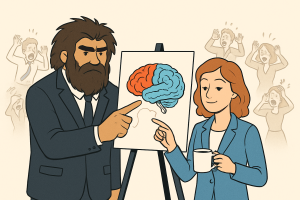
Your brain evolved over millions of years to keep you alive on the African savanna. When a rustling bush might contain a predator, the humans who paused to think rationally about base rates and probability distributions became lunch. The paranoid, impulsive, herd-following humans survived and passed on their genes.
That same wiring now controls your money decisions.
When the market drops 20% in three weeks, your amygdala — the same brain region that kept your ancestors alive — floods your system with stress hormones. Your prefrontal cortex, where rational analysis happens, goes offline. You don’t think “statistical reversion to the mean.” You think “DANGER. ESCAPE. NOW.”
Every cognitive bias is an ancient survival mechanism misfiring in a modern context:
Loss aversion — losing $100 feels twice as bad as gaining $100 feels good — evolved because our ancestors couldn’t afford to lose their food stores. One bad decision meant death.
Recency bias — overweighting recent events — made sense when yesterday’s lion attack was a good predictor of today’s danger. In markets, it makes you buy high and sell low.
Herd behavior — following the crowd — kept individuals safe within the group. In investing, it creates bubbles and crashes.
The people getting rich from your behavioral mistakes? They’re not necessarily smarter. They’ve just built systems that work around human psychology instead of fighting it.
The Contrarian’s Secret Weapon
Want to know what separates successful contrarian investors from everyone else?
They don’t try to overcome their biases. They design their behavior around them.
Warren Buffett doesn’t fight his emotions by reading market news all day. He doesn’t read market news at all. Charlie Munger doesn’t battle FOMO by tracking every hot stock. He focuses on maybe one investment decision per year.
I learned this lesson the hard way after my crypto disaster. Instead of trying to become a perfectly rational investor, I started building what I call “bias-proof systems.”
Every month, $1,200 moves automatically from my checking account into index funds. I don’t see the market price when it happens. I don’t get a choice. The decision was made once, years ago, when I was thinking clearly. Now my emotional brain can’t sabotage it.
When I want to make individual stock picks — and I still do, because completely suppressing that urge creates other problems — I only use money from a separate “speculation account” that gets exactly $200 per month. If I lose it all on crypto or meme stocks, my real wealth-building stays on track.
The key insight: behavioral finance isn’t about becoming smarter. It’s about becoming lazier in the right ways.
The Intelligence Trap
Here’s the cruel irony: the smarter you are, the more behavioral finance can hurt you.
Smart people like Sarah — and probably like you if you’re reading this — fall into what psychologists call the “intelligence trap.” You’re so good at solving complex problems that you assume money decisions should be complex too.
You research exotic investment strategies. You build elaborate spreadsheets. You follow 47 different financial Twitter accounts. All this activity makes you feel productive and intelligent, but it’s actually making you poorer.
Every additional input gives your biases more opportunities to hijack your decisions. Every day you spend “researching” is another day you’re not building wealth through boring, systematic investing.
The dumbest-seeming investors often get the best results because they’re not smart enough to outsmart themselves.
Why Your Financial Education Backfires
Most financial education makes behavioral problems worse, not better.
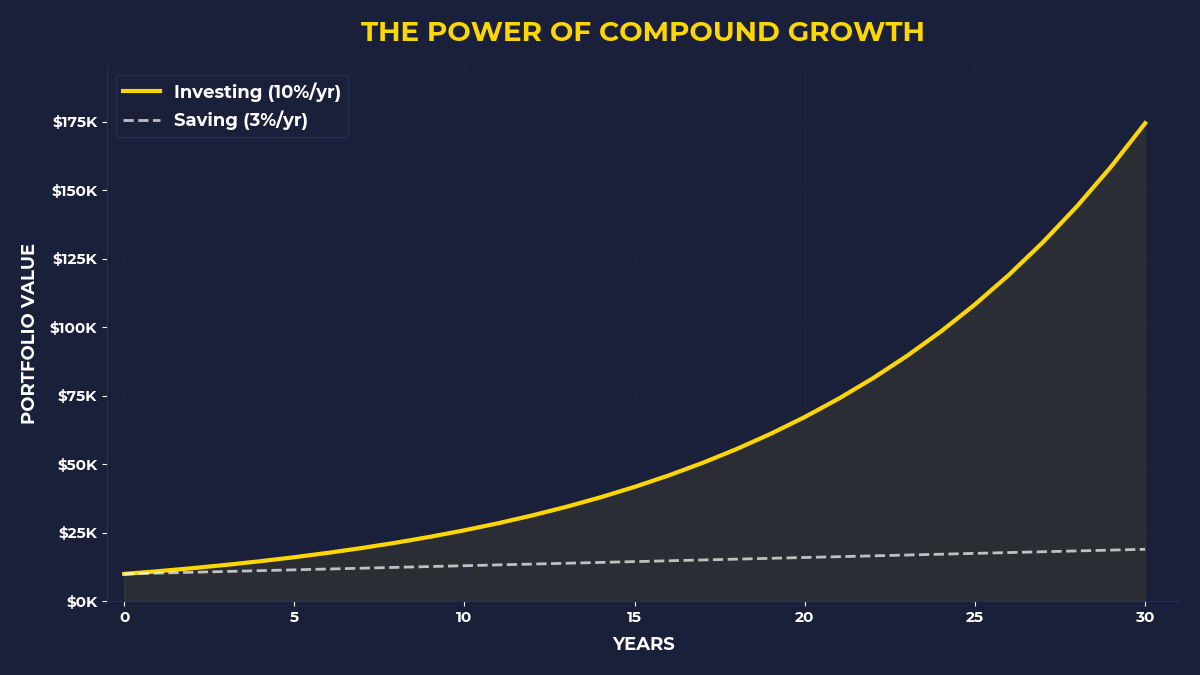
When you learn about compound interest, what happens? You start calculating how much money you’re “leaving on the table” every day you don’t invest. That creates urgency and pressure, which triggers impulsive decisions.
When you learn about market volatility, what happens? You start watching your portfolio obsessively, experiencing every fluctuation as a personal win or loss. That creates emotional attachment to outcomes you can’t control.
When you learn about all the different investment options — REITs, commodities, international funds, value vs. growth — what happens? You start second-guessing your simple strategy and chasing complexity.
Financial knowledge without behavior management is like giving a pyromaniac a chemistry textbook.
The solution isn’t to stop learning. It’s to learn the right things in the right order. Behavior first, strategy second.
The One Thing to Remember
Your brain will always try to sabotage your money decisions because it’s designed to keep you alive, not make you rich. The answer isn’t to fight your psychology — it’s to design systems that work with it. The best investors aren’t the smartest ones who overcome their biases. They’re the wisest ones who build processes that make their biases irrelevant. Every dollar you make through heroic self-control is a dollar you’ll eventually lose when willpower fails.
Set up automatic investing today — even $50 per month — so your emotional brain can’t interfere with your logical brain’s decisions
Stop checking your portfolio more than once per quarter — every look triggers an emotional reaction that can derail your strategy
Create a separate “play money” account with no more than 5% of your assets for speculation and stock picking
🎬 Prefer watching? Check out the video version on YouTube: