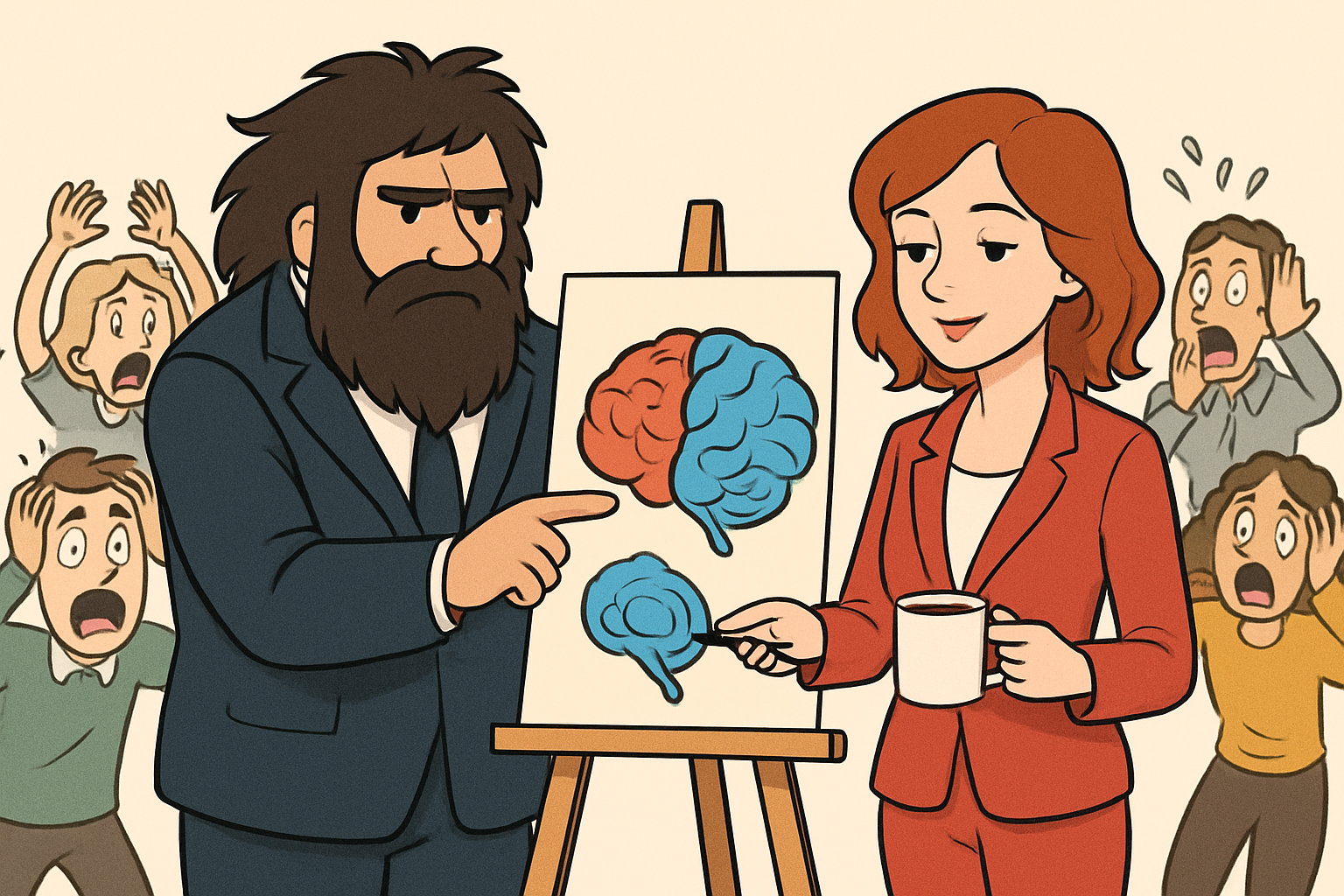
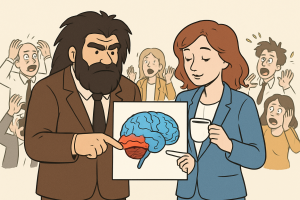
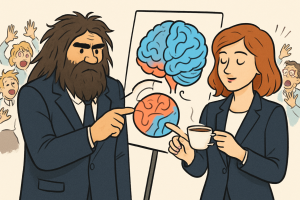
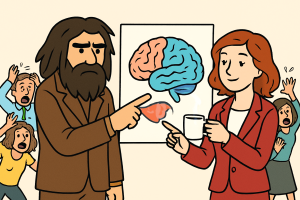
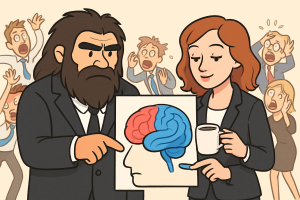
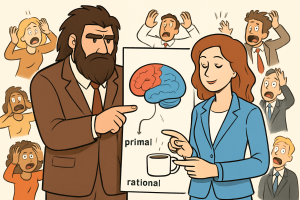
Your brain is a survival machine built 50,000 years ago. It’s optimized for avoiding lions, not building wealth.
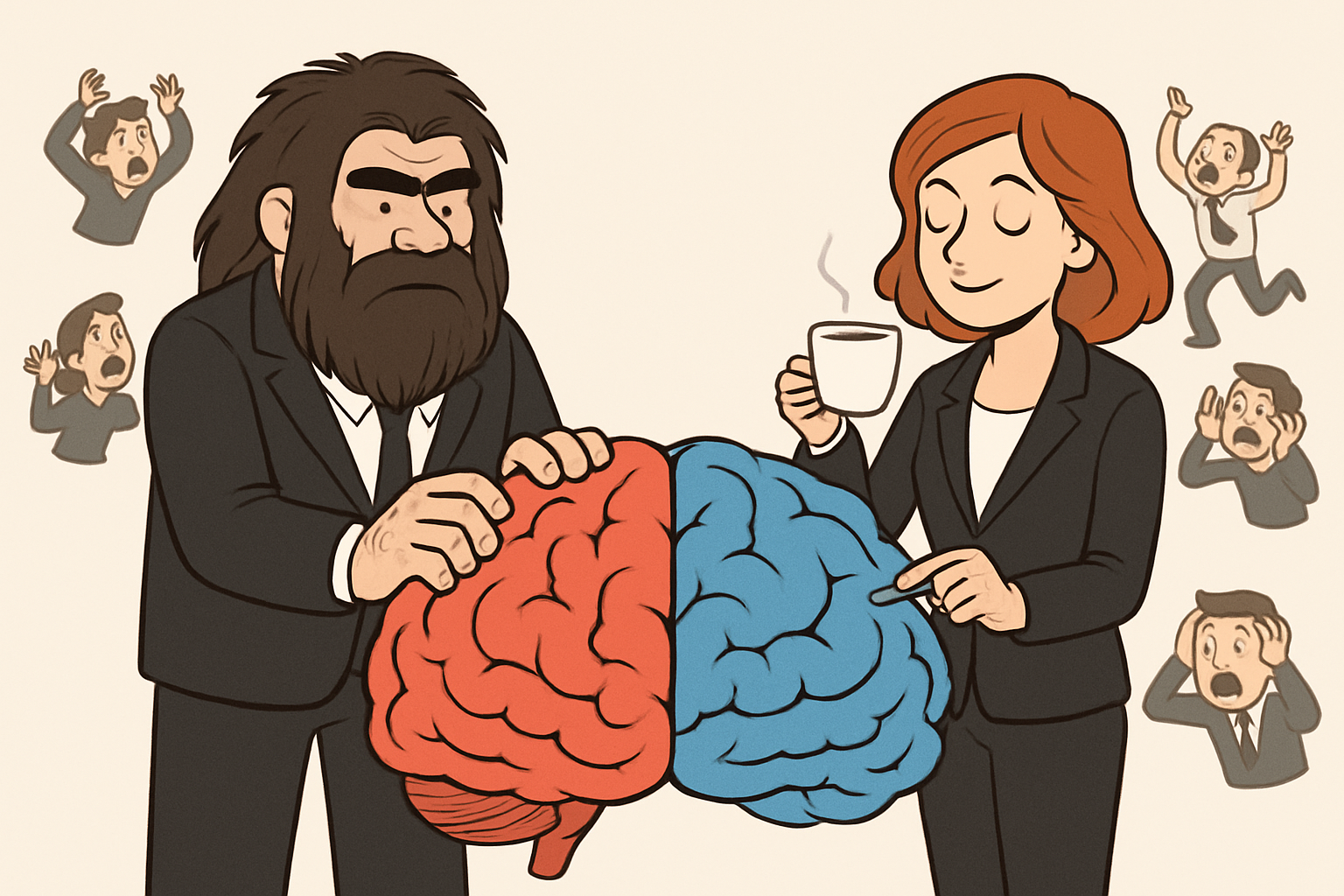
Every instinct that kept your ancestors alive now works against you in capital markets. The same neural pathways that helped humans survive the savanna now trigger at stock price movements, real estate listings, and quarterly earnings reports. Your amygdala doesn’t distinguish between a charging predator and a 20% portfolio drawdown — both trigger the same fight-or-flight response that has you selling at exactly the wrong moment.
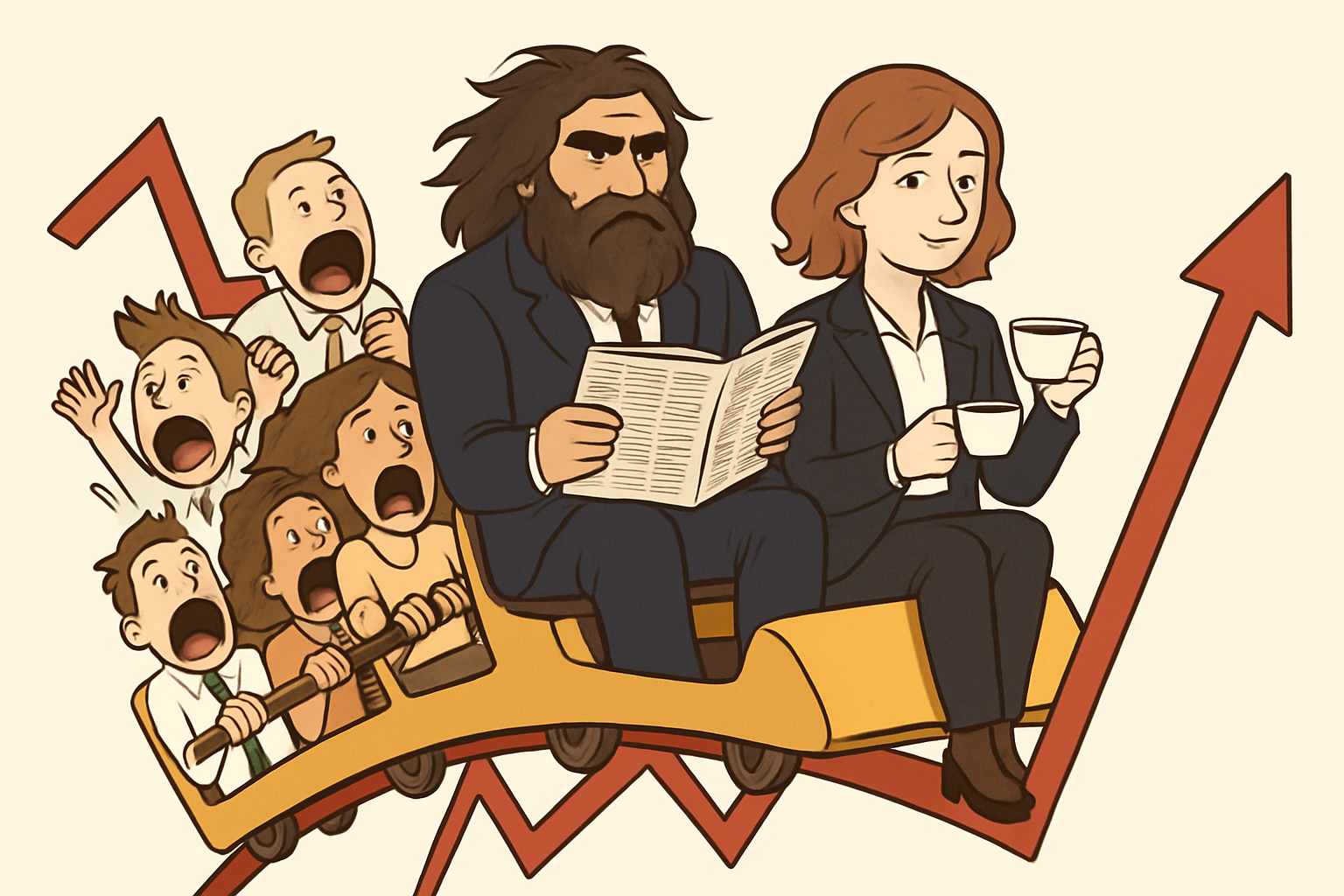
I learned this the expensive way in March 2020. While the S&P 500 was dropping 34% in five weeks, I watched my portfolio hemorrhage value and felt that familiar tightness in my chest. My rational mind knew this was temporary. My primate brain screamed “DANGER” and wanted to sell everything. The investors who got rich during that crash were the ones who recognized this biological programming and acted against it.
Why Fear Sells Bottoms and Greed Buys Tops
Here’s the behavioral trap that destroys most investment returns: your brain is wired for recency bias.
When markets crash, your amygdala floods your system with cortisol. You remember every news headline about financial ruin. Your pattern-matching software says “stocks going down equals danger” and triggers the overwhelming urge to flee. This is exactly when assets go on sale. Between March 2009 and March 2024, the S&P 500 returned 685%. Most investors missed it because their fear response had them sitting in cash.
The opposite happens during bubbles. When everyone around you is getting rich from crypto or meme stocks, your social comparison circuits activate. FOMO isn’t just an acronym — it’s loss aversion applied to social status. You see neighbors buying Teslas with Dogecoin gains and your brain interprets this as falling behind the tribe. Historically, this leads to wealth destruction. During the dot-com bubble, the NASDAQ rose 400% between 1995 and 2000, then fell 78% by 2002. The investors piling in during 1999 were responding to primate instincts, not investment logic.
Your brain evolved to prioritize immediate social standing over long-term wealth accumulation.
The Herd Instinct That Empties Your Account
Do you feel uncomfortable holding a position when everyone else thinks you’re wrong? That discomfort has a name: social proof bias. And it’s costing you money.
I once owned shares in a software company that was growing revenue 40% annually while the stock price stagnated. Every earnings call, analysts complained about “lack of profitability” while the company reinvested every dollar into expansion. My conviction was high, but the social pressure was real. Friends questioned the position. Financial media ignored it. My brain kept whispering: “If you’re the only one who sees value here, you’re probably wrong.”
I held for two years. The stock eventually tripled when the market finally recognized what the fundamentals had been screaming. But here’s what I remember most: the psychological weight of being alone in that position. Your ancestors survived by staying with the tribe. Being ostracized meant death. When you take a contrarian investment stance, those same neural circuits fire up and create genuine distress.
The investors who build generational wealth learn to embrace this discomfort. They understand that in markets, consensus is usually wrong at extremes. When 92% of investors were bearish in March 2009, that was the signal to buy everything. When crypto euphoria peaked in November 2021 with ordinary people quitting jobs to trade NFTs, that was the signal to sell everything.
Why Your Brain Makes You Trade Too Much
How often do you check your portfolio? Daily? Hourly? Every time you look, you’re activating what behavioral economists call myopic loss aversion.
Your brain processes short-term volatility as a series of individual losses and gains rather than understanding the long-term trajectory. A stock that’s up 200% over five years but down 3% today feels like a loss because your attention is anchored to the most recent price movement. This triggers the action bias — the compulsion to do something, anything, to regain control.
From 2000 to 2020, the S&P 500 averaged 7.5% annual returns. But the average investor earned just 3.3% annually during the same period, according to research firm DALBAR. The difference? Trading behavior driven by emotional reactions to short-term price movements.
Think about that math. Professional money managers, with all their resources and expertise, consistently underperform index funds because they can’t resist the urge to act on every market movement. Your primate brain sees inaction as weakness, but in investing, inaction is often the highest form of skill.
The Scarcity Mindset That Blocks Capital Formation
Here’s where behavioral finance gets really interesting: your ancestors lived in a zero-sum world where resources were finite. If another tribe had meat, your tribe might starve. This scarcity programming now sabotages your ability to think about capital creation.
When you see someone getting rich from stocks, real estate, or business ownership, part of your brain still thinks their gain is your loss. This zero-sum thinking keeps you focused on protecting what you have rather than growing it. You overweight “safe” assets like savings accounts that guarantee purchasing power erosion, because loss aversion makes the 2% annual inflation feel less threatening than 30% portfolio volatility.
I used to think this way. In my twenties, I kept $40,000 in a savings account earning 0.5% while inflation ran 3% annually. I was literally paying the bank to hold my money because my scarcity mindset prioritized avoiding short-term losses over building long-term wealth. Over five years, that decision cost me roughly $8,000 in purchasing power — money I’ll never get back.
The wealthy understand that capital markets are not zero-sum. When you buy equity in great businesses, you’re not taking money from someone else — you’re participating in value creation. Apple didn’t become worth $3 trillion by stealing value from other companies. They created new value by building products people wanted to buy. Your shares represent ownership in that value creation process.
How To Rewire Your Investment Brain
What separates successful investors from everyone else? They’ve learned to recognize their biological programming and build systems to override it.
Start with time horizon expansion. Your brain operates on immediate feedback loops, but wealth builds on decade-long cycles. When you feel the urge to sell during a market crash, ask yourself: “Will this matter in 2034?” Usually, the answer is no. The 2008 financial crisis felt apocalyptic in real-time. Today, it’s just a blip on long-term charts.
Create decision frameworks before emotions kick in. I have a simple rule: I can only sell positions on days when markets are up 2% or more. This forces me to make selling decisions when greed dominates fear, not the other way around. It’s a behavioral circuit breaker that prevents panic selling at market bottoms.
Automate as much as possible. Set up automatic transfers to investment accounts so you’re buying assets before your brain can process market conditions. Dollar-cost averaging isn’t just a mathematical strategy — it’s a psychological one. It removes the emotional burden of timing decisions and forces you to buy when prices are low.
Study your own behavior patterns. Keep a simple log: every time you want to make an investment decision driven by emotion, write it down and wait 48 hours. You’ll start noticing the triggers. Market volatility. News headlines. Social media posts about someone else’s gains. Awareness is the first step to control.
The Contrarian Edge Is Behavioral, Not Analytical
Most investors think they need better analysis, more information, or superior stock-picking skills. They’re wrong. The edge comes from emotional regulation and behavioral control.
When fear grips markets and everyone else is selling, can you buy? When euphoria peaks and your neighbors are bragging about crypto gains, can you remain disciplined? When your carefully researched position underperforms for two years while meme stocks soar, can you hold?
This isn’t about intelligence or analytical ability. It’s about recognizing that your brain is running software designed for a different environment. The investors who build generational wealth learn to work with their biology, not against it. They feel fear and buy anyway. They feel euphoria and sell anyway. They understand that in markets, your instincts are usually wrong at exactly the moments when being right matters most.
What The Primal Investor Takes Away
• Your survival instincts actively sabotage wealth building — fear sells bottoms, greed buys tops, and herd behavior chases whatever everyone else is chasing
• The average investor underperforms markets by 4.2% annually due to behavioral biases, not lack of information or analytical skill
• Create decision frameworks before emotions kick in — rules about when you can sell, automatic investing schedules, and 48-hour waiting periods for emotional decisions
• The contrarian edge is behavioral: feel fear and buy anyway, feel euphoria and sell anyway, embrace the discomfort of being alone in your positions
• Wealth building requires time horizon expansion — train your brain to think in decades, not days, and remember that temporary volatility is the price of permanent wealth
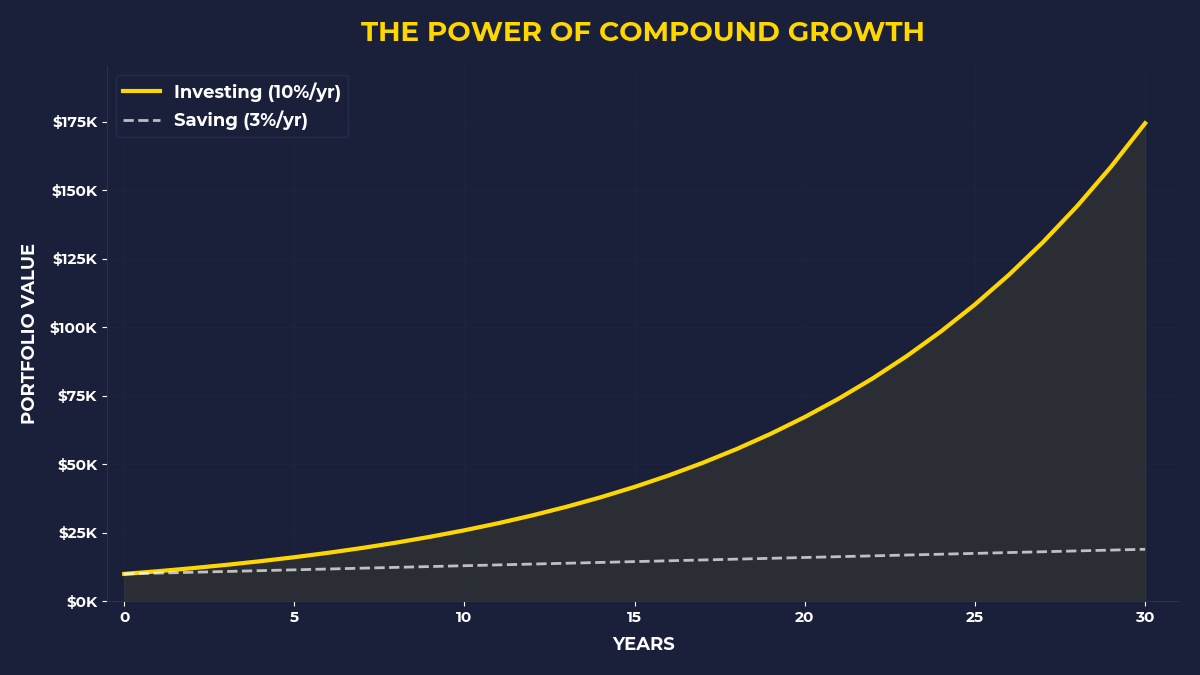
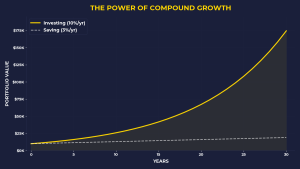
Your brain will never stop being a 50,000-year-old survival machine. But once you recognize its programming, you can build systems to override it and finally let compound returns work in your favor.
🎬 Prefer watching? Check out the video version on YouTube: