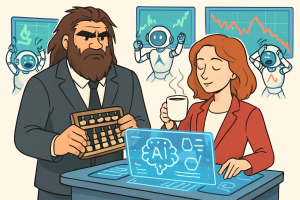
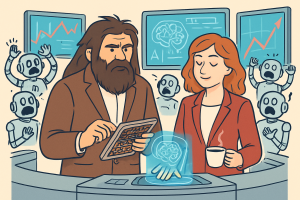
Marcus — 29, marketing coordinator in Denver — got the text at 3:47 PM on a Tuesday. “Can you hop on a call? Need to discuss your role.” His manager’s tone felt different. Colder.
Twenty minutes later, Marcus learned his company had implemented an AI content system that could produce his daily output in about six minutes. His job of three years? Gone by Friday. The kicker: his replacement cost $47 per month.
Marcus isn’t alone. He’s part of the largest wealth transfer in human history, and he’s on the wrong side of it.
I Watched This Coming Two Years Ago
I remember the exact moment I realized what was happening. December 2022, sitting in my apartment, watching ChatGPT write better marketing copy than most people I knew. Not just faster — better. More persuasive. More engaging.
My first thought wasn’t about the technology. It was about the money.
Who owned this? Who was capturing the value? Because someone was about to get very, very rich while millions of people like Marcus lost their livelihoods.
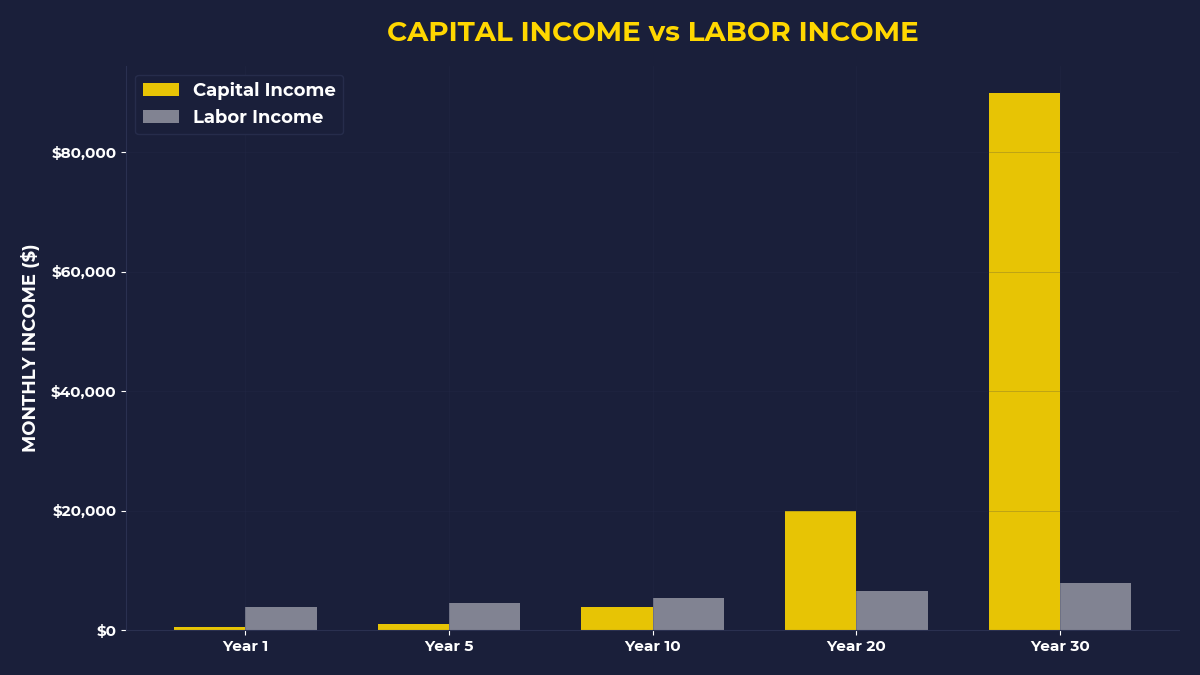
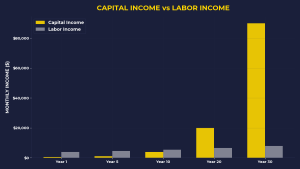
Here’s what I figured out that night, and what most people still don’t understand: AI doesn’t just eliminate jobs. It creates capital. Massive amounts of it. But only for the people who own the right assets.
The Economics Everyone Misses
Think about what just happened to Marcus. His company didn’t hire someone cheaper to do his job. They bought a system that does his job.
That system — the AI, the servers, the algorithms — that’s capital. It produces output without human labor. And whoever owns it captures 100% of the value it creates.
Marcus was earning $52,000 per year to write content. The AI system costs $564 per year and produces the same output. That’s $51,436 in pure profit flowing directly to capital owners.
Multiply that across millions of jobs, and you see the scale of what’s happening.
But here’s the part that keeps me up at night: Most people think this is about technology. It’s not. It’s about ownership.
Why Your Skills Won’t Save You
Every career advice article tells you the same thing: “Adapt. Learn new skills. AI will create new jobs.” This is dangerous nonsense.
AI doesn’t create jobs the way previous technologies did. The printing press eliminated scribes but created publishers, editors, and distributors. Thousands of new roles.
AI eliminates entire categories of human work and replaces them with… servers. No new human jobs required.
Think about that marketing AI that replaced Marcus. It doesn’t need:
– Account managers
– Project coordinators
– Quality control specialists
– Training departments
It needs electricity and occasional software updates.
This is why the “learn to code” advice feels increasingly hollow. AI is writing code now too. And it’s getting better every month.
The Two Economic Classes Being Created
AI economics is creating a brutal division: Owners and Obsolete.
The Owners have equity in companies building or deploying AI systems. When a marketing AI replaces 10 human workers, those $500,000 in annual salaries don’t vanish — they flow to the shareholders.
The Obsolete had jobs that AI can now do. They’re competing for the shrinking pool of work that still requires human hands or human judgment.
Look at the numbers: NVIDIA’s market cap grew by $1.8 trillion between 2023 and 2024. That wealth didn’t come from thin air. It came from the economic value AI creates by replacing human labor.
If you owned NVIDIA stock, you captured a piece of that transfer. If you worked in a job AI could do, you paid for it with your livelihood.
What I Did When I Realized This
When that reality hit me in December 2022, I made a decision that felt crazy at the time. I took 40% of my emergency fund and bought shares in AI companies.
Not because I’m some tech genius. Because I understood something simpler: If AI was going to eliminate millions of jobs, the wealth from those eliminated salaries had to go somewhere.
It was going to shareholders.
I bought Microsoft because they owned a chunk of OpenAI. I bought Google because they had DeepMind. I bought semiconductor companies because AI needs chips.
My friends thought I was insane for touching my emergency fund. “What if you need that money?”
I need it now. To buy a piece of the wealth transfer before it’s complete.
The Capital Question You’re Not Asking
Everyone’s asking: “What jobs will survive AI?” That’s the wrong question.
The right question: “What AI-related assets can I buy?”
Because here’s what’s really happening. Every month, AI gets better at doing human work. Every month, companies eliminate more positions and see their profits rise. Every month, that profit flows to whoever owns the stock.
You can spend the next five years learning “AI-proof” skills. But skills are labor. Labor gets replaced. Capital gets the replacement profit.
Marcus is now driving for Uber while he “figures out his next move.” But autonomous vehicles are coming for rideshare drivers too. And the profits from eliminating drivers? They’ll flow to whoever owns the autonomous vehicle companies.
See the pattern?
The Uncomfortable Math
Let me show you how this wealth transfer actually works with real numbers.
A customer service team of 50 people costs a company about $2.4 million annually in salaries and benefits. An AI customer service system costs about $180,000 per year to run.
That’s $2.22 million in annual savings flowing directly to shareholders.
If you own 100 shares of that company and it has 10 million shares outstanding, you just captured $22.20 of that displaced labor value. Every year. Forever.
Multiply this across thousands of companies and millions of jobs, and you see why AI wealth concentration is accelerating so fast.
The workers lost their jobs. The shareholders captured their salaries.
How To Switch Sides
Here’s what most people don’t realize: You can still switch sides in this transfer. But the window is closing.
Every dollar you invest in AI-related companies is a dollar that will capture some portion of displaced labor value. You’re buying a piece of the productivity that replaces human work.
This isn’t about picking the next hot AI stock. This is about recognizing that AI creates capital while it eliminates labor. And capital always beats labor in the long run.
Start with broad exposure: ETFs that hold major tech companies implementing AI. QQQ gives you the big players. BOTZ gives you robotics and AI companies specifically.
But here’s the key: You have to buy before your own job gets displaced. Because after that, you’re competing for scraps instead of capturing the wealth transfer.
The One Thing To Remember
AI economics isn’t about technology disrupting industries. It’s about capital eliminating labor and keeping 100% of the productivity gains. The wealth doesn’t disappear when jobs vanish — it concentrates in the hands of whoever owns the AI systems. You can spend years learning new skills to stay ahead of AI, or you can spend that same time acquiring ownership in the companies building AI. Skills get replaced. Capital gets the replacement profits.
Here’s what you do this week:
Open a brokerage account if you don’t have one
Invest at least $100 in an AI/tech ETF before you pay any non-essential bills
Set up automatic monthly investments in companies positioned to capture AI productivity gains
🎬 Prefer watching? Check out the video version on YouTube: