Marcus — 29, software developer at a mid-sized tech company in Denver — got the Slack message at 11:47 PM on a Tuesday. “Emergency deployment. Backend’s down. Need all hands.”
He rolled out of bed, grabbed his laptop, and spent the next four hours debugging code that a machine learning model had somehow broken during an automated update. By 4 AM, the system was stable. By 6 AM, he was back in bed for two hours of sleep before his regular workday started.
Three weeks later, Marcus learned that the same AI system that created the emergency had also automated away two junior developer positions on his team. The company saved $140,000 in annual salaries. Marcus got a $500 gift card to Best Buy for his “heroic effort” during the crisis.
That’s when it hit him: He wasn’t building the future. He was being replaced by it.
I Used to Think AI Was Just Another Tool
Look, I was just as naive as Marcus three years ago. I thought artificial intelligence was going to be like the internet — a powerful tool that would make everyone more productive and create new opportunities for everyone.
I was wrong.
Here’s what I didn’t understand then but see clearly now: AI doesn’t just make workers more productive. It replaces the need for workers entirely. And here’s the kicker — the wealth it creates doesn’t trickle down to the people it displaces. It concentrates at the top, with the people who own the AI systems.
I remember sitting in my apartment in 2021, watching my freelance writing clients slowly disappear as companies started using GPT-3 for content creation. I was angry. I felt cheated. I’d spent years building my skills, only to watch a machine do my job faster and cheaper.
That anger was useful. It forced me to ask a different question.
The Question That Separates Owners from the Obsolete
Instead of asking “How do I compete with AI?” — which is what most people are asking — I started asking “How do I own a piece of what’s replacing me?”
Think about it. When the printing press was invented, the scribes who tried to write faster and prettier got crushed. The ones who bought printing presses got rich.
When factories automated textile production, the craftsmen who insisted on hand-weaving their cloth starved. The ones who invested in textile machinery built fortunes.
AI is no different. Except this time, the automation isn’t coming for just one industry. It’s coming for every industry that involves human thinking, decision-making, or pattern recognition.
Which is pretty much every industry.
The people who understand this are quietly buying AI companies, AI infrastructure, and AI-enabled businesses. The people who don’t are polishing their resumes and hoping their jobs survive the next round of “efficiency improvements.”
What Most People Miss About AI Economics
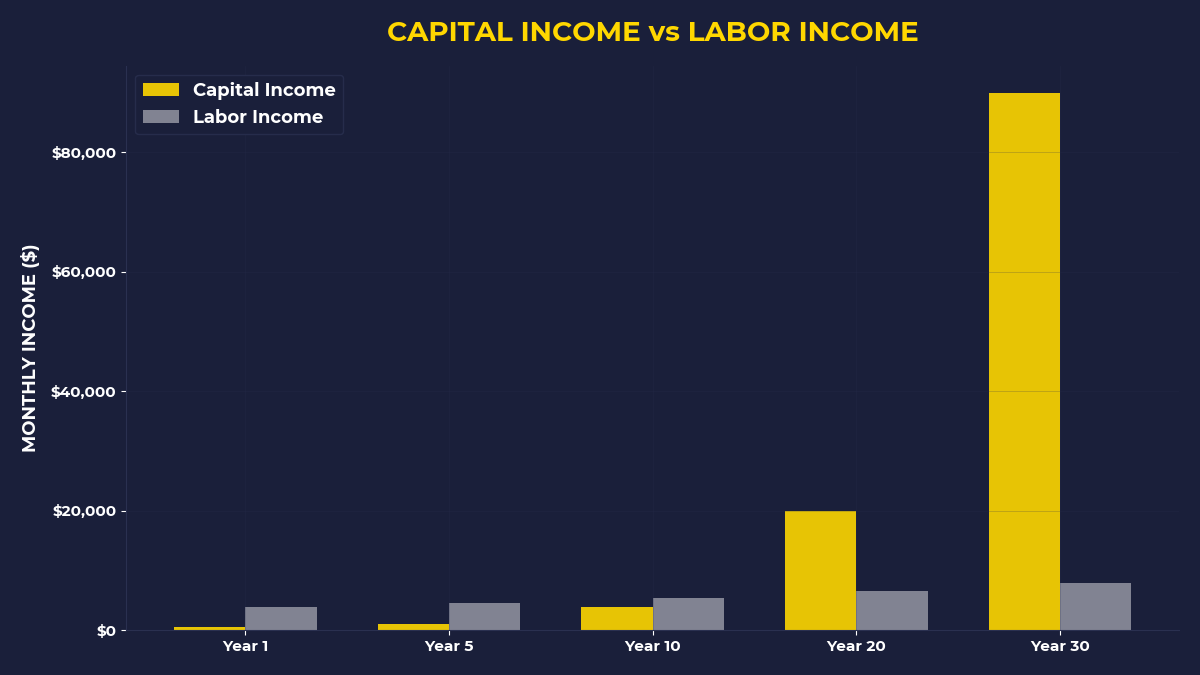
Here’s the uncomfortable truth: AI creates capital, not jobs.
When a company deploys an AI system that does the work of ten customer service reps, they don’t hire ten new employees somewhere else. They eliminate ten salaries and keep the savings. The AI system becomes a capital asset — something that generates income without requiring ongoing human labor.
Let me give you a specific example. A friend of mine runs a small marketing agency. Last year, he hired three copywriters at $50,000 each to handle client content. This year, he uses Claude and ChatGPT to do 80% of that work, with one human editor cleaning up the output.
He kept one writer. Laid off two. Saved $100,000 in annual costs.
Where did that $100,000 go? Into his pocket. Not into new jobs. Not into higher wages for the remaining writer. Straight to the business owner.
The AI didn’t create employment. It created capital for its owner.
The Wealth Transfer Nobody Talks About
Every time you interact with an AI system — whether you know it or not — you’re participating in a massive wealth transfer from labor to capital.
When you use GPS instead of asking for directions, you’re sending data to mapping companies that use AI to optimize routes and sell advertising. When you get a fraud alert from your credit card, you’re feeding data to AI systems that reduce the bank’s need for human analysts.
Even when you think you’re just talking to a chatbot, you’re training AI models that will eventually eliminate human jobs in customer service, technical support, and sales.
The value you create through these interactions doesn’t come back to you. It goes to the companies that own the AI systems.
This is the opposite of how most people think wealth gets created. They think you get rich by working harder, getting better skills, or climbing the corporate ladder. But AI is proving that wealth flows to ownership, not effort.
Why Your Job Is Training Your Replacement
Want to know something that’ll keep you up at night? Every email you write, every decision you make, every problem you solve at work is potentially training data for the AI system that will replace you.
Companies are using internal AI tools that learn from employee behavior. They call it “productivity enhancement.” Really, it’s replacement preparation.
Marcus didn’t know it, but every time he fixed a bug or deployed code, the AI system was learning his patterns. The emergency that kept him up all night? That was the AI testing its capabilities against edge cases it learned from months of watching human developers work.
The cruelest part is that the better you are at your job, the more valuable you are as training data.
The Two Classes AI Is Creating
Look around. AI is splitting the economy into two groups: people who own AI-powered capital, and people who compete with AI-powered capital.
The owners are getting obscenely wealthy. OpenAI’s valuation hit $157 billion in October 2024. NVIDIA’s market cap crossed $3 trillion. The founders, early investors, and employees with equity stakes are capturing wealth at a pace that makes the dot-com boom look quaint.
Meanwhile, the workers are getting squeezed. Radiologists competing with AI diagnostic tools. Journalists competing with AI writers. Truck drivers waiting for autonomous vehicles. Accountants watching AI handle tax prep.
The gap isn’t just growing. It’s accelerating.
And here’s what nobody wants to admit: This isn’t temporary disruption that’ll create new jobs eventually. This is permanent replacement of human cognitive labor with machine cognitive labor.
The new jobs that AI creates — AI trainers, prompt engineers, AI ethicists — require the same skills that AI is getting better at every day. These aren’t safe harbors. They’re temporary rest stops on the way to full automation.
What It Really Means to Own AI Capital
You might think owning AI capital means buying NVIDIA stock or investing in tech companies. That’s part of it, but it’s not the complete picture.
Real AI capital ownership means owning systems that use AI to generate income without your direct involvement. Here’s what that looks like:
A guy I know bought a portfolio of small e-commerce websites that use AI for customer service, inventory management, and pricing optimization. He doesn’t manage the day-to-day operations. The AI handles customer questions, adjusts prices based on demand, and even decides which products to reorder.
His role? Check the dashboard once a week and collect the profits.
Another friend invests in rental properties but uses AI-powered property management software that handles tenant screening, rent collection, and maintenance scheduling. The AI reduces his management overhead by 70% while increasing occupancy rates.
These aren’t tech entrepreneurs. They’re regular people who recognized that AI creates leverage for asset owners.
The Mistake 97% of People Are Making
Most people are trying to AI-proof their careers instead of AI-power their capital.
They’re taking courses in prompt engineering. Learning to work alongside AI. Developing “uniquely human” skills that AI supposedly can’t replicate.
This is like learning to shoe horses faster when cars are taking over transportation.
The smart money isn’t trying to compete with AI. It’s trying to own AI. Not the technology itself — that’s too complex and risky for most of us — but businesses and assets that benefit from AI implementation.
How to Position Yourself for the AI Wealth Transfer
If you’re someone who recognizes that the old rules about career advancement and job security are breaking down, here’s what you need to do:
Stop thinking like an employee. Start thinking like an investor.
Every dollar you earn is a choice. You can spend it on consumption, or you can use it to buy a piece of the AI economy that’s displacing human workers.
This doesn’t mean you need to quit your job tomorrow and start an AI company. It means you need to take a portion of your income — even if it’s just $100 a month — and systematically buy assets that benefit from AI automation.
ETFs that hold AI and automation companies. REITs that use AI for property management. Businesses that are increasing their margins through AI implementation.
The goal isn’t to get rich quick. The goal is to own a small piece of the wealth that AI is creating instead of being displaced by it.
The One Thing to Remember
AI is the most powerful capital creation machine in human history, but it’s not creating capital for everyone — it’s creating capital for owners. While workers compete with machines for jobs, owners use machines to eliminate the need for jobs. The wealth transfer is already happening. The question isn’t whether you’ll be affected by AI. The question is whether you’ll own a piece of the systems that are replacing human labor or be replaced by them.
Here’s what you can do today:
• Open a brokerage account if you don’t have one, and set up automatic investments into technology and AI-focused ETFs
• Look for one small business or side project you can start that uses AI to reduce your own labor requirements
• Stop asking “How do I AI-proof my career?” and start asking “How do I own AI-powered assets?”
🎬 Prefer watching? Check out the video version on YouTube: