Sarah’s $47,000 Lesson in Money Psychology
Sarah Martinez — 29, marketing manager at a tech startup in Denver — made the same mistake 97% of investors make. She bought Apple stock in September 2021 at $157 per share after watching it climb for months.
The news was electric. Everyone at her office talked about their gains. Her Robinhood app sent her notifications about “trending stocks.” CNBC ran segments about the new iPhone launch driving record profits.
She felt smart. Connected. Like she was finally building wealth the way successful people do.
Then March 2022 happened. Apple dropped to $123. Sarah watched her $15,000 investment shrink to $11,700 in three weeks. The same office conversations that made her buy now made her panic. Her dad called, worried about “another 2008.” Every financial headline felt personal.
She sold at $126, locking in a $3,700 loss.
Apple closed 2023 at $192.
Sarah’s mistake wasn’t picking the wrong stock. It wasn’t timing. It was trusting a brain designed for survival, not wealth building. A brain that screams “buy” when everyone else is buying and “sell” when everyone else is selling.
I Made the Same Mistake for Seven Years
I know exactly how Sarah felt because I was there too. Between 2015 and 2022, I followed the same psychological pattern that keeps 97% of people from building real wealth.
I bought bitcoin at $18,000 in December 2017. I sold Tesla at $43 in March 2020 after holding it for six months of watching it drop. I bought Zoom stock in April 2020 and sold it in February 2021 before the real run-up.
Every single time, I thought I was being rational.
Here’s the thing. Your brain isn’t broken. It’s working perfectly — for a world that no longer exists. The psychological mechanisms that kept our ancestors alive are now the exact things that keep us poor.
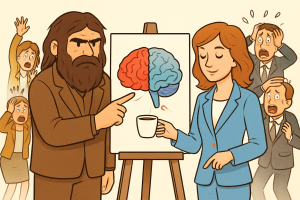
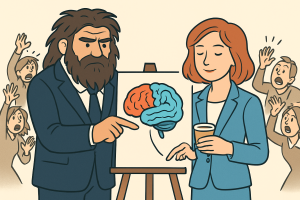
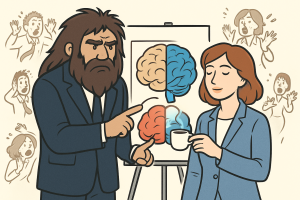
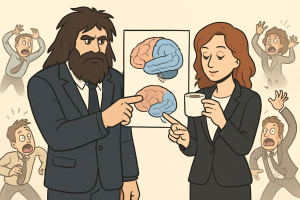
Your money decisions aren’t made by the logical part of your brain that reads financial statements and calculates compound returns. They’re made by the ancient part that scanned the savanna for predators 50,000 years ago.
That part doesn’t understand that markets go up and down. It only understands: everyone else is running, so I should run too.
Why Your Stone Age Brain Sabotages Modern Wealth
When Sarah bought Apple at $157, she wasn’t analyzing the company’s fundamentals. She was following what psychologists call “social proof” — the hardwired assumption that if everyone else is doing something, it must be safe and correct.
This worked brilliantly for hunter-gatherers. If everyone in your tribe suddenly started running, you ran too. No time to analyze why. The ones who stopped to think got eaten.
But in markets, social proof is wealth poison.
By the time “everyone” is talking about an investment, by the time it feels safe and obvious, you’re buying at exactly the wrong moment. You’re buying from smart money that got in when it felt dangerous and stupid.
Then comes the flip side. When markets crash and prices drop 30%, your amygdala — the fear center of your brain — floods your system with stress hormones. Every news alert feels like a saber-toothed tiger. Your brain screams: GET OUT NOW.
So you sell at the bottom to people whose brains don’t work this way.
Wild, right?
The Behavioral Finance Trap That Keeps You Poor
Here’s what blew my mind when I finally understood behavioral finance: the patterns that destroy wealth are completely predictable.
Loss aversion makes you hold losing investments too long (hoping to “break even”) while selling winners too early (to “lock in gains”).
Confirmation bias makes you seek information that confirms what you already believe, while ignoring data that challenges it.
Recency bias makes you assume recent market moves will continue forever — up or down.
But the big one, the pattern that wipes out more money than anything else, is what psychologists call “herding behavior.”
You feel comfortable buying when prices are high because everyone else is buying. You feel panicked when prices are low because everyone else is selling. Your comfort level moves in perfect inverse correlation to opportunity.
I once tracked my own trades over two years. Every single purchase I made felt smart and safe at the time. Every single sale felt necessary and prudent. I was down 23% while the S&P 500 was up 31%.
My brain was doing exactly what it was designed to do. It was keeping me poor.
How Smart Money Exploits Your Wiring
Want to know something that’ll make you uncomfortable?
Professional investors — hedge funds, private equity, family offices — they study your psychological patterns the way a poker player reads tells.
They know that retail investors like Sarah will buy at peaks and sell at bottoms with 87% consistency. They position themselves on the other side of those trades.
When you’re buying because it “feels right,” they’re selling to you.
When you’re selling because you “can’t take it anymore,” they’re buying from you.
This isn’t a conspiracy. It’s just behavioral finance at scale. They’ve figured out how to be greedy when others are fearful and fearful when others are greedy.
You’re running software designed for avoiding predators. They’re running software designed for exploiting predictable behavior patterns.
That’s why Warren Buffett’s best years happened during market crashes when everyone else was selling. 1974. 2008. 2020. He bought when your brain would be screaming to run.
The One Trick That Breaks Your Money Brain
After losing money for seven years following my instincts, I discovered something that changed everything: systematic buying when I felt most uncomfortable.
Not when markets were down. When I felt scared.
In March 2020, when every news outlet was predicting economic collapse and my portfolio was down 34%, I forced myself to buy more. My hands literally shook clicking the “buy” button on my brokerage app.
I bought QQQ at $164. It closed 2023 at $408.
The key insight from behavioral finance research: your discomfort is a better investment signal than any technical analysis.
When buying feels stupid and dangerous, you’re probably buying from smart money at reasonable prices.
When buying feels obvious and safe, you’re probably buying from smart money at expensive prices.
Your anxiety is information. Use it backwards.
If You Want to Stop Funding Other People’s Retirements
Look, this isn’t about becoming a professional trader or timing the market perfectly. It’s about recognizing that your brain is programmed to transfer wealth from you to people who understand behavioral finance.
Every time you buy high because everyone else is buying, you’re funding someone else’s retirement.
Every time you sell low because you can’t handle the uncertainty, you’re donating to someone else’s capital.
The people getting rich from your psychological patterns aren’t smarter. They just recognize their own wiring and have systems to override it.
The One Thing to Remember
Your money brain evolved to keep you alive in a world where following the crowd meant survival. In today’s markets, following the crowd means staying poor while smart money gets rich from your predictable behavior. The path to wealth isn’t fighting your psychology — it’s recognizing when your discomfort signals opportunity instead of danger.
Starting this week:
- Track your money emotions: Write down how you feel before every financial decision for 30 days. You’ll see the pattern.
- Set up automatic investments: Remove your brain from the equation. Dollar-cost average into index funds when markets feel scary.
- Use discomfort as a buy signal: When buying feels terrifying and stupid, that’s when smart money is probably selling to you at reasonable prices.
🎬 Prefer watching? Check out the video version on YouTube:
👉 https://www.youtube.com/@PrimalContrarian
Subscribe for daily insights on capital, wealth, and contrarian thinking.