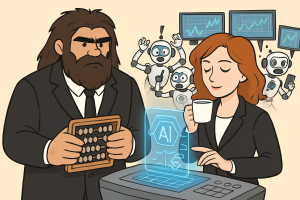
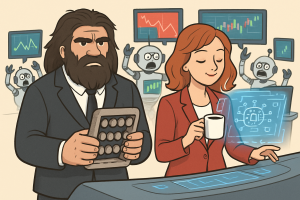
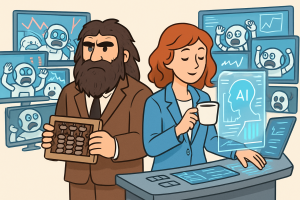
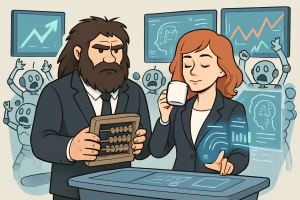
The Programmer Who Saw His Future Disappear
Marcus — 29, senior software engineer at a fintech startup in Denver — opened his laptop last Tuesday morning to find something unsettling. The AI tool his company had started testing could write code faster than he could think it.
Not just simple functions. Complex algorithms. Database queries. API integrations. Stuff that took him years to master.
The tool finished a project he’d estimated at three weeks of work. In forty-seven minutes.
Marcus makes $147,000 a year. He’s good at what he does. Hell, he’s great at it. But staring at those lines of code the AI had generated — clean, efficient, bug-free — he felt something shift in his chest. A cold recognition that all his expertise, all those late nights learning new frameworks, might not matter as much as he thought.
He’s not wrong to worry.
I Used to Believe Skills Were Enough
I know exactly how Marcus felt because I lived through something similar in 2018.
I was freelance writing then, charging $150 per article for marketing copy. Good money. I was fast, I understood audience psychology, and clients loved my work. Then ChatGPT hit the scene, and within six months, I watched my rates get cut in half as companies started using AI for first drafts.
Here’s the thing that kept me up at night: I was really good at what I did. I’d spent years perfecting my craft. But “really good” doesn’t mean much when a machine can produce 80% of your output for pennies.
The mistake I made — the same one Marcus is making now — was thinking my skills would protect me.
They won’t.
AI Creates Capital, Not Jobs
Every conversation about artificial intelligence focuses on jobs. Which ones will disappear. Which ones are “AI-proof.” How to retrain for the future.
All the wrong questions.
AI doesn’t create jobs. It creates capital. Massive amounts of it. And that capital flows to one group of people: the ones who own the AI systems, not the ones who compete against them.
Think about what happened when Marcus’s company deployed that coding AI. Did they hire more programmers? No. They kept Marcus — for now — and pocketed the productivity gains. The value that used to require three weeks of human labor now gets captured by whoever owns the software.
That’s not wealth creation. That’s wealth transfer.
From people who sell their time to people who own systems that replace time.
The Demand Revolution
But here’s what most people miss about the AI economics revolution: it’s not just about automation replacing labor. It’s about who controls the demand.
When I was freelance writing, I thought I was selling my writing skills. Wrong. I was selling my access to demand — companies that needed content. The moment AI could satisfy that same demand cheaper, my skills became irrelevant.
Marcus thinks he’s a programmer. Really, he’s a supplier to companies that demand code. AI doesn’t just write code — it controls the flow of demand for coding services.
Capital is stored demand. AI amplifies this by creating systems that capture and redirect human needs at scale.
The people who own these systems own the future cash flows from human demand. The people who compete against these systems become obsolete.
Do You Own Any Part of the Future?
Here’s the uncomfortable question I had to ask myself in 2018, and the one Marcus needs to ask now: When AI eliminates or reduces demand for your skills, what do you own that benefits from the change?
Most skilled professionals own nothing. Zero equity in the companies replacing them. Zero stake in the AI systems making their expertise redundant. Zero ownership of the platforms that capture value from their industry’s transformation.
They’re highly educated, highly skilled, and completely exposed.
I learned this the hard way. While my writing rates got cut in half, OpenAI’s valuation went from $0 to $90 billion. While freelancers struggled, Microsoft’s stock — they own part of OpenAI — climbed 47% in 2023.
The wealth didn’t disappear. It just moved from the people doing the work to the people owning the systems.
The Great Separation
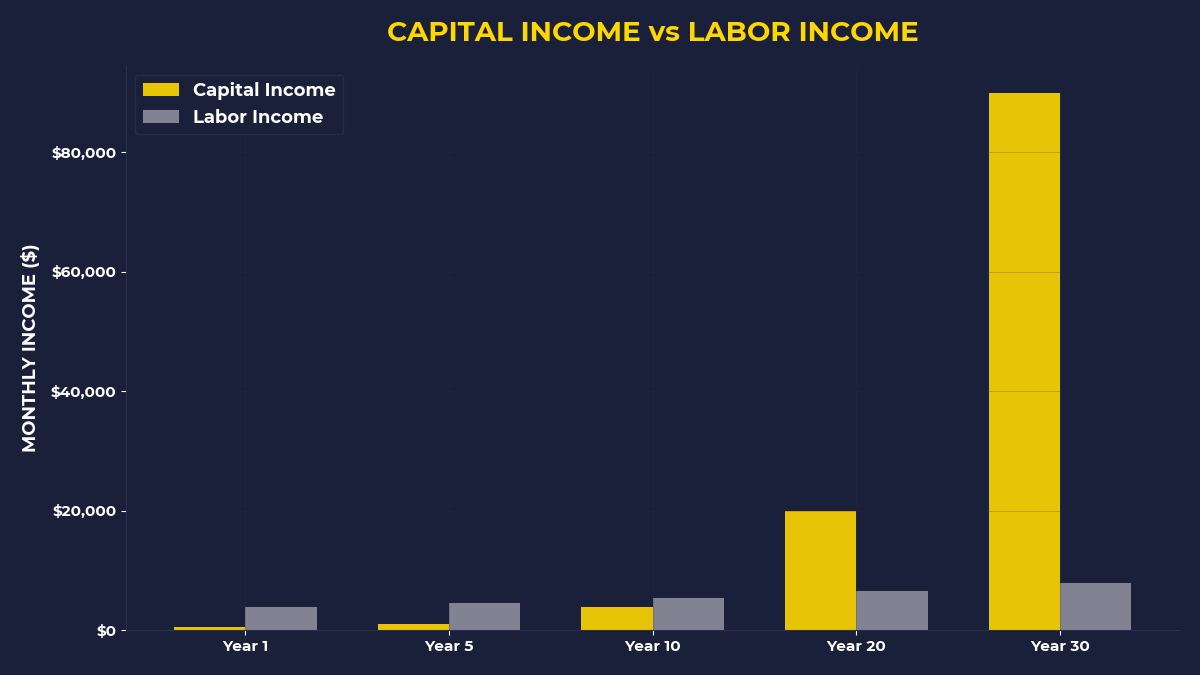
AI creates two distinct economic classes, and the line between them isn’t education or skill level.
It’s ownership.
Class One: People who own pieces of AI-driven systems. They own stock in companies building AI tools. They own real estate that benefits from AI productivity gains. They own intellectual property that gets amplified by AI rather than replaced by it.
Class Two: People who compete against AI-driven systems. They sell services AI can replicate. They trade time for money in industries AI is transforming. They have skills but no stakes.
The brutal truth? Your PhD doesn’t determine which class you’re in. Your salary doesn’t either. Your stock portfolio does.
Marcus makes $147,000 a year but owns zero shares in AI companies. Meanwhile, someone making $45,000 who’s been buying NVIDIA stock for two years is positioned better for the AI wealth transfer.
Wild, right?
What I Did When the Writing Gig Collapsed
When AI started eating my freelance income, I had a choice. Double down on becoming a “better” writer, or start owning pieces of the system replacing me.
I chose ownership.
Not because I’m smarter than other writers — I’m not. Because I finally understood that fighting AI was like fighting the internet in 1995. The smart play wasn’t to resist the change. It was to own pieces of it.
I took every dollar I wasn’t spending on “upskilling” courses and bought stock in companies I knew would benefit from AI adoption. Microsoft. Alphabet. NVIDIA. Even some smaller AI-focused companies I researched.
My writing income dropped 40% between 2022 and 2024. My investment account grew 73%.
Same economic shift. Different side of the equation.
The One Thing That Still Matters
Here’s what I wish someone had told Marcus — and me — earlier: In an AI-driven economy, your job is not to become irreplaceable. It’s to own pieces of the systems doing the replacing.
You can’t out-code an AI. You can’t out-write it. You can’t out-design it. But you can own it.
And ownership doesn’t require you to understand how AI works any more than owning Apple stock requires you to build iPhones. You just need to recognize where the demand is flowing and position yourself to capture it instead of fighting it.
The AI revolution isn’t coming. It’s here. The wealth transfer is happening right now, every day, as human labor gets replaced by automated systems owned by people who saw this coming.
The question isn’t whether you’ll be affected. You will be. The question is whether you’ll be on the side that benefits or the side that gets left behind.
If you’re someone who’s built your entire financial future on selling your skills and your time — if your wealth-building plan depends on being irreplaceable in a world where machines can replace almost everything — then you need to start thinking about ownership.
Because AI economics doesn’t care how talented you are. It only cares what you own.
The One Thing To Remember
AI isn’t just changing how work gets done — it’s changing who captures the value from that work. Skills become commoditized, but ownership of the systems doing the work becomes incredibly valuable. Every dollar you’re not investing in AI-driven wealth creation is a dollar you’re betting on your irreplaceability in an economy that’s systematically replacing human expertise.
Here’s what to do today:
- Take 10% of your next paycheck and buy shares in companies building or using AI systems (even just an index fund that includes major tech stocks)
- Stop spending money on courses that make you better at things AI can already do — spend it on ownership instead
- Ask yourself: “When AI transforms my industry, what will I own that benefits from the change?”
🎬 Prefer watching? Check out the video version on YouTube:
👉 https://www.youtube.com/@PrimalContrarian
Subscribe for daily insights on capital, wealth, and contrarian thinking.