The Invoice You Never Notice
Every Monday morning, you wake up to work for capital owners.
Your rent check goes to someone who owns real estate. Your grocery bill flows to shareholders of Kroger and Walmart. Your Netflix subscription enriches Reed Hastings and his investors. Your morning coffee? That’s Howard Schultz’s Starbucks empire extracting $4.50 from your checking account.
The pattern is everywhere once you see it. Capital owners collect while you contribute.
Here’s what most people miss: they spend their entire careers strengthening this system instead of joining it. They optimize their labor productivity while remaining completely disconnected from capital ownership. They get really good at making other people rich.
I used to be one of these people.
Why Famous Singers Make Millions While You Get Bills
When I was 26, I couldn’t figure out why pop stars earned more in three months than most engineers make in a decade. It wasn’t talent — plenty of struggling musicians had better voices than the ones selling out arenas. It wasn’t work ethic — construction workers put in longer hours than any celebrity.
The answer hit me when I started thinking about capital theory.
Fame is stored demand. When Taylor Swift releases an album, she’s not trading hours for dollars. She created something once that generates cash flow from millions of people repeatedly. Her capital — her brand, her catalog, her platform — works 24/7 while she sleeps.
The engineer builds someone else’s products. The pop star owns demand.
This isn’t about becoming famous. It’s about understanding the structural difference between working for capital and owning it.
Capital Is Stored Demand (Not Money in Your Savings Account)
Most people think capital means having money in the bank. Wrong.
Capital is a structure that captures recurring human demand. Warren Buffett learned this at age 6 when he collected lost golf balls and resold them for 50 cents per dozen. The golf balls weren’t capital — the system that captured golfers’ recurring need for replacement balls was capital.
By age 11, Buffett was reading financial statements and buying his first shares of Cities Service Preferred for $38. The stock dropped to $27 immediately. Most kids would have panicked and sold. Buffett held. When it recovered to $40, he sold for a small profit.
The stock eventually hit $200.
That early mistake taught him the difference between trading and owning. Trading uses your time and stress to generate small gains. Owning means your capital works while you focus on finding the next opportunity.
Consider this: between 1965 and 2023, Berkshire Hathaway delivered a compound annual return of 19.8% versus 10.5% for the S&P 500. The difference? Buffett stopped working for money and started buying pieces of businesses that generated cash flow from other people’s labor.
Why Your Emergency Fund Is Training You To Stay Poor
The conventional wisdom says build a six-month emergency fund before investing. This advice guarantees you’ll never accumulate meaningful capital.
Here’s why: emergency funds are training wheels for financial fear. They teach you to hoard cash while inflation quietly steals 3% of your purchasing power annually. Meanwhile, productive assets compound at 7-10% over long periods.
I learned this the expensive way. For three years, I kept $15,000 in a high-yield savings account earning 0.5%. I felt responsible and safe. In reality, I was paying an opportunity cost of $900-1,350 per year while inflation eroded my capital.
Look. You need some cash buffer. But not six months of expenses sitting in an account earning less than inflation.
Robert Kiyosaki tells a story about living in a friend’s garage after his business failed in the 1980s. Even while homeless, he followed one rule: pay himself first. Every dollar he earned went to assets before bills. When bill collectors called, he worked extra jobs to cover the gap.
This sounds insane until you understand the psychology. When you pay bills first, there’s never anything left for assets. When you buy assets first, you get creative about covering expenses.
The pressure forces you to think like a capital owner instead of a wage earner.
The Golf Ball Principle: How Compound Returns Actually Work
Want to understand how capital compounds? Study Buffett’s golf ball business model.
At age 6, he wasn’t just selling golf balls. He was building a system that captured recurring demand from golfers who constantly lost balls in the rough. Every ball he found and resold generated profit he could reinvest in finding more balls or expanding to new golf courses.
The key insight: he used profits to buy more productive capacity, not consumption.
This is how Harry Larson built a fortune from $175 in 1930. He noticed people using a coin-operated scale at a drugstore and asked the owner about the revenue. The scale generated about $20 per month, with the store keeping 75%. Larson bought three scales for $175 and earned $98 monthly.
Here’s the part that matters: “I bought 70 machines in total, and the additional 67 were purchased with coins from the first three machines.”
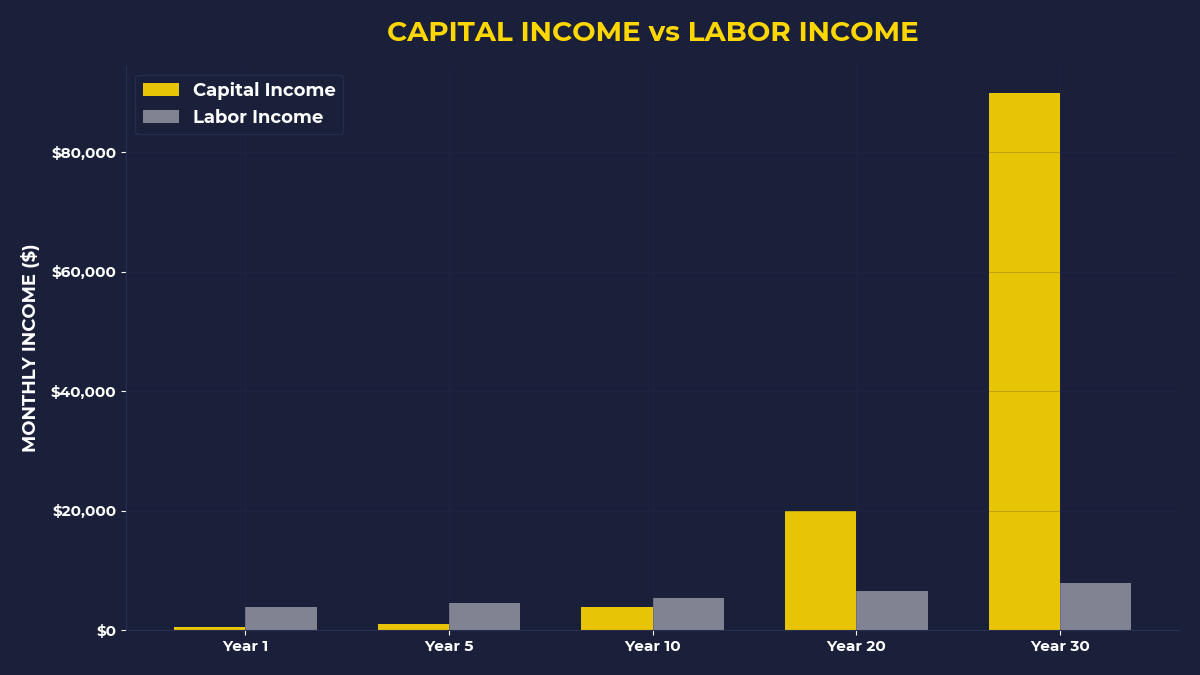
That’s compound capital accumulation. Not saving money to buy assets later. Using asset cash flow to buy more assets immediately.
The scale business taught Larson leverage. Instead of working for money, his machines collected coins 24/7. Instead of trading time for income, he owned systems that generated income from other people’s actions.
What Every Bill Collector Teaches You About Capital
Your monthly expenses reveal the most important lesson about capital theory: you’re already funding multiple capital owners whether you realize it or not.
Your mortgage payment builds equity for you (if you own) or your landlord (if you rent). Your car payment enriches Ford Motor Credit. Your phone bill flows to Verizon shareholders. Your insurance premiums generate investment returns for Warren Buffett through GEICO.
Every check you write is an invoice from a capital owner.
The question becomes: when do other people start writing checks to you?
Most people never flip this script. They optimize for higher wages while remaining permanent customers of capital owners. They get promoted, increase their income, and proportionally increase their payments to landlords, car dealers, and subscription services.
The wealthy think differently. They ask: “What should I buy?” instead of “What should I do?”
Why Most People Build Other People’s Dreams
The psychology behind staying poor is rooted in loss aversion — our Stone Age brain’s obsession with avoiding risk rather than maximizing gain.
When you have $1,000, your primitive mind says: “Don’t lose the $1,000.” When a capital owner has $1,000, their trained mind says: “How can this $1,000 generate $100 annually forever?”
This difference in thinking separates permanent wage earners from capital accumulators.
I see this pattern constantly. Smart engineers earning $120,000 annually who’ve never bought a stock. Marketing directors with zero equity in anything. Doctors spending every raise on consumption upgrades instead of productive assets.
They’re optimizing for lifestyle inflation instead of capital accumulation.
Meanwhile, their less educated neighbors buy rental properties, start small businesses, or systematically accumulate index funds. In 20 years, the neighbor owns assets generating passive income. The high-wage professional owns nothing but a job they can’t afford to lose.
The One Question That Changes Everything
Here’s the mental model shift that matters: stop asking “How can I make more money?” and start asking “What productive assets should I own?”
Making more money from labor has natural limits. Your day has 24 hours. Your energy has limits. Your skills become obsolete. At some point, you can’t work harder or smarter enough to dramatically change your financial position.
Owning productive assets has no such limits.
When you own shares of Microsoft, thousands of software engineers work to increase your capital value. When you own rental real estate, tenants pay your mortgage while the property appreciates. When you own a profitable business, employees and systems generate cash flow beyond your personal effort.
This is leverage in its purest form: other people’s time and energy working to compound your capital.
What The Primal Investor Takes Away
Capital theory isn’t academic—it’s the difference between building wealth and staying trapped in the labor-for-money cycle. Here’s your immediate action plan:
• **Flip the payment priority**: Buy assets before paying non-essential bills. Create productive pressure that forces capital-owner thinking.
• **Track your capital invoices**: List every monthly payment that enriches someone else’s capital. Ask which of these you could eventually own instead of rent.
• **Apply the golf ball test**: Before any purchase, ask “Does this generate recurring cash flow or just consume my cash flow?”
• **Start with index funds**: If business ownership feels overwhelming, buy broad market ETFs that give you equity in hundreds of capital-generating companies.
• **Reinvest everything**: Use asset income to buy more assets, not upgrade consumption. Compound your ownership, not your lifestyle.
The crowd works for capital. Contrarian investors become capital. Your next dollar decides which category you’re in.
🎬 Prefer watching? Check out the video version on YouTube:
👉 https://www.youtube.com/@PrimalContrarian
Subscribe for daily insights on capital, wealth, and contrarian thinking.