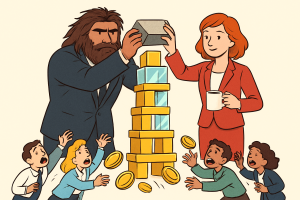
Have you ever actually looked at your monthly bills recently?
I mean really looked at them. Not just to see how much you owe, but to see where your money is going.
The Bills That Never Stop Coming
Your rent or mortgage payment. That goes to someone who owns real estate.
Your car payment. That flows to someone who owns an auto financing business.
Your electric bill, water bill, internet bill. Each one is a payment to someone who owns essential infrastructure.
Your Netflix subscription, Spotify subscription, gym membership. More payments to people who own platforms and services.
Even that morning coffee and bagel. You’re sending cash flow to someone who owns a coffee business.
Every single day, you write checks (literal or digital) to capital owners. You might call them bills, but they’re really invoices. Invoices from people who own things you need.
And here’s what hit me like a brick wall when I first understood this: most people spend their entire lives on the paying side of this equation, never the receiving side.
The Story That Changed Everything for Me
I once read about a businessman who lost everything. His company went bankrupt due to accounting issues, and he and his wife were literally living in a friend’s garage.
Bills were piling up. Creditors were calling. The pressure was crushing.
But here’s what this guy did that seemed completely backwards at the time: when money came in from odd jobs, he didn’t pay the bills first. He invested in assets first — stocks, real estate, anything that could generate income. Then he figured out how to pay the bills.
People thought he was crazy. “Pay your bills first,” everyone said. “Be responsible.”
But he had learned something most people never figure out: if you always pay everyone else first, you’ll always be broke.
When the bills couldn’t get paid with his regular income, he worked nights and weekends doing manual labor — cutting grass, odd jobs, whatever it took. But he never touched his investment money. That was for buying his way out of the bill-paying game.
Within a few years, he was wealthy again. The income from his investments covered his bills, and he was free.
Why This Goes Against Everything You’ve Been Taught
Everything about this approach feels wrong, doesn’t it?
We’re taught to be “responsible.” Pay your bills on time. Don’t invest money you can’t afford to lose. Live within your means.
All good advice for staying out of trouble. Terrible advice for building wealth.
Here’s why: when you pay bills first, you’re training yourself to see other people’s capital as more important than your own. You’re saying their cash flow matters more than yours.
Think about it this way: every month, you get a paycheck. Where does it go?
First to the landlord or bank (housing).
Then to the utility companies (electricity, water, internet).
Then to the credit card companies (past purchases).
Then to subscription services, insurance companies, and dozens of other capital owners.
Whatever’s left — if anything — might get saved or invested.
This system guarantees you’ll never build serious wealth. You’re designed to be a cash flow generator for other people’s capital.
The Simple Flip That Changes Everything
What if you flipped the order?
What if the first check you wrote every month was to yourself — specifically, to buy ownership stakes in income-producing assets?
Stock in companies that pay dividends. Real estate investment trusts. Index funds. A small business. Anything that puts you on the receiving end of cash flow.
I know what you’re thinking: “But then how do I pay my bills?”
Same way the guy in the garage did it. You hustle harder to make up the difference.
You take on extra work, cut expenses, sell stuff you don’t need. You do whatever it takes to cover the bills without touching your investment money.
This creates a beautiful pressure: you start looking for ways to earn more instead of ways to save more. Saving money has limits. Earning money doesn’t.
What Capital Actually Is (And Why Most People Never Own Any)
Here’s something most people don’t understand about wealth: capital isn’t just money sitting in a bank account.
Capital is stored demand.
When people need what you own — whether it’s shares in a company, real estate they want to rent, or a business that solves their problems — that need becomes cash flow in your direction.
Famous singers make millions not because they work millions of times harder than everyone else. They make millions because millions of people demand their music. That demand gets stored in their recordings, their brand, their concerts. It becomes capital.
The same principle works at every level. Own part of a company people need, and you get part of their profits. Own real estate people need, and you get rent. Own any asset people demand, and you get paid.
Most people never own any capital because they spend all their money renting access to other people’s capital. They rent housing instead of owning real estate. They work for wages instead of owning business equity. They keep their money in checking accounts instead of owning productive assets.
Every dollar that goes to bills is a dollar that could have gone toward ownership. And every dollar that goes toward ownership eventually generates dollars that can pay bills.
The Freedom You’re Really Buying
People think building wealth is about having fancy things or never worrying about money.
That’s missing the point entirely.
The real prize is time freedom. The ability to wake up on a Monday morning and choose what to do with your day.
Think about the difference between building someone else’s house for wages and building your own house for yourself. Same physical work, completely different experience. One feels like drudgery, the other feels like creation.
That’s what capital ownership does. It shifts you from survival mode to creation mode.
When your assets generate enough cash flow to cover your bills, you stop selling your time for money. You start using your time for things that matter to you — family, creativity, solving problems you care about.
Most people spend decades in repetitive labor, telling themselves they’ll be creative “someday” when they have time. Capital gives you that time.
The One Thing To Remember
Every bill you pay is a wealth transfer to a capital owner, and every dollar you invest is a step toward becoming one yourself. The only way to escape the bill-paying treadmill is to gradually move from the paying side to the receiving side of cash flow. Start small, start today, but start with the right order: pay yourself first, then figure out everything else.
- This week: Calculate how much you pay in monthly bills versus how much you invest in ownership. The ratio will probably shock you.
- Next month: Flip your payment order. Invest a fixed amount in index funds or dividend stocks before paying non-essential bills.
- Going forward: When bills get tight, look for ways to earn more rather than invest less. Protect your capital purchases like your financial freedom depends on it — because it does.