I’ve never met an investor who thought they were driven by emotion.
Every single one believes they make rational decisions based on data, research, and sound analysis. They can spot behavioral biases in other people with surgical precision. They roll their eyes at panic sellers and FOMO buyers. They shake their heads at the herd mentality that drives bubbles and crashes.
Yet 97% of them are making the exact same primal mistakes, driven by the exact same Stone Age programming that kept our ancestors alive but keeps modern investors poor.
The cruel irony of behavioral finance: the investors who need it most are the ones who think it applies to everyone else.
When I Discovered My Own Invisible Programming
I used to be one of these people.
Back in 2008, I watched the S&P 500 drop 57% from its October 2007 peak to the March 2009 trough. I saw the panic. I observed the fear. I recognized the herd behavior for what it was—a massive wealth transfer from weak hands to strong ones.
What I didn’t see was my own behavior.
I didn’t realize I was anchoring my buy decisions to recent peaks. I didn’t notice I was avoiding stocks that had fallen the most—the exact opposite of what a contrarian should do. I didn’t recognize that my “patient waiting for better prices” was actually loss aversion disguised as discipline.
Here’s what finally opened my eyes: I kept a trading journal for six months, recording not just what I bought and sold, but why I made each decision and how I felt at the time. When I reviewed it, I discovered a stranger making my investment decisions.
This stranger sold winners too early because he couldn’t bear the thought of giving back gains. He held losers too long because admitting a mistake felt like admitting stupidity. He avoided buying during the best opportunities because fear felt like prudence.
Your Brain Is Running Stone Age Software
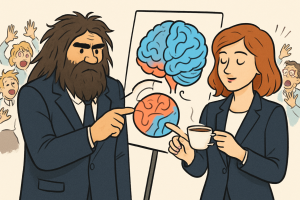
Your investment decisions aren’t made by the rational analyst you think you are.
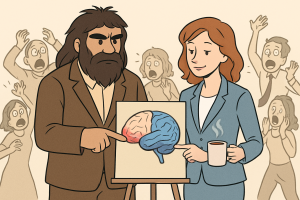
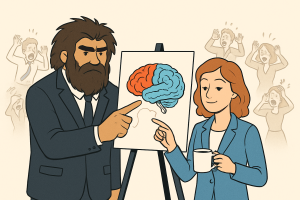
They’re made by neural pathways carved by 200,000 years of evolution, optimized for surviving on the African savanna, not navigating modern capital markets. Your amygdala doesn’t distinguish between a charging lion and a 20% portfolio drawdown—it just knows something bad is happening and triggers the same fight-or-flight response that kept your ancestors alive.
The problem? What kept humans alive for millennia now keeps investors poor.
Loss aversion made sense when losing your winter food supply meant death. Now it makes you sell at market bottoms. Herd behavior protected our ancestors from predators—if everyone’s running, you should run too. Now it makes you buy high and sell low with mathematical precision.
Recency bias helped early humans respond quickly to immediate threats. Now it makes you extrapolate the last three months of market action into the next three years.
The Behavioral Patterns You Can’t See
Why do most investors think they’re immune to these biases?
Because behavioral traps feel like rational decisions from the inside. Your brain is remarkably skilled at creating logical-sounding reasons for emotional choices. Psychologists call this “motivated reasoning”—your conclusions come first, then your brain reverse-engineers the justification.
When you sell a falling stock, you don’t think “I’m panic selling because my amygdala is hijacking my prefrontal cortex.” You think “I’m taking a prudent loss to preserve capital.” When you chase a hot sector, you don’t recognize FOMO. You see “capitalizing on a secular trend.”
The most dangerous biases are the ones that feel like wisdom.
I once avoided buying Amazon at $90 in 2001 because “no company should trade at 100 times sales.” That wasn’t fundamental analysis. That was anchoring bias dressed up as value investing. I was anchoring to traditional valuation metrics instead of recognizing a new business model that would render those metrics obsolete.
The stock went to $3,200 before splitting.
The Confirmation Trap
Here’s the behavioral pattern that destroys more wealth than any other: confirmation bias.
Once you form an opinion about a stock, sector, or market direction, your brain becomes a heat-seeking missile for information that confirms your view and a deflector shield for information that challenges it. You unconsciously seek out analysts who agree with your positions and dismiss those who don’t as “biased” or “uninformed.”
Between 2011 and 2020, the S&P 500 delivered annualized returns of 13.9%. Yet the average equity fund investor earned just 5.1% annually during the same period, according to Dalbar’s Quantitative Analysis of Investor Behavior. Where did the 8.8% annual difference go?
Behavioral mistakes. Buying high when confirmation bias said “this time is different.” Selling low when loss aversion screamed “cut your losses before they get worse.”
Can You Actually Change Your Brain?
Most behavioral finance content stops at identification. “Here are 20 cognitive biases. Don’t do these things.” As if awareness alone could override millions of years of evolution.
That’s like telling someone not to blink when something flies at their face.
The solution isn’t fighting your programming. It’s designing systems that make your programming work for you instead of against you. You can’t eliminate bias, but you can structure your decision-making process to minimize its damage.
I started using pre-commitment strategies. Before I buy any position, I write down three specific scenarios that would make me sell: a fundamental thesis breaker, a technical stop loss, and a time-based review. No exceptions. No “let me see how I feel when it happens.”
When the selling moment arrives, I don’t trust my feelings. I trust my earlier, calmer self.
The Structural Solution to Behavioral Problems
The most successful investors I know don’t have better emotional control than everyone else.
They have better systems.
Warren Buffett doesn’t sit around trying to suppress his cognitive biases. He has a simple rule: only buy businesses he understands at prices that make sense for the long term, then hold until the business deteriorates or he finds something better. The system eliminates most opportunities for behavioral mistakes.
Dollar-cost averaging works not because it maximizes returns—lump-sum investing usually beats it. It works because it eliminates the behavioral challenge of trying to time perfect entry points. You remove the decision from your emotional, pattern-seeking brain and hand it to a calendar.
The best behavioral defense is removing behavior from the equation.
What The Primal Investor Takes Away
• Your brain is running 200,000-year-old software optimized for survival, not wealth building—what feels like rational analysis is often emotional reaction dressed up in logical clothing
• Pre-commitment beats willpower every time—write down your selling criteria before you buy, when your judgment isn’t clouded by gains or losses
• The most dangerous biases feel like wisdom—if an investment decision makes you feel smart or contrarian, that’s often your brain tricking you
• Build systems that eliminate behavioral choices rather than trying to make better behavioral choices
• The investors who think they’re immune to behavioral biases are usually the most vulnerable to them
Your biggest investment risk isn’t market volatility or economic uncertainty. It’s the primal brain that kept your ancestors alive but keeps you from building wealth.
🎬 Prefer watching? Check out the video version on YouTube: