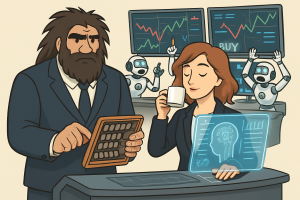
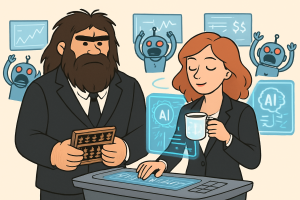
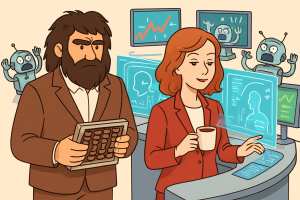
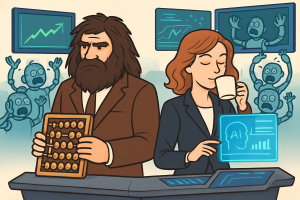
Marcus — 29, software engineer in Denver — got the email on a Tuesday morning in March. His company had just implemented an AI system that could write code 40% faster than their entire development team. The subject line read: “Organizational Restructuring.”
He wasn’t fired. Not yet.
But sitting in that conference room, listening to his boss explain how “AI augmentation” would make everyone more productive, Marcus felt something cold settle in his stomach. The writing was on the wall, written in algorithms that could soon write themselves.
Why Most People Are Asking the Wrong Question About AI
I know exactly how Marcus felt because I went through my own version of this realization three years ago. Not with AI — with automation in general. I watched entire departments get replaced by software, watched friends scramble to “upskill,” watched smart people convince themselves that staying ahead of technology was just a matter of learning faster.
Here’s what I learned the hard way: You cannot outrun technological progress by working harder.
The question everyone asks is: “What skills do I need to stay relevant?” But that’s like asking which deck chair gives you the best view while the Titanic is sinking. The real question is: “How do I get off this ship entirely?”
Marcus spent the next six months taking online courses in machine learning. He attended conferences about “human-AI collaboration.” He read articles about prompt engineering and became fluent in ChatGPT. Smart moves, right?
Wrong question entirely.
The Two Classes AI Is Creating Right Now
AI isn’t just changing jobs. It’s splitting the economy into two distinct classes:
**The Capital Owners**: People who own the AI systems, the data, the platforms, and the companies that use AI to multiply productivity.
**Everyone Else**: People who compete against AI, get replaced by AI, or become extensions of AI systems they don’t own.
Think about that for a second. ChatGPT can write marketing copy in 30 seconds that used to take a copywriter 3 hours. Who benefits? The copywriter who “collaborates” with AI? Or the person who owns OpenAI stock and the companies using AI to fire their copywriting teams?
Marcus was training himself to become a more efficient cog in a machine that would eventually eject him anyway.
What Capital Ownership Actually Means in the AI Age
Here’s where most people get confused. They think capital means having a lot of money sitting in a bank account. Wrong.
Capital is stored demand. It’s owning something that people consistently need and pay for.
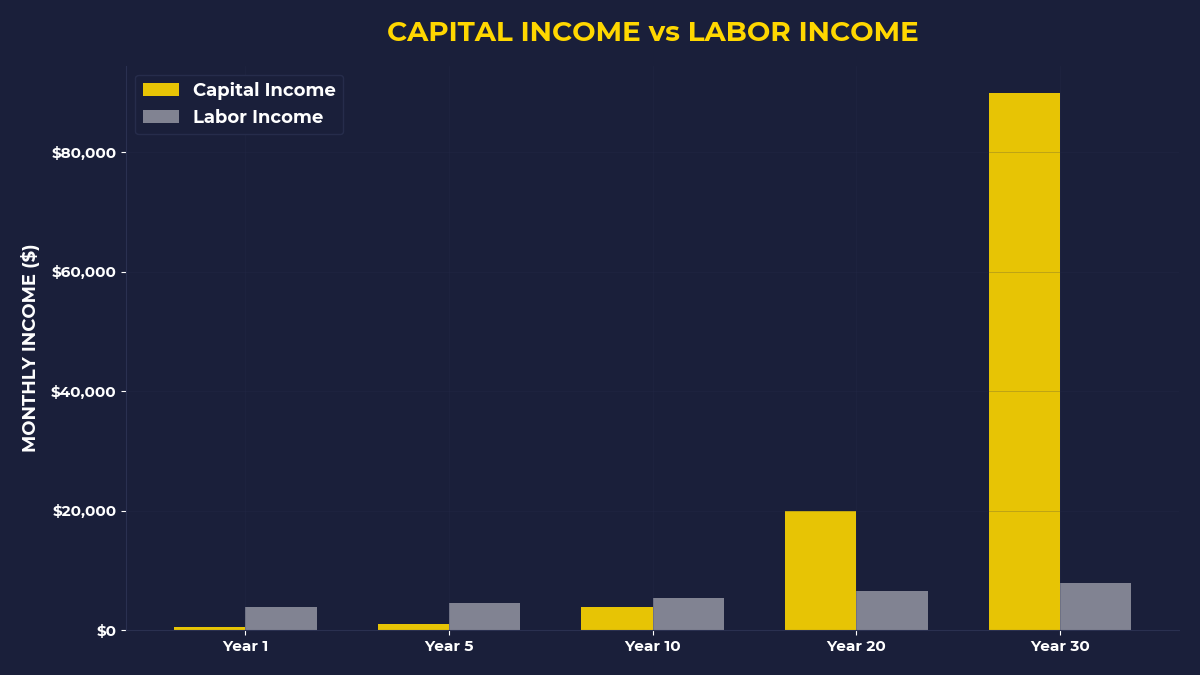
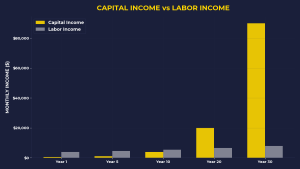
When AI makes a company 40% more efficient, that extra productivity flows to capital owners as profits. When AI reduces a company’s labor costs by $2 million per year, that $2 million doesn’t disappear — it flows to shareholders as dividends and stock price appreciation.
The copywriter who gets replaced by AI? Their income vanishes.
The person who owns stock in the company that replaced them? They just got a raise.
I made this mistake early in my career. I owned zero shares in any company while spending 50+ hours a week making other people’s businesses more profitable. Every process I improved, every efficiency I created, every dollar I saved — it all flowed upward to people who owned equity while I collected the same bi-weekly paycheck.
The AI Productivity Explosion Nobody Talks About
Do you realize what’s actually happening right now? AI is creating the largest productivity boom in human history. Companies are seeing 30-50% efficiency gains in months, not years.
But productivity gains don’t automatically raise wages. They raise profits.
Between 1973 and 2018, worker productivity increased by 70% while wages only grew 12%. Now imagine what happens when AI increases productivity by 200-400% over the next decade.
Marcus finally understood this six months after that conference room meeting. His company had indeed become more productive — so productive they’d eliminated 60% of their engineering positions. The remaining engineers weren’t making 60% more money. The shareholders were.
That’s when he stopped asking “How do I stay relevant?” and started asking “What should I buy?”
How to Position Yourself on the Right Side of AI Economics
Look. I’m not telling you to quit your job tomorrow and become a day trader. But I am telling you this: every month you delay building capital ownership is a month you’re falling further behind the AI wealth transfer that’s happening right now.
Here’s what Marcus did, and what I wish I’d done earlier:
He took 20% of his salary — not his leftover money, his salary — and started buying ownership stakes in companies benefiting from AI automation. Not crypto speculation or meme stocks. Boring companies using AI to eliminate human jobs and increase margins.
The twist? He bought stock in his own company first.
If they were productive enough to fire 60% of their workforce, they were productive enough to generate higher profits for shareholders. Marcus owned 127 shares when the layoffs happened. Those shares appreciated 34% over the next eight months as the market rewarded the company’s AI-driven cost reductions.
His severance package hurt. The stock gains softened the blow.
The One Asset Nobody Teaches You to Buy
Most people think they need to understand AI to profit from it. That’s like thinking you need to understand combustion engines to benefit from owning ExxonMobil stock in 1950.
The asset you need isn’t AI knowledge. It’s equity in companies that will use AI to become more profitable.
This isn’t about picking winners. It’s about positioning yourself to benefit from the overall trend. When AI makes businesses more efficient, that efficiency flows to owners, not employees.
I started buying QQQ (the Nasdaq ETF) three years ago, not because I predicted the AI boom, but because I realized I was on the wrong side of technological progress. Every month, 15% of my paycheck goes to buying ownership in the companies that are eliminating jobs like mine.
Sounds morbid? It’s actually liberation.
If You’re Someone Who Sees This Coming
If you’re someone who recognizes that AI isn’t just changing your industry — it’s rewriting the rules of who gets rich and who gets left behind — then you understand why this matters.
If you’re someone who’s tired of making other people’s businesses more valuable while your own financial position stagnates, this is your moment.
If you’re someone who wants to benefit from the productivity explosion instead of becoming its casualty, the window is still open. But it’s closing fast.
The people who will stay rich through the AI transition aren’t necessarily the smartest or most skilled. They’re the ones who own capital that benefits from AI productivity gains instead of competing against them.
The One Thing To Remember
**AI doesn’t destroy wealth — it transfers it from workers to capital owners.** Every job eliminated by artificial intelligence makes the companies using that AI more profitable. Every efficiency gained through automation increases the value of owning those automated systems. The question isn’t whether this transfer will happen. It’s already happening. The question is which side you’ll be on when it accelerates.
Here’s what to do right now:
Before you pay any bills this month, transfer $100 to a brokerage account and buy shares in an AI-focused ETF or large tech companies implementing AI
Calculate 10-20% of your current income and set up automatic monthly investments in companies that benefit from AI productivity, not companies that compete against it
If your company uses AI to become more efficient, buy their stock before they announce the layoffs that will inevitably follow
🎬 Prefer watching? Check out the video version on YouTube: