The Machine That Makes Owners Rich
Artificial intelligence doesn’t eliminate jobs. It eliminates the need for humans to own their own economic output.
Every AI breakthrough you celebrate is actually a wealth transfer mechanism disguised as technological progress. While you’re marveling at ChatGPT’s latest trick or Claude’s reasoning ability, the real game is happening in the ownership layer. The people building AI aren’t just creating better tools — they’re creating new forms of capital that generate value without human labor.
Here’s what most people miss: AI economics operates on a completely different model than industrial economics. In the industrial age, you traded time for money. In the AI age, you either own the systems that create value, or you compete with them for scraps.
I learned this the hard way when I first started thinking about AI investments back in 2019. I was focused on which companies would “win” the AI race, completely missing the structural shift happening underneath. I bought NVIDIA at $180 and sold at $220, thinking I’d timed it perfectly. Meanwhile, the stock went to $800 because I was thinking like a stock picker instead of thinking like a capital owner.
Why Your AI Strategy Is Actually Someone Else’s Retirement Plan
Walk through your morning routine and count how many AI systems you interact with. Your phone’s autocomplete. Netflix recommendations. Google search results. Amazon’s product suggestions. Spotify’s playlist curation. Your GPS navigation. Even your email spam filter.
Each interaction generates data. Each data point trains the system. Each improvement makes the system more valuable. And who captures that value? Not you.
You’re contributing to the training of systems you’ll never own. Think about that.
The conventional wisdom says AI will “augment human capabilities” and “create new types of jobs.” This is the same optimistic thinking that said globalization would lift all boats and that the internet would democratize opportunity. Technically true, structurally misleading.
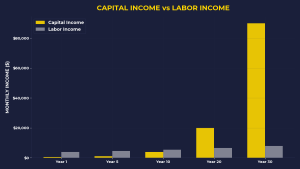
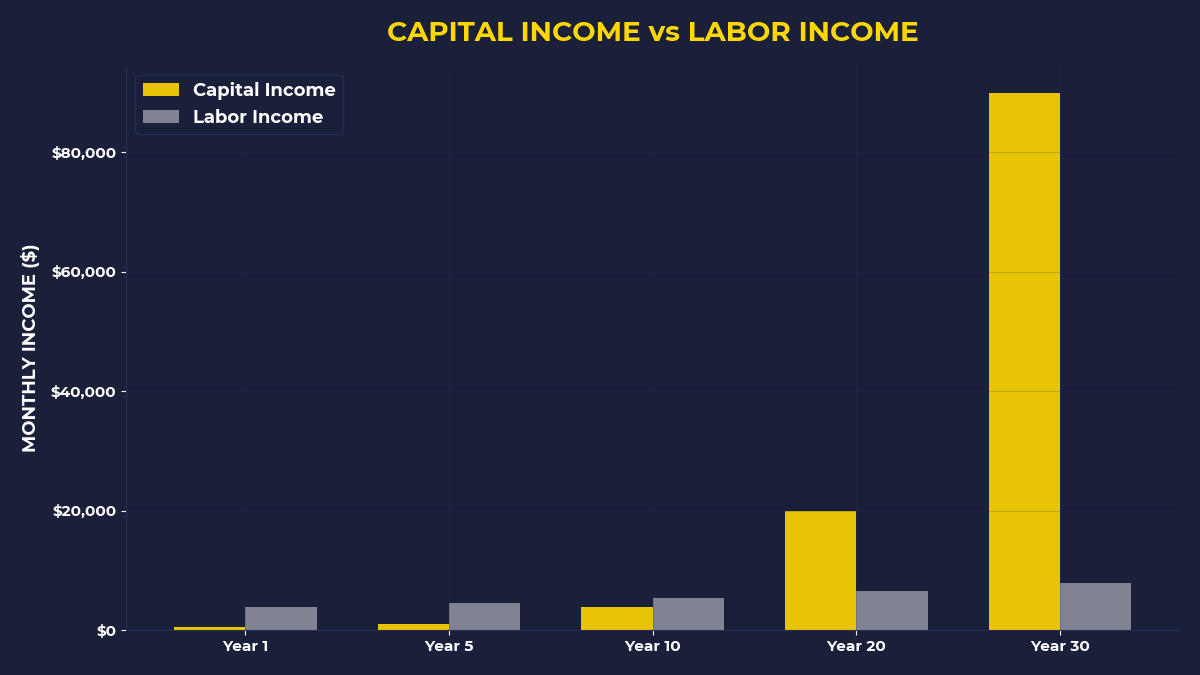
Yes, AI augments human capabilities. But it augments capital owners’ capabilities exponentially more than it augments workers’ capabilities. A person with a laptop and an AI assistant might be 3x more productive. A person who owns the AI company that serves 10 million users is 10,000x more leveraged.
The Two-Class Economy Is Already Here
Here’s the structural reality nobody wants to discuss: AI economics creates abundance for owners and scarcity for workers. Not because there isn’t enough wealth to go around, but because AI concentrates wealth-generation capability in fewer and fewer hands.
Look at the numbers. In 2023, NVIDIA’s revenue grew 126% year-over-year to $60.9 billion, largely driven by AI chip demand. Their gross margin hit 73%. That’s not a company selling products — that’s a company collecting rent on the infrastructure of the AI economy.
Meanwhile, McKinsey estimates that AI could automate 375 million jobs globally by 2030. But here’s the part they don’t emphasize: those jobs aren’t being eliminated, they’re being capitalized. The value those workers created doesn’t disappear — it gets captured by whoever owns the AI systems that replace them.
I used to think this was a dystopian future scenario. Then I realized it’s already happening.
When was the last time you talked to a human customer service representative? When did you last get driving directions from a person instead of an algorithm? How often do you discover new content through human curators versus recommendation engines?
The displacement is invisible because it’s convenient. We don’t mourn the loss of travel agents because Expedia is easier. We don’t miss bank tellers because ATMs are faster. We don’t notice that each convenience is a small wealth transfer from human labor to capital owners.
What Does Demand Look Like When Machines Create Supply?
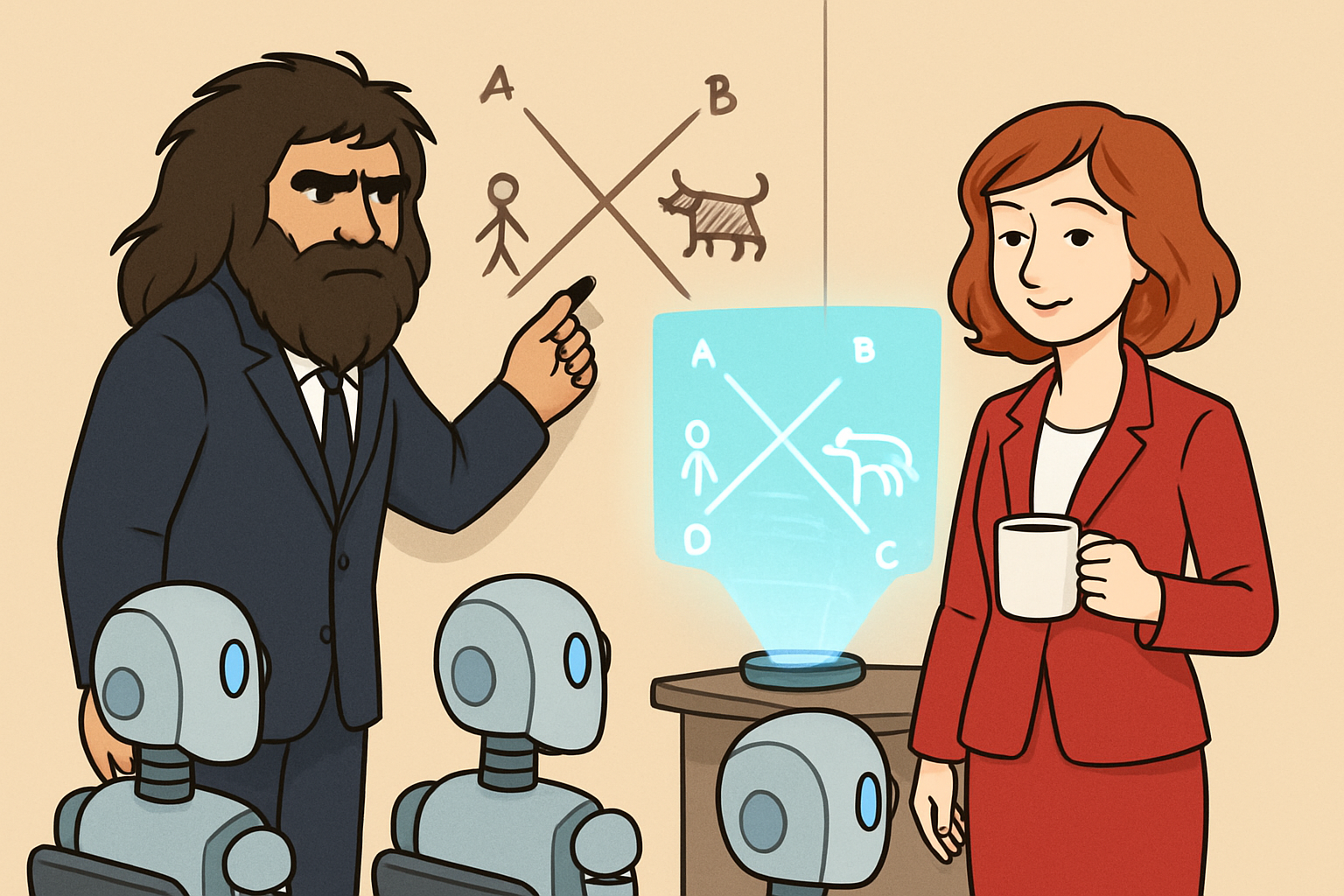
The fundamental shift in AI economics isn’t technological — it’s about who captures demand.
In traditional economics, human labor creates supply to meet human demand. You work, you get paid, you spend money on things other humans make. The circle completes itself.
In AI economics, machines create supply while humans still generate demand. But the machines are owned by capital, not by the people whose demand they’re serving.
Let me give you a concrete example. A traditional restaurant employs 15 people to serve 200 customers per day. The revenue gets distributed among owners, managers, cooks, servers, and suppliers — most of whom are human.
An AI-optimized ghost kitchen might serve the same 200 customers with 3 humans and a bunch of automated systems: inventory management AI, order prediction algorithms, robotic food preparation, automated delivery routing. Same demand, same revenue, but 80% fewer humans capturing value from the transaction.
Where does that displaced value go? To whoever owns the AI systems, the robots, and the algorithms.
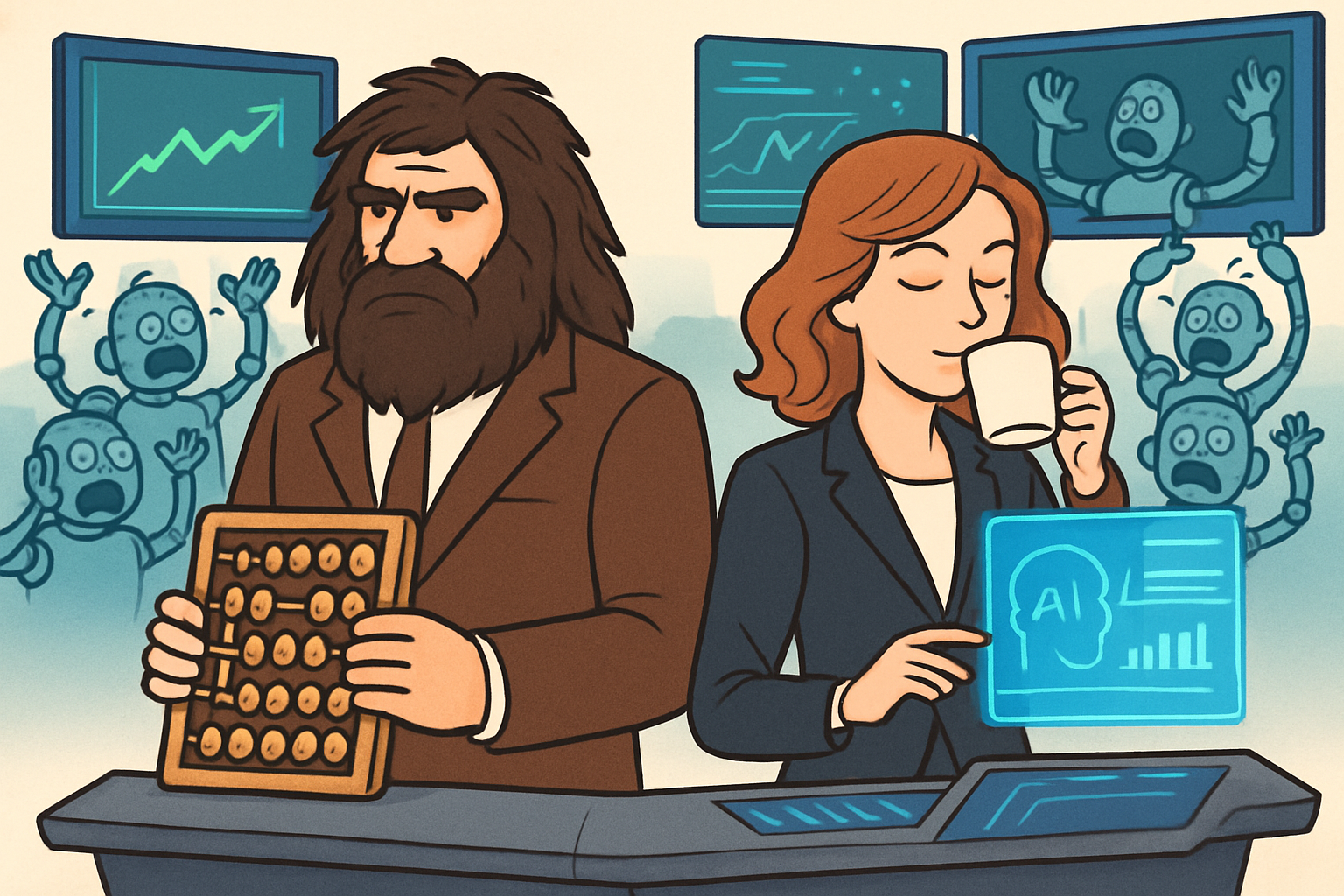
The Primitive Brain Versus AI Economics
Your brain is wired to think about AI the same way it thinks about any new technology: “How can I use this tool to do my job better?”
This is loss aversion disguised as adaptation. You’re trying to preserve your existing role instead of questioning whether your existing role will exist.
The primitive instinct is to compete with the machines on their terms. Learn to use AI tools. Become more efficient. Add AI skills to your resume. This is like learning to be a better typewriter repairman in 1985.
The contrarian approach is to think like the machines’ owners. Instead of asking “How do I compete with AI?” ask “How do I own AI-driven cash flows?”
Here’s what I mean. When I first started using AI tools in my investment research, my immediate reaction was excitement about becoming a more efficient analyst. I could process more data, generate more insights, make better decisions faster.
Then I realized I was optimizing for the wrong variable. The question isn’t whether AI makes me a better analyst. The question is whether being a better analyst matters when AI systems can analyze markets 24/7 without salary requirements, vacation time, or emotional biases.
Two Questions That Separate Owners From Obsolete
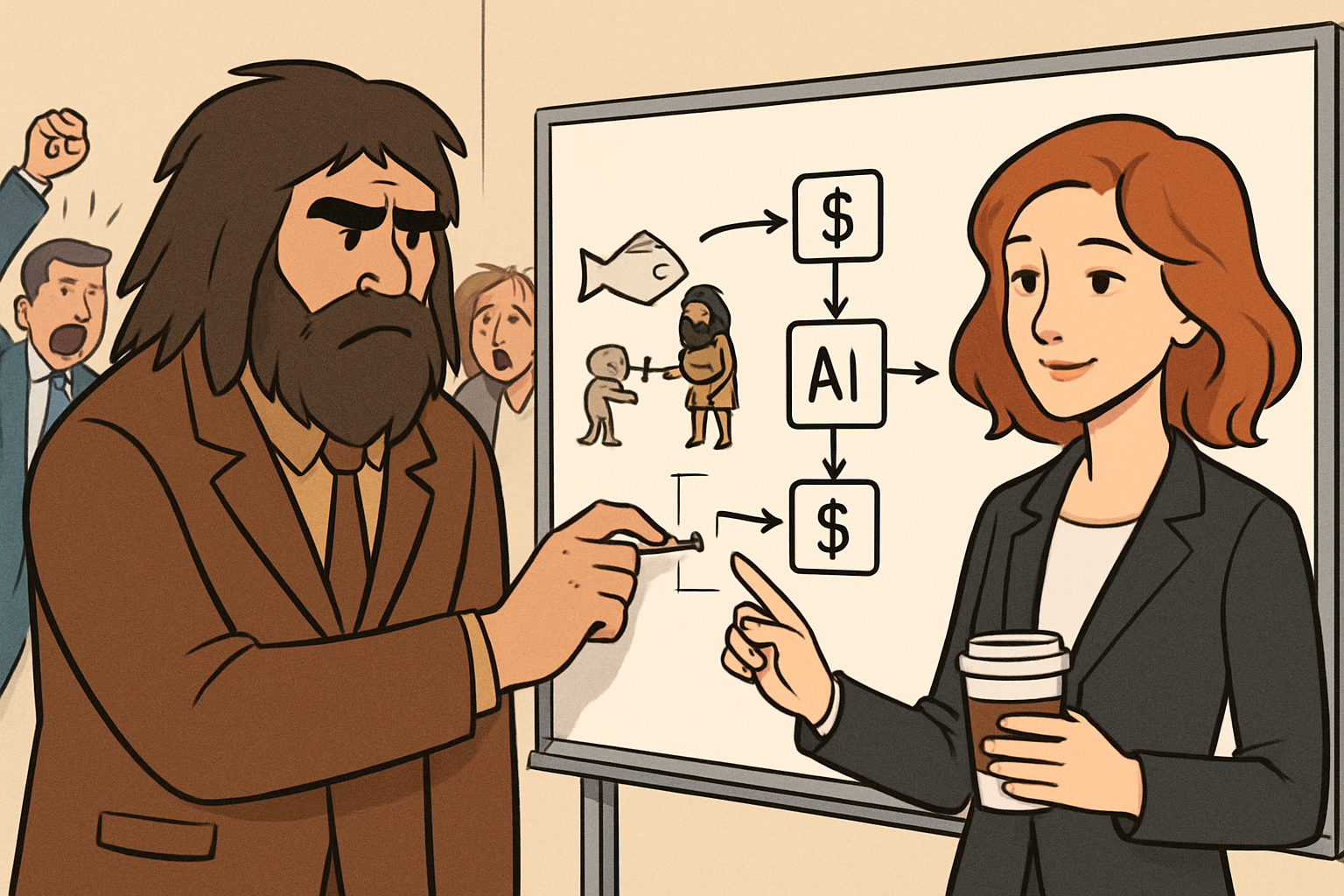
Every person navigating AI economics faces the same fork in the road. You can take the worker path or the owner path. Most people don’t even realize they’re choosing.
The worker path: “How do I use AI to do my current job better?”
The owner path: “How do I own systems that capture value as AI displaces human labor?”
Look. I’m not saying everyone needs to quit their job and start an AI company. That’s not realistic and it’s not necessary.
But you do need to start thinking like an owner instead of thinking like a worker. Because AI economics rewards ownership exponentially more than it rewards labor — even highly skilled, AI-augmented labor.
Here’s the practical difference. A worker asks: “Which AI certification should I get to stay relevant?” An owner asks: “Which companies will capture the most value as AI transforms this industry?”
A worker thinks: “I need to learn to prompt AI effectively.” An owner thinks: “I need to own the companies that sell AI services.”
A worker worries: “What if AI takes my job?” An owner realizes: “AI taking jobs means more profit for AI owners.”

The Capital Structure of AI Economics
Understanding AI economics means understanding where the cash flows actually go.
When you use ChatGPT, you’re not just getting answers. You’re contributing to a system that will eventually eliminate entire categories of human knowledge work. The value you help create through your usage gets captured by OpenAI’s investors, not by you.
When you order food through DoorDash, you’re not just getting convenient delivery. You’re feeding data to algorithms that will eventually optimize away the need for human drivers, human dispatchers, and human customer service. The efficiency gains get captured by DoorDash shareholders, not by the humans being optimized out of the system.
This isn’t a moral judgment. It’s a structural observation.
The companies building AI infrastructure — cloud computing, semiconductor manufacturing, data processing, algorithm development — are creating the equivalent of digital real estate. Everyone else will pay rent to use that infrastructure.
Between 2020 and 2023, Microsoft’s market capitalization grew from $1.4 trillion to over $2.8 trillion, largely driven by their Azure cloud business and AI investments. That’s not just stock price appreciation — that’s the market recognizing that Microsoft owns essential infrastructure in the AI economy.
Meanwhile, industries being transformed by AI show a different pattern. Traditional media companies have struggled while AI-native platforms capture attention and advertising dollars. Retail employment has declined while e-commerce algorithms optimize inventory and logistics.
The pattern is consistent: AI creates enormous value, but that value accrues to capital owners, not to displaced workers.
What The Primal Investor Takes Away
• Stop optimizing your labor for AI augmentation. Start buying equity in companies that capture value from AI displacement. Your job is not to compete with machines — it’s to own the cash flows machines generate.
• Recognize AI economics as a capital concentration mechanism. Every AI advancement transfers economic leverage from human workers to system owners. Position yourself on the owner side of this transfer.
• Focus on infrastructure over applications. The companies providing compute power, data storage, and AI development tools capture more sustainable value than companies using AI to optimize existing processes.
• Think in systems, not tools. AI isn’t just making individual tasks more efficient — it’s creating entirely new economic structures that route value to different recipients. Understand where the cash flows go.
• Embrace the primitive fear, then act opposite. Your instinct is to defend your current economic role. The contrarian move is to own the systems that make current economic roles obsolete.
The AI revolution isn’t coming — it’s here. The only question is whether you’ll spend the next decade working for the machines or owning them. Your primitive brain wants to compete. Your wallet wants you to own.
🎬 Prefer watching? Check out the video version on YouTube:
👉 https://www.youtube.com/@PrimalContrarian
Subscribe for daily insights on capital, wealth, and contrarian thinking.