The Great Sorting Has Already Begun
AI doesn’t replace jobs. It replaces the economic value of human time.
Everyone’s debating which jobs AI will kill first. Wrong question. The real question is this: when AI can do your work better, faster, and cheaper, what happens to the economic premise of trading hours for dollars?
Here’s what I’ve learned after watching three waves of automation gut entire industries: the people who survive economic transitions aren’t the ones with the best skills. They’re the ones who own the systems that benefit from change.
I used to think expertise was protection. In 2008, I watched mortgage brokers with 20 years of experience lose everything in six months. Their knowledge became worthless overnight. But the people who owned mortgage-backed securities? Some of them made fortunes shorting their own market.
The pattern repeats every time: disruption enriches owners and destroys workers.
Why Your Human Premium Is Evaporating
Think about what you get paid for. Really think about it.
Most white-collar work boils down to pattern recognition, information synthesis, and decision-making under uncertainty. In 2019, a human doing financial analysis charged $200 per hour because that work required years of training and cognitive effort.
Today, GPT-4 can analyze a company’s financials in 30 seconds. Claude can write investment memos that pass for human work. AI can now perform tasks that took me four years of finance education to learn.
The human premium—the extra value you command for being human—is collapsing across knowledge work. This isn’t happening in 2030. It’s happening now.
Between 2023 and 2024, companies cut 40% more jobs despite posting record profits. They’re not replacing workers with other workers. They’re replacing entire departments with AI systems.
The Capital Acceleration Effect
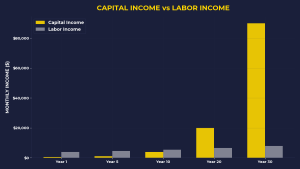
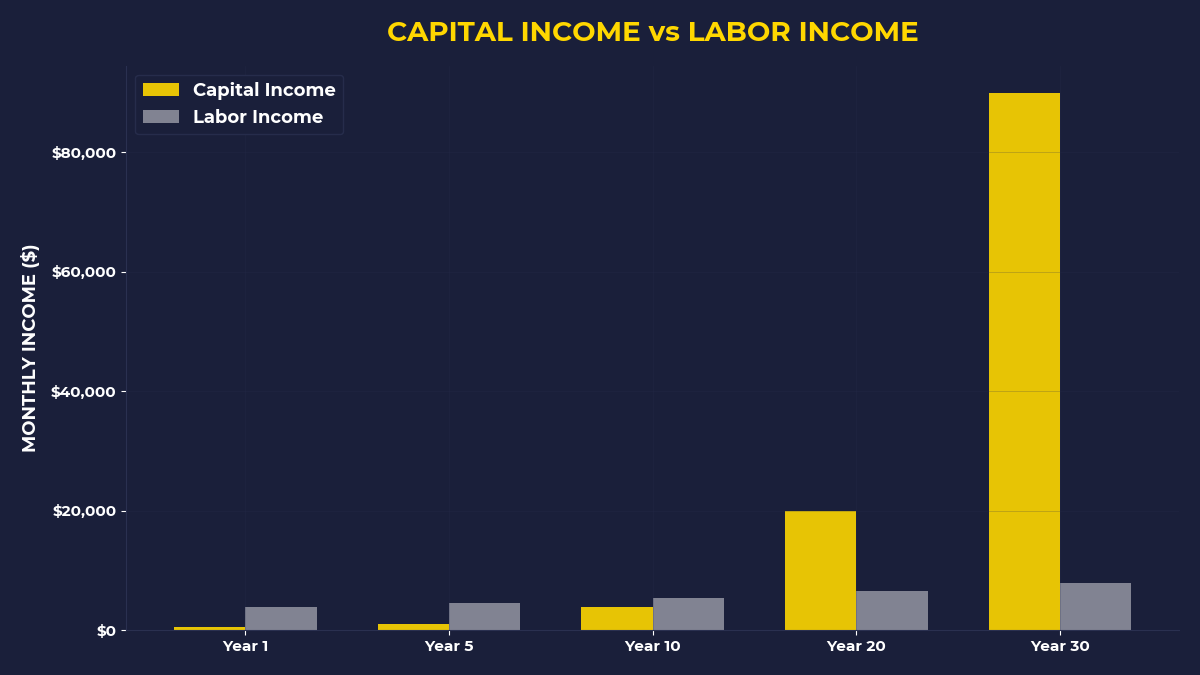
Here’s the part everyone misses about AI economics: it doesn’t just replace labor. It supercharges capital.
When Netflix automated video recommendations in 2006, they didn’t just fire the people who used to suggest movies. The algorithm made every dollar of Netflix’s content investment 10 times more valuable by matching viewers with content they’d actually watch.
AI amplifies the return on capital by orders of magnitude. A manufacturing company that invests $1 million in AI-powered automation doesn’t just save on labor costs—it can run 24/7, optimize inventory in real-time, and predict maintenance before breakdowns occur.
Capital gets smarter. Labor gets cheaper.
The companies deploying AI aren’t just cutting costs—they’re creating winner-take-all advantages. Amazon’s AI doesn’t just recommend products; it predicts what you’ll buy before you know you want it. That’s not efficiency. That’s economic domination.
What I Learned From Missing the Internet Boom
I was 28 in 1998 when Amazon went public. The stock seemed insanely overvalued at $18 per share.
I understood the internet. I knew e-commerce would grow. But I made the classic mistake of thinking about Amazon as a bookstore that happened to be online, not as a capital allocation machine that happened to sell books.
While I debated whether Amazon was “worth” $18, Jeff Bezos was using every dollar of investment to build the infrastructure that would define retail for the next 25 years. He wasn’t building a bookstore. He was building capital that could compound indefinitely.
That $18 stock hit $3,000 by 2021. Not because books got more valuable, but because Bezos turned early investment into a self-reinforcing system of capital accumulation.
AI is following the same pattern. The companies building AI infrastructure today aren’t just creating products—they’re creating the economic rails that everyone else will pay to use.
The Two-Class Economy Is Already Here
Look around. The economic divide isn’t between rich and poor anymore. It’s between people who own systems and people who are operated by systems.
Uber drivers don’t work for Uber—they work for an algorithm that sets their routes, rates, and schedules. The algorithm captures most of the value. The humans provide the labor.
Content creators don’t work for YouTube—they feed an AI that decides what content gets seen, which creators get promoted, and how much revenue each video generates. The platform owns the demand. The creators supply the content.
This is the future of AI economics: humans as inputs to systems they don’t own.
The antidote is simple but uncomfortable: stop being an input. Start owning the systems.
Why Everyone Else Gets Your AI Productivity Gains
Here’s the cruel economics of AI: if you use AI to become more productive at your job, you don’t capture the value. Your employer does.
Let’s say you’re a marketing manager who learns to use AI tools that let you produce in 4 hours what used to take 40. Congratulations—you’ve just made yourself 10 times more efficient.
What happens next? Your company either gives you 10 times more work for the same salary, or they realize they only need one marketing manager instead of ten.
The productivity gains flow to the capital owner, not the worker. Always.
But flip the equation: if you own stock in the company that deploys AI to increase productivity by 10x, you capture that value as a shareholder. The same AI that threatens your job enriches your portfolio.
The Capital Question in the AI Era
Every financial decision now comes down to one question: does this put me on the side that benefits from AI disruption, or the side that gets displaced by it?
Saving money in high-yield accounts? You’re preserving purchasing power while AI deflates the value of human time.
Investing in skills training? You’re trying to outrun automation instead of profiting from it.
Buying index funds that include AI companies? You’re positioning yourself to benefit from the productivity explosion.
Starting a business that leverages AI to create defensible systems? You’re building capital that compounds as AI gets more powerful.
The AI revolution isn’t about technology. It’s about who captures the value that technology creates.
What The Primal Investor Takes Away
• Stop trying to AI-proof your job. Start buying companies that profit from AI displacement.
• Your skills are depreciating assets. Your ownership stakes in AI-leveraged businesses are appreciating ones.
• Every dollar you spend on consumption is a dollar that doesn’t work for you in the capital acceleration. Prioritize ownership over optimization.
• The companies building AI infrastructure today will extract rent from everyone else tomorrow. Own the infrastructure, not the applications.
• AI makes labor abundant and capital scarce. Position yourself on the scarce side of that equation.
Your paycheck represents the past—when human time had irreplaceable value. Your capital represents the future—when systems generate value independently of human input. The transition is happening whether you participate or not.
🎬 Prefer watching? Check out the video version on YouTube:
👉 https://www.youtube.com/@PrimalContrarian
Subscribe for daily insights on capital, wealth, and contrarian thinking.