Marcus — 29, software developer in Seattle — called me last Tuesday night, voice tight with anxiety. “I just watched another demo of GPT-4 writing better code than I can. Should I be worried about my job?”
Wrong question entirely.
While Marcus obsesses over protecting his paycheck, the real story is happening three floors up in his own building. His company’s executives are asking a different question: “How do we use AI to replace ten Marcus’s with one system?” They’re not worried about AI taking their jobs. They’re figuring out how to own the AI that takes everyone else’s.
I Used to Ask the Same Wrong Question
I know exactly how Marcus feels because I was there in 2016. Netflix’s recommendation algorithm had just gotten scary-good at predicting what people wanted to watch. I was freelancing as a content strategist, and I spent weeks spiraling about whether AI would replace writers.
Here’s what I missed completely: Netflix’s stock went from $80 to over $400 in the next five years.
The people who owned Netflix stock didn’t care that AI was changing how content got created. They cared that AI was making Netflix more valuable. Every algorithm improvement meant higher subscriber retention. Every personalized recommendation meant lower customer acquisition costs. Every efficiency gain flowed straight to shareholders.
I was asking “Will AI take my job?” when I should have been asking “How do I own a piece of the AI that’s reshaping everything?”
Why Everyone Focuses on Jobs Instead of Capital
Think about how this conversation always goes. Someone mentions AI, and immediately everyone starts talking about which jobs will disappear. Truck drivers, radiologists, customer service reps, lawyers — the list goes on.
But here’s what nobody mentions: every job that AI eliminates represents massive cost savings for someone. And those cost savings don’t just evaporate into thin air. They flow to capital owners.
When ChatGPT helps a company answer customer inquiries without hiring three support staff, that’s $180,000 in annual salary savings flowing somewhere. When AI helps a logistics company optimize routes and cut fuel costs by 15%, that’s millions in savings flowing somewhere.
Where does it flow? To the people who own equity in those companies.
The AI capital transfer isn’t some future event. It’s happening right now, every single day, in thousands of companies making their operations more efficient through artificial intelligence.
What the Smart Money Already Knows
I learned this the hard way in 2020. My friend Sarah — 35, marketing director for a mid-size retailer — got laid off when her company implemented AI-powered ad optimization. The algorithm could do in two hours what took her team two days.
Sarah spent six months job hunting, terrified that AI had made her obsolete.
Meanwhile, her former company’s gross margins improved by 8% that quarter. Stock price went up 23%. The CEO got a bonus.
Sarah was focused on getting another job. But the real question was: why didn’t she own a piece of the company that was benefiting from AI efficiency gains?
This is the fundamental split happening in the economy right now. Workers are trying to protect their jobs from AI. Capital owners are using AI to make their assets more valuable.
Guess which group is winning.
The Two-Tier System AI Is Creating
Look, I’m not saying jobs don’t matter. Of course they do. You need income to live. But if you’re only thinking about protecting your paycheck, you’re missing the bigger game.
AI creates two distinct economic classes:
**The Obsolete**: People whose primary value comes from their labor. They compete directly with AI systems that get better and cheaper every month. Even if they keep their jobs, their bargaining power shrinks as AI alternatives improve.
**The Owners**: People who own equity in companies deploying AI. Every efficiency gain, every cost reduction, every productivity improvement flows to them as increased asset values and dividend payments.
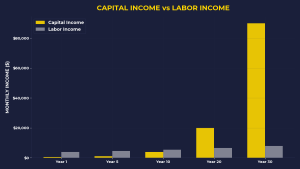
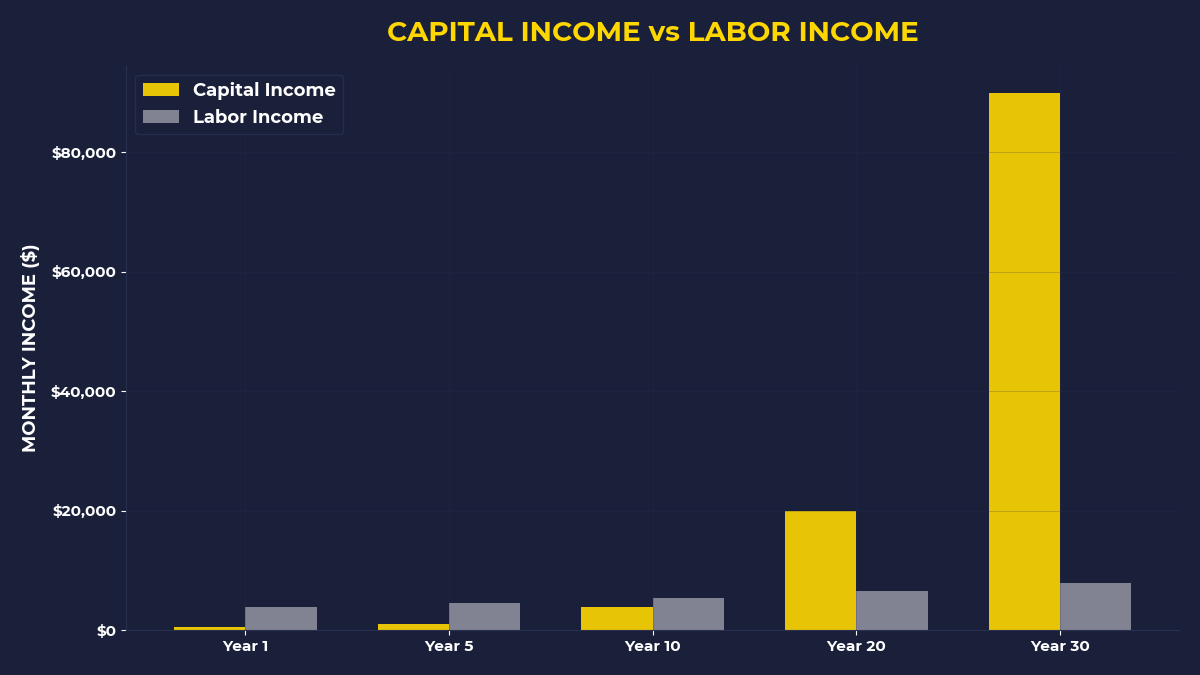
The wealth gap between these two groups isn’t growing gradually. It’s exploding exponentially, because AI improvements compound.
When a company replaces one worker with AI, that’s a one-time cost savings. But when that AI system learns and improves, handling more complex tasks and replacing additional workers? That’s compound savings flowing to the same capital owners.
Why Your Emergency Fund Won’t Save You
Here’s where most financial advice misses the point entirely. The standard recommendation is to build an emergency fund, update your skills, and “stay relevant” in the job market.
That’s defensive thinking in an offensive game.
Marcus has $15,000 sitting in his savings account “just in case.” That money earns maybe 0.5% while inflation runs at 4%. He’s literally paying to be prepared for a future where his skills become obsolete.
But what if Marcus used that $15,000 differently? What if instead of preparing for unemployment, he positioned himself to benefit from the same AI revolution that might eliminate his job?
$15,000 invested in companies building and deploying AI could grow into something that replaces his salary entirely. Not in 30 years — in maybe 10 or 15, as AI adoption accelerates.
The Question That Changes Everything
Are you ready for this? The question that separates future capital owners from future economic refugees isn’t “How do I protect my job from AI?”
It’s “How do I own a piece of the AI revolution before everyone else figures it out?”
This means buying equity in companies that use AI to eliminate costs, increase efficiency, or create new forms of demand. Not companies that might benefit someday — companies already deploying AI to improve their bottom line today.
When I finally made this mental shift in 2021, everything changed. Instead of worrying about AI threatening my consulting work, I started buying shares in companies using AI to serve customers better and cheaper. Every improvement to their AI systems increased the value of my ownership stake.
Now when ChatGPT gets an upgrade, I don’t panic about competition. I check my brokerage account to see how much my Microsoft shares went up.
What This Looks Like in Practice
If you’re someone who lies awake at night wondering whether AI will make you obsolete, I understand. The fear is real because the threat is real.
But fear without action is just anxiety. And the wrong action — like hoarding cash or trying to compete with machines — is almost worse than no action.
The right action is surprisingly simple: stop trying to beat AI and start owning it instead.
Every dollar you spend defending against AI disruption is a dollar you’re not investing in AI opportunity. Every month you delay buying equity in AI-driven companies is a month you miss the compounding returns of technological disruption.
The AI capital transfer is the biggest wealth creation event since the internet. But unlike the internet boom, this one is happening faster and with more obvious winners.
The One Thing to Remember
While 97% of workers worry about AI taking their jobs, smart money is buying equity in the companies using AI to replace workers. The wealth created by AI efficiency gains has to go somewhere — and it flows to capital owners, not wage earners. The question isn’t whether AI will disrupt your industry, but whether you’ll own a piece of that disruption before everyone else catches on.
- Before you spend another dollar on “upskilling” courses, put that money into companies already using AI to cut costs and increase profits
- Stop thinking about AI as a job threat and start researching which companies in your industry are using AI most aggressively
- Ask yourself: “Do I own equity in companies that benefit when human labor gets more expensive?” If not, that’s your first investment priority
🎬 Prefer watching? Check out the video version on YouTube:
👉 https://www.youtube.com/@PrimalContrarian
Subscribe for daily insights on capital, wealth, and contrarian thinking.