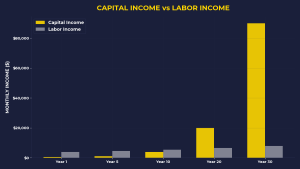
The primal investor understands something most never grasp: there is a mathematical ceiling on human effort, but no ceiling on capital multiplication. When Warren Buffett collected golf balls as a child and sold them for $6 per dozen, he was not building a career in golf ball retrieval. He was constructing his first leverage system—one that would teach him the fundamental difference between addition and multiplication in wealth creation.
Labor adds. Capital multiplies. This is not motivational rhetoric; it is structural mathematics. The wage earner can work twice as hard to earn twice as much, but the capital owner can deploy the same principle across ten systems to earn ten times as much without proportional effort. Understanding this distinction is not academic—it is the difference between a life spent selling time and a life spent buying it back.
The Golf Ball Principle: From Linear to Exponential
Consider Buffett’s childhood enterprise more carefully. Initially, he worked linearly: find lost golf balls, clean them, sell them for profit. One hour of work produced X dollars. Double the hours, double the revenue. This is the addition model that governs most human economic activity.
But the real lesson emerged when Buffett used his golf ball profits to purchase his first rental car—a Rolls-Royce he leased to others. Suddenly, the mathematics changed. The car generated income while Buffett slept. The same capital deployed across multiple vehicles created multiple income streams without proportional increases in his personal time investment.
The structural insight: **capital systems work in parallel, while labor works in sequence**. A worker can focus on one task at a time. A capital owner can own ten businesses simultaneously, each operating independently, each contributing to the total return.
Why Your Brain Sabotages Multiplication Thinking
The human brain evolved for immediate survival, not wealth accumulation. This creates systematic errors in how we approach capital building. The most destructive is **linear bias**—the primitive tendency to assume that more effort directly equals more results in a one-to-one relationship.
Linear bias explains why most people instinctively think: “If I work harder, I’ll make more money.” This logic works within the wage system but fails completely in capital formation. The capital owner thinks differently: “If I deploy my capital across more high-quality systems, those systems will generate more total cash flow.”
Consider the coin-operated scale story that influenced young Buffett. Harry Larson noticed that seven people used a pharmacy’s weight scale in minutes. Rather than thinking “I should stand here all day taking coins,” he thought “I should own multiple scales in multiple locations.” The first thought is linear; the second is multiplicative.
The Compound System Architecture
What Larson built was not a business but a **compound system**. He bought his first scale for $175, generating $20 monthly income. But instead of consuming that $20, he used it to purchase additional scales. Each scale operated independently. Each generated cash flow. Each cash flow purchased additional scales.
The mathematics become dramatic: one scale generates $20/month. Two scales generate $40/month. Ten scales generate $200/month. But here’s the critical insight—managing ten scales requires marginally more effort than managing one scale, while generating ten times the return.
The Leverage Question: Systems vs. Effort
The wage earner asks: “What should I do to make money?” The capital builder asks: “What should I buy to make money?” This is not semantic difference; it represents entirely different approaches to wealth creation.
When Buffett later purchased farmland, he was not becoming a farmer. He was buying a system that converted land, weather, and agricultural demand into cash flow. When he purchased stocks, he was not becoming a corporate executive. He was buying fractional ownership in systems that converted customer demand into shareholder returns.
The leverage principle works because capital systems can be replicated and scaled without linear increases in personal oversight. A property owner can own 100 rental units through property management companies. A stock investor can own pieces of 50 companies through brokerages. Each system operates independently while contributing to total returns.
The Structural Advantage of Ownership
Consider why celebrities earn millions while skilled workers earn wages. A singer records a song once, but that song can be purchased millions of times. The initial effort is finite; the revenue potential is unlimited. This is not talent inequality—it is structural advantage.
The singer owns the intellectual property rights to their work. Each time someone pays for that content, cash flows to the owner. The construction worker, no matter how skilled, cannot sell the same hour of labor to multiple customers simultaneously. Their effort cannot be multiplied across parallel revenue streams.
Why Most People Build Addition Machines Instead
The structural difference between addition and multiplication explains why most people never accumulate significant capital despite working their entire lives. They build addition machines: more hours, higher wages, additional qualifications. Each improvement creates linear increases in income.
But addition machines have mathematical ceilings. There are only 24 hours in a day. Human energy is finite. Skills have market-determined wage ranges. No matter how optimized, addition systems eventually hit capacity constraints.
Multiplication machines—capital systems—have no such constraints. A real estate portfolio can expand across multiple markets. A stock portfolio can include hundreds of companies. An intellectual property portfolio can generate income across decades. The primary constraint is not time or energy but access to quality investment opportunities and the discipline to reinvest returns rather than consume them.
The Compound Reinvestment Discipline
The critical behavioral requirement for wealth multiplication is **compound reinvestment discipline**. This means using capital returns to purchase additional capital rather than increasing consumption. Most people fail here because of present bias—the primitive tendency to value immediate gratification over future wealth accumulation.
Buffett’s childhood approach demonstrates this discipline. Golf ball profits purchased rental assets. Rental income purchased additional assets. Each cash flow cycle expanded the total capital base rather than funding lifestyle inflation.
The Regime Shift: From Time-Seller to Capital-Owner
The transition from addition to multiplication requires a fundamental regime shift in thinking. The wage earner optimizes for hourly productivity. The capital owner optimizes for system quality and capital deployment efficiency.
This shift is structural, not incremental. It requires moving from “How can I earn more per hour?” to “How can I own systems that generate returns independent of my time?” The first question leads to career optimization. The second leads to wealth accumulation.
The 2008 financial crisis illustrated this distinction clearly. Wage earners who lost jobs lost their primary income source. Capital owners who owned quality assets—stocks in strong companies, real estate in desirable locations, intellectual property—continued receiving cash flows even while unemployment spiked to 10%.
Building Your First Multiplication System
The practical application begins with capital allocation discipline. Instead of consuming every dollar earned, the aspiring capital owner diverts a percentage toward asset purchases. These assets must have one crucial characteristic: they must generate cash flow independent of the owner’s daily involvement.
Public stocks represent fractional ownership in business systems. REITs provide exposure to real estate cash flows without property management requirements. Index funds offer diversified exposure to hundreds of cash-generating businesses simultaneously. Each represents a form of multiplication system—capital deployed across enterprises that operate independently while generating owner returns.
What The Primal Investor Takes Away
Addition has ceilings; multiplication does not. Labor-based income is constrained by time and energy. Capital-based income can scale across multiple systems without proportional effort increases.
Capital systems work in parallel while human effort works in sequence. One person can own fractional interests in hundreds of businesses, each operating simultaneously and contributing to total returns.
The critical question shifts from “what work should I do?” to “what assets should I own?” Wealth accumulation requires deploying capital into systems that generate returns independent of personal time investment.
Compound reinvestment discipline distinguishes wealth builders from income optimizers. Using capital returns to purchase additional capital creates exponential growth that eventually dwarfs wage-based income.
Linear bias sabotages wealth thinking. The primitive assumption that effort and results scale proportionally prevents most people from understanding and implementing multiplication strategies.
Quality asset selection matters more than quantity of effort. One excellent business investment can generate more lifetime wealth than decades of wage optimization.
The primal investor recognizes that true wealth comes not from working harder but from owning better. Capital multiplies because it can be deployed across multiple systems simultaneously. Labor adds because human effort remains bound by time and physical constraints. Understanding this distinction is the first step toward building multiplication systems rather than optimizing addition machines.
🎬 Prefer watching? Check out the video version on YouTube: