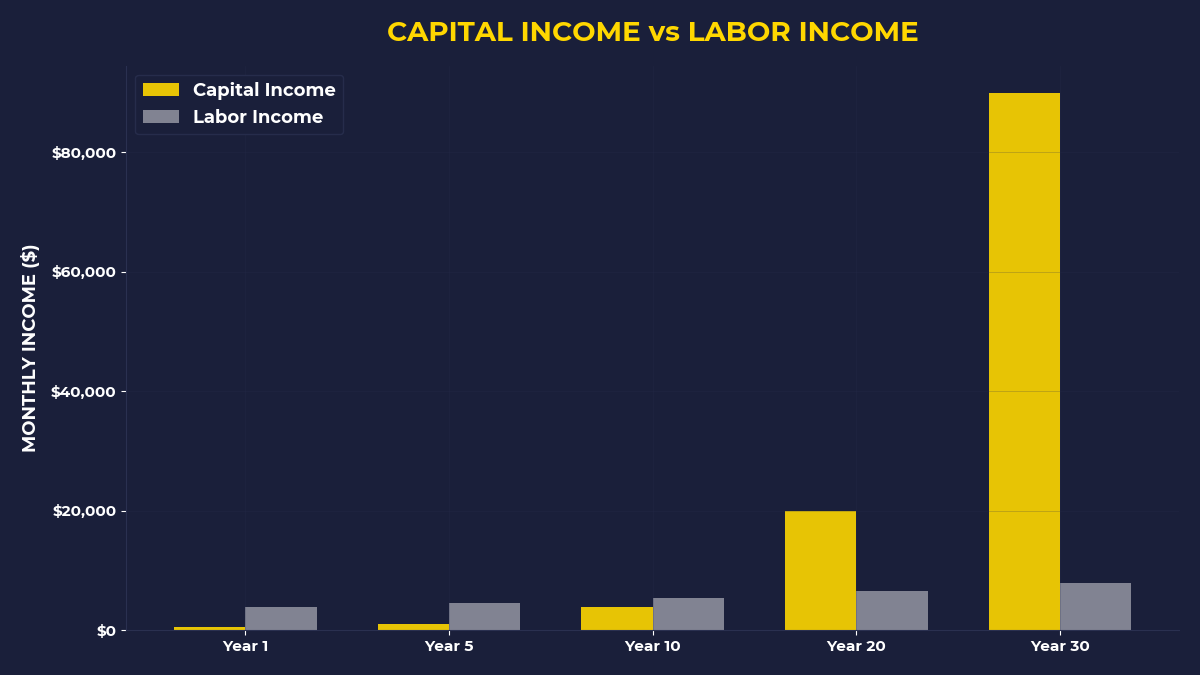
Every Monday morning, millions of people wake up to build other people’s dreams. They clock in, execute tasks, collect paychecks — and wonder why they never seem to get ahead. The answer lies in a fundamental misunderstanding about what creates wealth. We’ve been taught to ask “What work should I do?” when the real question is “What should I buy?”
The asset nobody teaches you to buy isn’t stocks, bonds, or real estate. It’s something more fundamental: demand storage systems. These are structures that capture human need and convert it into cash flow while you sleep. The wealthy understand this instinctively. The working class never learns it at all.
This isn’t about picking the right mutual fund or timing the market. It’s about understanding why Warren Buffett collected golf balls as a child and why that simple act contained the blueprint for building generational wealth.
Why Famous Singers Get Rich While Hard Workers Stay Poor
Consider why a popular singer earns millions while a construction worker — who contributes more tangible value to society — earns a modest wage. The difference isn’t effort, talent, or even social value. It’s structural. The singer owns a demand storage system: their songs continue generating royalties decades after creation. The construction worker sells time for money, one hour at a time.
This reveals the primitive instinct that keeps most people trapped: loss aversion disguised as prudence. We fear investing in assets because we might lose our “safe” money today. Meanwhile, we accept the guaranteed loss of selling our time for wages tomorrow. The primal investor recognizes this mental trap and inverts it.
Capital isn’t money sitting in a bank account. Capital is stored demand — the right to capture human need as it expresses itself economically. When you buy shares of Apple, you’re not buying a piece of metal and glass manufacturing. You’re buying a piece of humanity’s persistent demand for communication tools.
The Golf Ball Principle: Warren Buffett’s First Compound Machine
Young Warren Buffett didn’t just collect lost golf balls — he built his first demand storage system. He identified a gap: golfers lost balls, but still needed balls. He positioned himself between the demand (golfers) and the supply (lost balls in the woods). Twelve balls for six dollars represented his first taste of extracting value from stored demand.
But the real insight came later. Buffett took that six dollars and bought more assets — rental car businesses, farms, eventually stocks. Each asset purchase was the same principle scaled up: buy something that stores demand and converts it to cash flow. Then use that cash flow to buy more demand storage systems.
This is what compound interest actually means in practice. It’s not a mathematical concept — it’s a structural one. You compound by owning systems that generate cash, then using that cash to own more systems. The magic isn’t in the interest rate; it’s in the ownership structure.
The Scale Machine
The story of Harry Larson illustrates leverage within demand storage. Larson observed people using a coin-operated scale in a pharmacy. Instead of dismissing it as trivial, he calculated: if one scale generates $20 monthly profit for the pharmacy owner, what would 70 scales generate? He bought one scale with $175, used its cash flow to buy a second, then a third. Eventually, he owned 70 scales generating $1,750 monthly — in 1930s dollars.
The key wasn’t working harder. It was working through assets. Each scale operated independently, capturing demand without Larson’s direct involvement. This is leverage: your assets work while you sleep.
Why Your Bills Are Capital Transfer Mechanisms
Every monthly bill you pay represents a capital transfer to someone else’s demand storage system. Your rent flows to a real estate owner. Your utilities flow to infrastructure owners. Your streaming subscriptions flow to content platform owners. Your coffee purchase flows to brand and location owners.
The devastating pattern: you pay everyone else’s assets before you buy your own. This is the herding instinct in action — following the social script of consumption before investment. The primal investor inverts this sequence. As Robert Kiyosaki learned while living in a garage, you pay yourself first by buying assets, then figure out how to cover bills afterward.
This forces creative problem-solving. Instead of automatically accepting lifestyle inflation, you’re forced to find additional income sources or optimize spending. The psychological pressure creates wealth-building momentum that comfortable consumption never generates.
The Creative Labor Trap
Here’s the cruel paradox: humans are naturally creative beings, but lack of capital forces us into repetitive labor. Without assets generating base-level income, all our energy goes to survival work. We build other people’s visions because we lack the economic freedom to build our own.
This isn’t just about money — it’s about time sovereignty. When you own demand storage systems, you reclaim discretionary time. That time can be deployed toward creative projects that compound your advantage further. It’s a positive feedback loop that most people never enter because they never buy their first asset.
The difference between building your own house and helping build someone else’s house captures the essence of capital ownership. One creates lasting value you control; the other creates temporary income you immediately consume.
The Monday Morning Test
Ask yourself: what would you do if you had complete time freedom? Most people answer with consumption activities — travel, hobbies, relaxation. But after the initial novelty, creative impulses emerge. You’d want to build something meaningful. Capital ownership doesn’t guarantee creativity, but it creates the conditions where creativity becomes possible.
Why Asset Allocation Misses the Point
Traditional investment education focuses on asset allocation: how much in stocks versus bonds, domestic versus international, growth versus value. This misses the fundamental question: are you buying demand storage systems or just financial instruments?
A stock index fund is a demand storage system — you own pieces of companies that solve human problems profitably. A bond is typically not — you’re lending money to someone else’s demand storage system. Real estate can be either, depending on whether it captures ongoing demand (rental income) or just appreciation hopes.
The primal investor asks: does this asset position me to capture persistent human demand? If yes, how much cash flow does it generate? If the answer is “none directly, but it should appreciate,” you’re speculating, not storing demand.
The Regime Question
We don’t predict whether stocks will go up or down next year. We ask: what regime are we in, and what types of demand storage systems thrive in this regime? In an inflationary regime, assets that can raise prices (brands, scarce resources, pricing power businesses) outperform. In a deflationary regime, assets with fixed costs and variable revenues suffer while cash-generative businesses with low fixed costs thrive.
This structural thinking beats timing. You position yourself to benefit from the regime, regardless of short-term price movements.
The Implementation Framework
Start with this mindset shift: every financial decision is either buying demand storage or consuming stored value. Your salary represents someone else’s demand storage system paying you to help operate it. The question becomes: what percentage of that payment do you redirect toward your own demand storage systems?
The minimum viable approach: systematically buy pieces of the most successful demand storage systems on Earth through index funds. The S&P 500 represents 500 of the most effective demand capture mechanisms ever created. When you buy the index, you own a slice of Apple’s ecosystem lock-in, Microsoft’s software monopolies, Amazon’s logistics network.
The accelerated approach: build your own demand storage system through side projects or small businesses. The key insight from the golf ball story: you don’t need to create demand — just position yourself between existing demand and available supply. This could be as simple as identifying inefficiencies in existing markets and creating solutions.
The Leverage Decision
Once you own one demand storage system generating positive cash flow, you face the leverage decision: do you scale this system or diversify into other systems? Harry Larson scaled one system (coin-operated scales) to 70 units. Buffett diversified across systems (from golf balls to rental cars to stocks). Both approaches work; the key is using cash flow from existing assets to acquire more assets, not to fund consumption.
What The Primal Investor Takes Away
Capital is stored demand, not money. Look for assets that capture persistent human needs and convert them to cash flow.
Buy assets before paying bills. This forces creative problem-solving and prevents lifestyle inflation from consuming investment capital.
Your job is operating someone else’s demand storage system. The goal is building your own while contributing to theirs.
Compound through ownership, not just returns. Use cash flow from assets to buy more assets, creating a self-reinforcing wealth system.
Ask “what should I buy?” not “what should I do?” This mental shift moves you from labor to capital, from working harder to working through assets.
Time freedom enables creative freedom. Assets buy back your time, which you can then deploy toward higher-leverage activities.
The wealthy don’t work harder — they work through better structures. The one asset nobody teaches you to buy is the capacity to capture demand while you sleep. Everything else is just implementation details.
🎬 Prefer watching? Check out the video version on YouTube: