The $47,000 Misunderstanding That Keeps You Poor
The median American household has $47,000 sitting in bank accounts and CDs, earning 0.5% annually while inflation runs at 3.2%. They call this their “capital.” They are catastrophically wrong.
Capital isn’t the money you save. Capital is the structure that captures demand and converts it into cash flow that flows to you while you sleep. The difference between these two definitions is the difference between working until you die and retiring at 45.
I learned this the expensive way. In 2019, I had $180,000 in savings accounts, thinking I was building capital. I felt responsible, conservative, smart. Meanwhile, my friend bought three rental properties with 20% down payments. His $180,000 bought him $900,000 worth of assets that generated $4,200 monthly. My $180,000 generated $75 monthly and lost purchasing power daily.
He owned capital. I owned currency.
Why Pop Stars Make Millions While Engineers Stay Broke
Here’s what finally cracked the code for me. I was wondering why a mediocre pop singer makes $50 million annually while a brilliant software engineer caps out at $400,000. The engineer works harder, creates more value, solves actual problems. The pop singer lip-syncs to auto-tuned nonsense.
The answer isn’t talent. It’s capital structure.
The pop singer owns a piece of stored demand. Millions of people want to hear that song, watch that performance, buy that merchandise. That demand gets captured in recording contracts, streaming royalties, concert venues, brand partnerships. The demand flows to the pop star’s bank account 24/7, whether she’s sleeping, shopping, or getting drunk in Ibiza.
The engineer trades time for money. No matter how brilliant, there are only 2,080 working hours in a year. His income is capped by his hours. The pop star’s income is capped by global demand, which is functionally unlimited.
Capital is stored demand with a distribution mechanism.
The Bills That Reveal Your Position in the Economic Food Chain
Look at your monthly expenses. Every line item is an invoice from a capital owner.
Your mortgage payment flows to someone who owns the demand for shelter in your neighborhood. Your car payment flows to someone who owns the demand for transportation. Your Netflix subscription flows to someone who owns the demand for entertainment. Your grocery bill flows to someone who owns the demand for food distribution.
You are the demand. They own the structure that captures it.
This realization hit me like a freight train in 2020. I calculated that I was paying $4,800 monthly to various capital owners — rent, car payment, utilities, subscriptions, insurance. That’s $57,600 annually flowing from my checking account to their investment accounts. I was a cash flow generator for other people’s capital.
Most people never flip this equation. They spend their entire lives being the demand that flows to capital owners, never becoming capital owners themselves.

What Warren Buffett’s Golf Balls Teach About Real Capital
When Warren Buffett was 11, he collected lost golf balls from local courses and sold them for 50 cents each. He could find 12 balls in an afternoon and make $6. Good money for an 11-year-old in 1941.
But here’s what made it capital: Buffett didn’t just work harder to find more golf balls. He hired other kids to find golf balls while he focused on the sales and distribution system. The demand for cheap golf balls was consistent. The supply was predictable. The operation could scale without his direct labor.
The golf balls weren’t the capital. The system that captured golfer demand and converted it to cash flow was the capital.
Later, Buffett used the profits to buy pinball machines and place them in barbershops. The machines generated quarters 24/7 while Buffett was in school. By age 14, he was earning more from his capital than most adults earned from their jobs.
The progression was always the same: identify demand, build a structure to capture it, use the cash flow to acquire more demand-capturing structures.
Why Your Emergency Fund Is Actually an Emergency
Financial advisors tell you to keep 6 months of expenses in a savings account. This is wealth destruction advice disguised as prudence.
Let’s say you need $60,000 for your emergency fund. In a 1% savings account, this generates $600 annually while losing purchasing power to inflation. You’re paying roughly $1,500 per year in opportunity cost to hold this “safety.”
That same $60,000 could buy you a 20% stake in a profitable small business generating $12,000 annually. Or shares in dividend-paying companies yielding 4-6% plus growth. Or rental property generating monthly cash flow.
I know what you’re thinking: “But what if I need the money?”
Here’s the thing. Capital generates the cash flow that prevents emergencies. When you own pieces of demand-capturing structures, money flows to you monthly. You’re less likely to need emergency funds because you have emergency cash flow.
The emergency fund mindset is employee thinking. Capital owner thinking is: build cash-generating assets that make emergencies irrelevant.

The Question That Separates Owners From Workers
Workers ask: “What should I do to make more money?”
Capital owners ask: “What should I buy to capture more demand?”
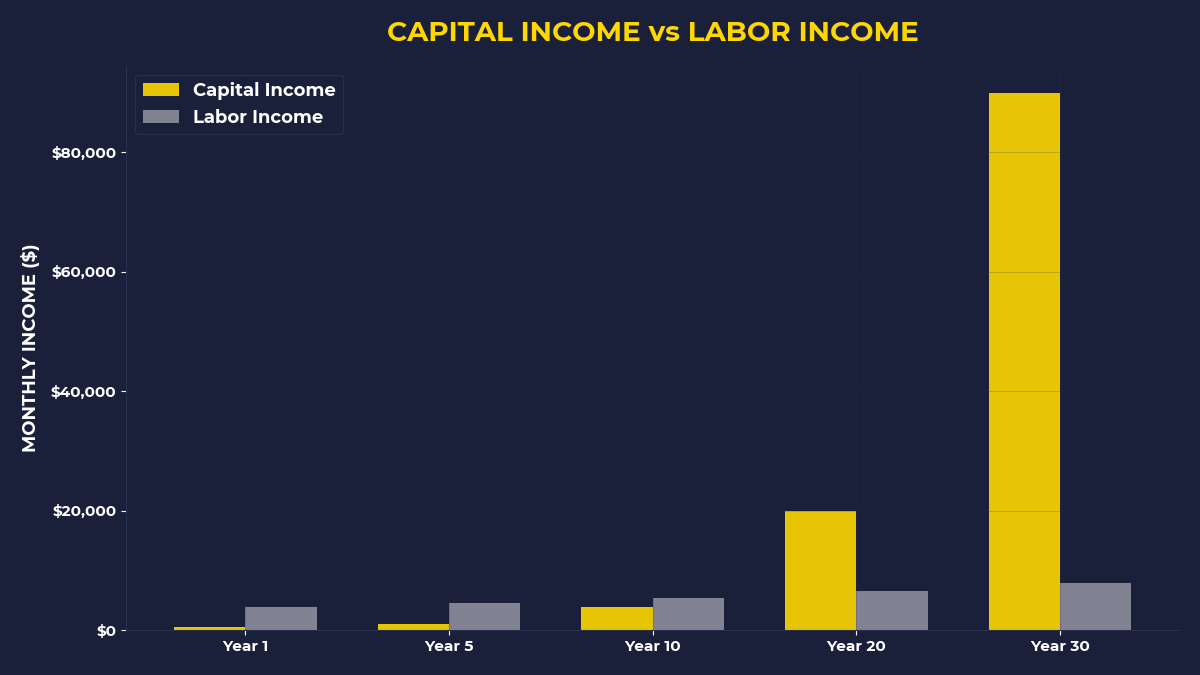
The worker improves skills, works overtime, negotiates raises, switches jobs. All good strategies, but they’re bounded by time and energy. You can optimize your way from $80,000 to $150,000, maybe $200,000. But you can’t optimize your way to $2 million annually without owning something.
The capital owner studies demand patterns, identifies undervalued assets, builds systems, acquires cash-flowing structures. Their income is bounded by their ability to identify and capture demand, which is functionally unlimited.
I spent my twenties asking the worker question. I got promoted, learned new skills, worked 60-hour weeks. My income grew from $45,000 to $125,000 over eight years. Solid progress, but linear.
Then I started asking the capital question. What assets could I buy that would pay me? What demand could I capture? What structures could I own?
The income trajectory changed from linear to exponential.

How to Start Buying Demand Instead of Trading Time
You don’t need $500,000 to start owning capital. You need to understand that every dollar has two potential destinations: consumption or capital acquisition.
Most people follow this sequence: earn money, pay bills, buy stuff, save whatever’s left (usually nothing).
Capital builders follow this sequence: earn money, buy assets first, pay bills with what’s left, increase earning capacity to cover the gap.
This sounds backwards because our primate brain prioritizes immediate survival over long-term wealth. We want to pay the mortgage first, buy groceries first, handle the “necessities.” The capital sits last in line, if there’s anything left.
But here’s what I learned from studying wealthy people: they pay themselves first, not last. They buy assets before they pay bills, then figure out how to cover the bills with increased income or decreased expenses.
Start with 10% of your gross income. Before you pay anything else, buy something that captures demand and generates cash flow. Index funds capturing corporate earnings demand. REITs capturing real estate demand. Individual stocks in companies with sustainable competitive advantages.
The specific asset matters less than the habit of buying demand-capturing structures with your first dollars, not your last.
What the Primal Investor Takes Away
• Capital is stored demand, not stored money. Focus on acquiring structures that capture human demand and convert it to cash flow, not accumulating currency in low-yield accounts.
• Your monthly bills reveal your position in the economic hierarchy. Every payment flows to someone who owns the demand you’re expressing. Flip the equation by becoming the demand owner.
• Ask “What should I buy?” instead of “What should I do?” Workers optimize their labor; capital owners optimize their assets. The income potential is incomparably different.
• Pay yourself first, not last. Buy assets before paying bills, then increase income to cover the gap. Your future self will thank you for prioritizing capital over consumption.
• Start with 10% and scale up. The habit of buying demand-capturing assets with your first dollars builds the neural pathways of capital thinking. Size matters less than consistency in the beginning.
The gap between capital owners and everyone else isn’t talent, education, or work ethic. It’s understanding what capital actually is and having the courage to buy it when your primate brain screams “pay the bills first.” Once you understand that capital is stored demand, you can’t unsee the matrix of cash flows surrounding you every day.
🎬 Prefer watching? Check out the video version on YouTube:
👉 https://www.youtube.com/@PrimalContrarian
Subscribe for daily insights on capital, wealth, and contrarian thinking.