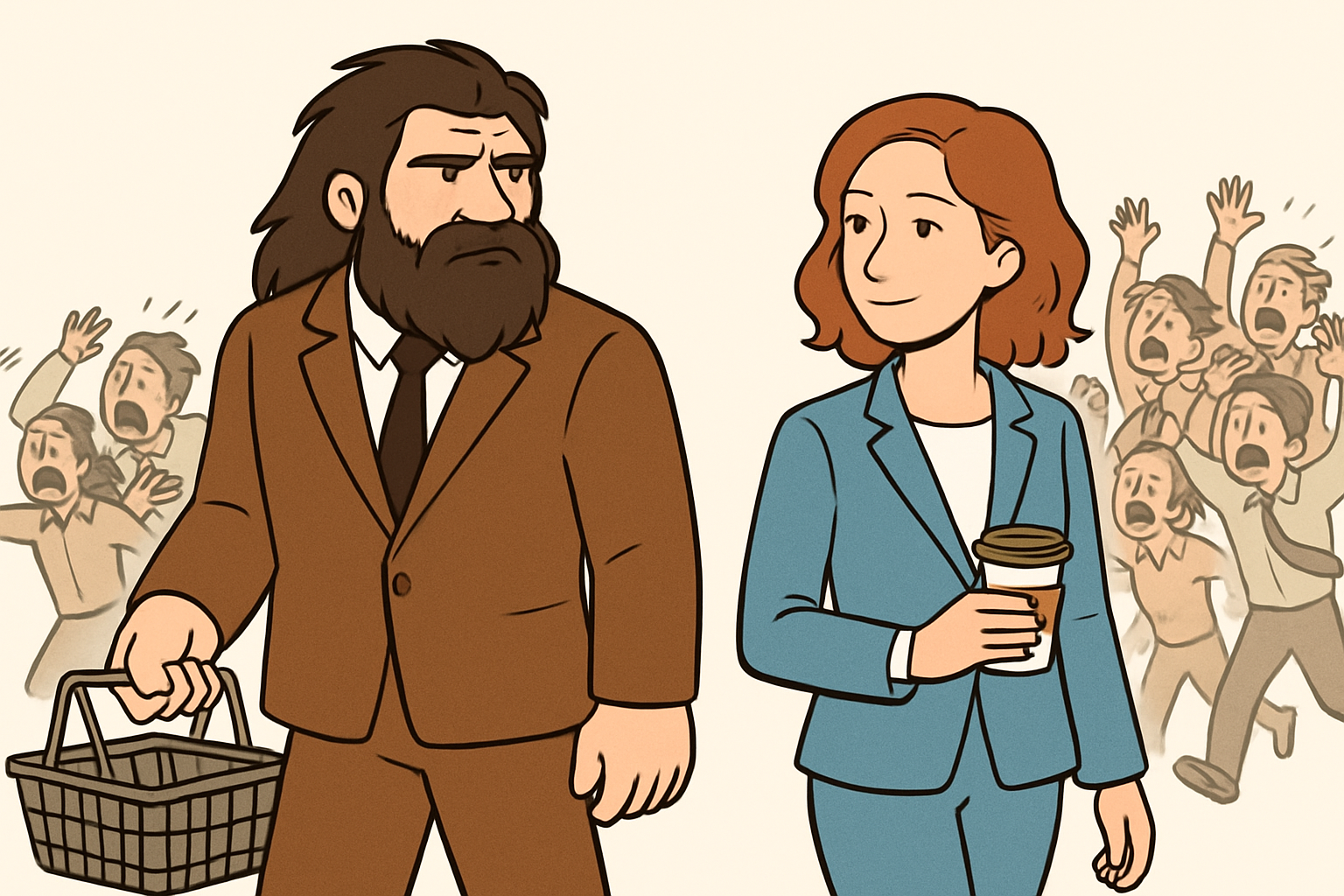
The primitive brain sees work as the path to wealth. More hours, more skills, more effort—surely this equation leads to financial freedom. This is the great deception of wage-thinking. The hardest workers in any economy are rarely the wealthiest. The wealthiest are those who stopped working for capital and started owning it.
Most people spend their entire careers building other people’s optionality while renting their own time by the hour. They mistake activity for progress, wages for wealth, and hard work for the structural advantage that actually creates lasting prosperity. The primal investor understands a fundamental truth: capital is not money you earn—it is demand you own.
Why Famous Singers Earn More Than Heart Surgeons
Consider why a popular musician can earn more in one concert than a skilled surgeon makes in a year, despite the surgeon’s decade of training and life-saving work. The primitive mind rebels against this. Surely the surgeon provides more value? The surgeon certainly works harder, studies longer, and serves a more essential function.
But capital doesn’t care about effort or social utility. Capital flows to whoever captures sustained demand. The musician who creates one hit song owns a piece of intellectual property that generates cash flow every time it plays on the radio, streams on Spotify, or gets licensed for a commercial. That single asset—the song—works 24/7 across global markets without the artist lifting another finger.
The surgeon, no matter how skilled, can only operate on one patient at a time. His expertise, though valuable, cannot scale beyond his physical presence. He trades time for money in the most literal sense. The musician trades creativity for equity in a demand-generating asset.
The Structural Difference Between Labor and Capital
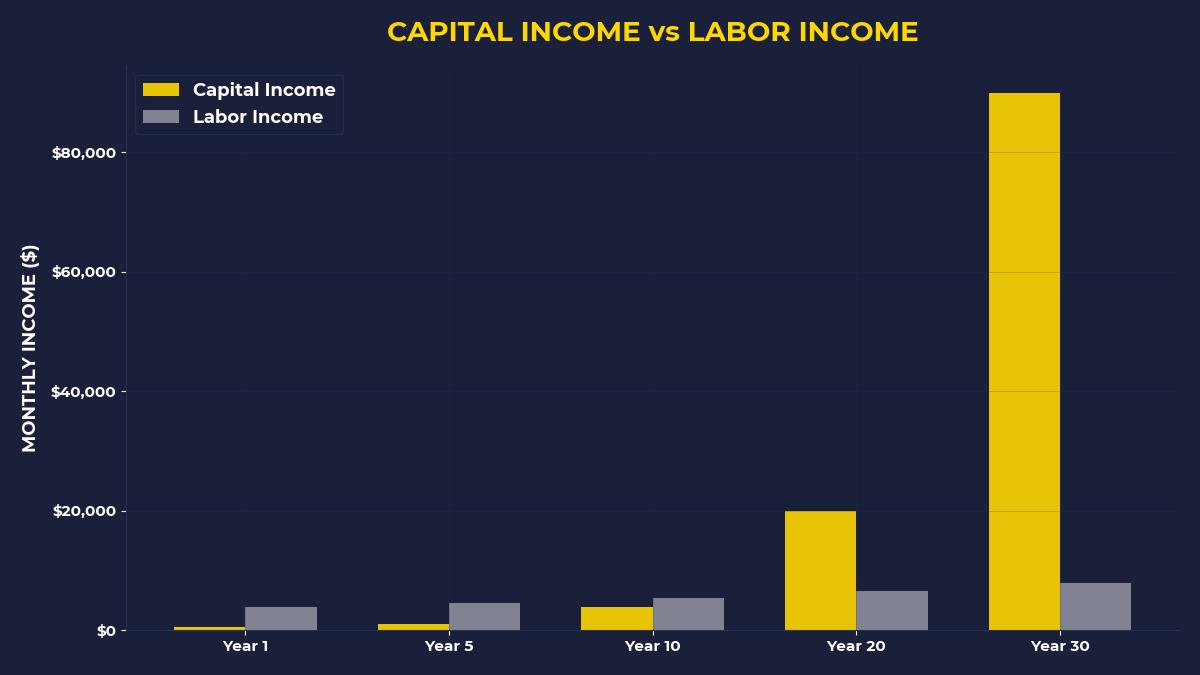
Labor adds value linearly. Capital multiplies value exponentially. When you work, you create value that flows upward to capital owners—your employer, landlord, the companies behind every product you buy, even the financial institutions processing your transactions. Every monthly bill represents a claim that capital owners have on your labor output.
Your rent check flows to whoever owns the real estate. Your car payment enriches the auto manufacturer’s shareholders. Your grocery bill pads the profits of food distributors and retailers. Even your morning coffee purchase feeds into someone else’s demand-generating asset investment strategy. You are the demand. Others own the systems that capture it.
This isn’t exploitation—it’s structure. The question is whether you’ll spend your lifetime on the labor side of this equation or find a way to own assets on the capital side.
The Golf Ball Principle: How Warren Buffett Learned to Buy Assets
Young Warren Buffett’s golf ball business illustrates the transition from labor-thinking to capital-thinking. As a child, Buffett would wade into ponds and search through bushes near golf courses, collecting lost golf balls. He’d clean them and sell them at 50 cents each—pure labor for money.
But Buffett quickly recognized the leverage opportunity. Instead of personally collecting every golf ball, he could hire friends to do the collecting and cleaning while paying them 25 cents per ball. Now Buffett earned 25 cents per ball without the physical work, while his friends earned 25 cents for their labor. When scaled across multiple workers and locations, this created a true compound interest wealth building system.
The insight: Don’t ask “What work should I do?” Ask “What assets should I buy?” Buffett’s later investments in farms, car dealerships, and rental properties followed the same principle—acquire assets that generate cash flow independent of his personal labor hours.

Why Your Emergency Fund Keeps You Poor
The conventional wisdom to “pay yourself first” by building an emergency fund reveals labor-versus-capital thinking at its most destructive. When your paycheck arrives, where does it go first? To your emergency savings account, earning 0.5% annually while inflation runs at 3%+.
Meanwhile, the real capital owners—those who built the companies where you work, shop, and bank—see their assets appreciate at 10-15% annually. Your “safe” emergency fund is systematically losing purchasing power while their equity stakes compound.
Robert Kiyosaki’s contrarian practice, even during his most financially desperate period, was to invest in assets before paying bills. When facing eviction, he’d still buy rental properties or business equipment first, then work extra jobs to cover immediate expenses. This seems backwards until you understand the structural thinking investment approach: assets work around the clock to generate income, while labor only pays when you’re working.

The Leverage Principle: From Ownership to Multiplication
Harry Larson’s scale business demonstrates how asset ownership creates leverage. Walking into a pharmacy, Larson noticed customers using a penny-operated scale. The store owner explained he rented the scale and kept 75% of the revenue—about $20 monthly. Larson invested $175 to lease three scales and immediately generated $98 monthly income.
But here’s what separated Larson from typical “side hustle” thinking: he used the cash flow from those first three scales to acquire 67 more scales. His monthly income scaled from $98 to over $1,400 (in 1930s dollars) without proportional increases in his time investment.
This exemplifies the labor versus capital ownership mindset. Labor thinkers might congratulate themselves on earning extra income from three scales. Capital thinkers use the cash flow to acquire more income-generating assets until they own a system that works independently of their daily involvement.

From Repetitive Labor to Creative Capital
The primal instinct of loss aversion keeps most people trapped in repetitive labor patterns. The secure paycheck feels safer than the uncertain path of asset acquisition. But this safety is illusory. Your paycheck depends entirely on someone else’s continued willingness to employ you, often in a role where you’re building their assets rather than your own.
Consider the psychological difference between building someone else’s house versus building your own. When you’re employed laying bricks for another person’s construction project, each day feels repetitive and draining. When you’re building your own home, using your own design and materials, the same physical work feels creative and energizing.
Capital ownership transforms your relationship to work. Instead of trading time for wages, you’re building systems that generate optionality. Each dollar invested in demand-generating assets increases your future choices rather than just covering current expenses.
What The Primal Investor Takes Away
- Capital is stored demand, not money in your bank account. Own pieces of businesses, real estate, or intellectual property that capture sustained human demand.
- Leverage multiplies ownership, not just effort. Use cash flow from one asset to acquire additional income-generating assets, creating compound growth independent of your labor hours.
- Ask “What should I buy?” instead of “What should I do?” This single question reframes your entire approach to wealth from labor-thinking to capital-thinking.
- Pay assets first, then bills. Even small amounts consistently invested in equity ownership compound over decades while emergency funds lose purchasing power.
- Your monthly bills are invoices from capital owners. Every payment you make enriches someone who owns the systems you depend on—become one of those owners.
The path from labor to capital ownership isn’t about working harder or earning more wages. It’s about systematically converting earned income into assets that generate unearned income, building optionality until your capital works harder than you ever could.
🎬 Prefer watching? Check out the video version on YouTube:
👉 https://www.youtube.com/@PrimalContrarian
Subscribe for daily insights on capital, wealth, and contrarian thinking.