Have you ever wondered why some people seem to magically accumulate wealth while others, despite earning decent incomes, never get ahead?
I used to think it was about discipline, budgeting, or finding the perfect investment strategy. Then I discovered something that changed everything about how I think about money.
The Man Who Lived in a Garage
Robert Kiyosaki tells a story that most people find impossible to believe. After his business failed due to accounting issues, he and his wife were evicted from their home. They ended up living in a friend’s garage.
But here’s the part that sounds crazy: even while living in that garage, receiving constant pressure from creditors, Kiyosaki did something that defied all conventional wisdom.
Every time money came in, he paid himself first.
Not the rent. Not the utilities. Not the groceries. He bought investments — stocks, real estate, business assets — before paying a single bill.
Then, and only then, did he figure out how to pay the bills. He worked extra jobs, mowed lawns on weekends, did whatever it took to cover his expenses after he’d already invested in his future.
Most people think this is backwards. Irresponsible, even. But Kiyosaki understood something that separates capital owners from everyone else: the order in which you allocate your money determines whether you build wealth or stay trapped in the bill-paying cycle forever.
Why Everyone Gets Your Money Before You Do
Take a look at your monthly expenses. Your landlord gets paid. The electric company gets paid. Your phone provider gets paid. Netflix gets paid. Your car payment gets paid.
Every single one of these payments goes to capital owners — people who own the apartments, the power plants, the cell towers, the entertainment platforms, the banks.
They get your money automatically, consistently, month after month. Meanwhile, you — the person who actually earned the money — get whatever’s left over. If anything.
This is why most people never build wealth. They’ve designed their financial lives to pay everyone else first, then hope there’s something remaining for their future self.
But hope is not a strategy. And leftovers don’t build fortunes.
The Golf Ball Principle
Young Warren Buffett understood this instinctively. As a kid, he collected lost golf balls from ponds and bushes around golf courses, cleaned them up, and sold them in packs of twelve for six dollars.
But here’s what made him different from other enterprising kids: he didn’t spend his profits on candy or toys. He reinvested every penny into more golf ball ventures, then later into pinball machines, then farm land.
Each time cash came in, his first thought wasn’t “What can I buy?” but “What asset can I acquire that will generate more cash?”
He was paying himself first — not with savings account deposits, but with ownership stakes in income-producing assets.
This is the secret that most people miss. Paying yourself first doesn’t mean putting money in savings. It means buying pieces of the system that generates wealth, not just storing cash that sits there.
Capital Is Stored Demand
When you buy a share of stock, you’re not just buying a piece of paper. You’re buying a claim on future customer payments. Every time someone buys a Coca-Cola, uses Microsoft Office, or shops on Amazon, part of that transaction flows to you as a shareholder.
When you buy rental real estate, you’re positioning yourself to receive monthly payments from people who need housing. When you start a business, you’re creating a system that captures value from customers who want what you’re offering.
This is what capital actually is: stored demand. It’s your claim on the future economic activity of others.
But here’s the crucial part — you have to acquire these ownership stakes before life forces you to spend the money elsewhere. Because once you pay the bills, that money is gone. It’s transferred to other capital owners, and you get nothing in return except temporary access to their assets.
The Reframe That Changes Everything
Most people think about money in this order: Earn → Pay Bills → Save/Invest Whatever’s Left.
This seems responsible. It feels like the “adult” thing to do. Pay your obligations first, then worry about your future.
But this approach guarantees that your future self will be just as financially dependent as your present self. You’re optimizing for short-term cash flow while ignoring long-term capital accumulation.
Capital owners think differently: Earn → Buy Assets → Hustle to Cover Bills.
This feels risky because it creates immediate pressure. When you commit money to investments before paying bills, you force yourself to find additional sources of income. You become resourceful. You discover income streams you never knew existed.
More importantly, you ensure that your future self gets paid first, not last.
What This Looks Like in Practice
Let’s say you earn $4,000 per month and your bills total $3,500. The conventional approach leaves you with $500 to “save” — money that often gets spent on random expenses anyway.
The pay-yourself-first approach looks different. Before touching any bills, you invest $600 in index funds, individual stocks, or a side business. Now you need to find an extra $100 somewhere to cover your expenses.
This forces creativity. Maybe you pick up a weekend gig. Maybe you sell something you don’t need. Maybe you finally start that freelance project you’ve been thinking about.
The key insight: when your back is against the wall, you find money you didn’t know you had access to. But when there’s no pressure, you drift along spending whatever comes in.
The One Thing To Remember
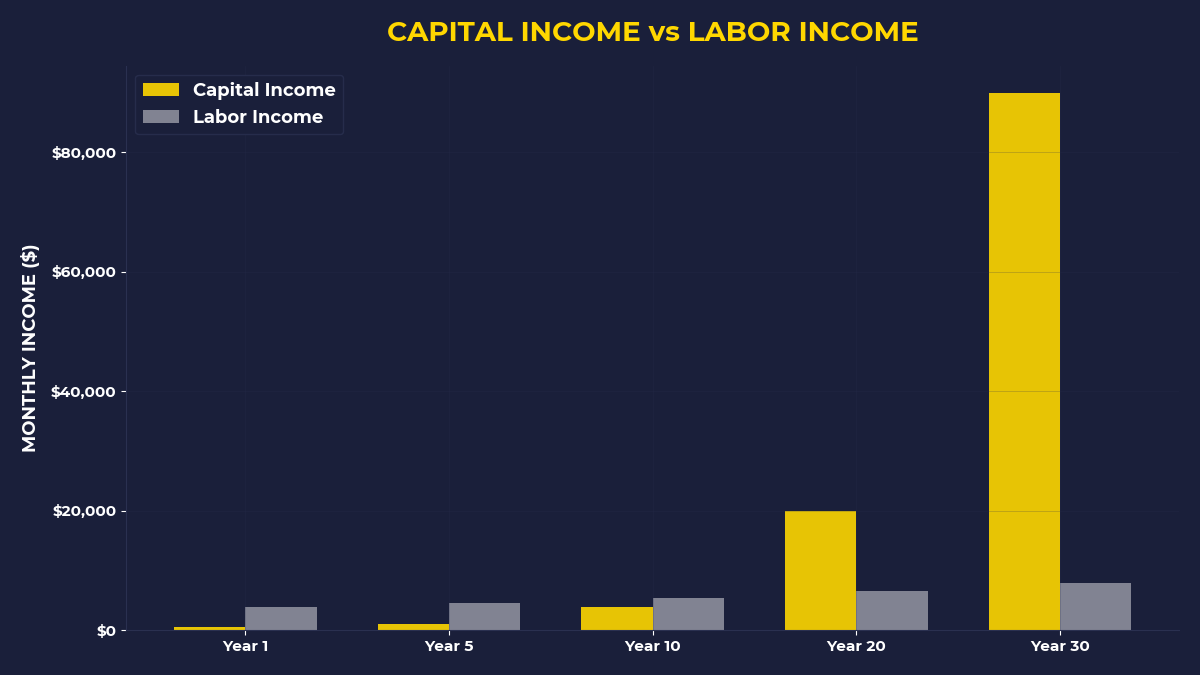
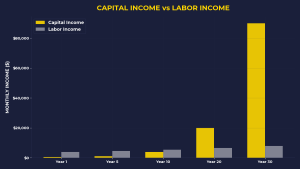
Your wealth is determined by one simple metric: how much of your income flows to you as a capital owner versus how much flows away to other capital owners. Every dollar you send to your landlord, your bank, or your subscription services is a dollar that could have been buying you a piece of the wealth-generation system instead. The only way to flip this equation is to pay the future version of yourself before you pay anyone else.
Here’s what you can start today:
Calculate 10-20% of your next paycheck and commit that amount to buying assets (stocks, index funds, or business investments) before paying any bills
Open a separate investment account and set up automatic transfers so this happens without willpower or decision-making
When bill pressure mounts, brainstorm three specific ways to earn extra income rather than reducing your asset purchases
🎬 Prefer watching? Check out the video version on YouTube: