Have you ever wondered why some people seem to effortlessly build wealth while others work twice as hard and barely get ahead?
I used to think the difference was luck, connections, or secret knowledge. Then I discovered something that changed everything: successful people ask a fundamentally different question than everyone else.
The Question Everyone Asks (That Keeps Them Poor)
Walk into any bookstore. Browse the success section. What do you see?
Hundreds of books telling you what to do. Wake up at 5 AM. Meditate. Network better. Learn new skills. Work harder. Optimize your schedule.
These aren’t bad ideas. But they’re built on the wrong question: “What should I do to make money?”
This question leads to a hamster wheel. You work harder, you earn more, but somehow you never get ahead. Why? Because doing more still means trading your time for money.
And time is the one thing you can never get back.
The Question That Changes Everything
Wealthy people ask a different question: “What should I buy?”
Let me tell you about Warren Buffett’s golf ball story. When he was a kid, Buffett would search for lost golf balls around local courses. He’d clean them up and sell them for 6 dollars per dozen.
Now imagine if young Warren had stopped there. He could have worked harder, searched longer, maybe hired friends to help find more balls. That’s the “what should I do” approach.
But here’s what actually happened. Buffett took his golf ball money and bought something. First a pinball machine he rented to a barbershop. Then part of a farm. Later, shares in businesses.
While other kids were still looking for work, Buffett was collecting rent from his pinball machine. The machine worked while he slept.
That’s the power of asking “what should I buy” instead of “what should I do.”
Your Monthly Bills Are Somebody Else’s Answer
Look at your credit card statement from last month. Every charge represents someone else who asked “what should I buy?”
Your rent? Someone bought real estate and now collects your payment.
Your Netflix subscription? Someone bought servers, content, and technology that automatically charges your card.
Your morning coffee? Someone bought a location, equipment, and a brand that draws you in daily.
Every dollar you spend flows to someone who owns something. They’re not working harder than you. They’re just on the receiving end of the cash flow.
The goal isn’t to stop spending. It’s to get on the other side of the equation.
Why “Buy Assets First” Sounds Crazy (But Works)
Here’s where most people’s brains short-circuit. I’m suggesting you buy assets before paying bills.
Robert Kiyosaki tells a story about when his business failed and he and his wife were living in a friend’s garage. They had bills piling up, creditors calling, the works.
What did he do? Every dollar that came in, he invested first. Then he worked nights and weekends doing odd jobs to pay the bills.
This sounds backwards until you understand the psychology. When you pay bills first, there’s never money left for investing. But when you invest first, you find creative ways to cover expenses.
You hustle harder because you have to. You cut unnecessary spending because you must. You become resourceful because you’ve already committed to your financial future.
Most importantly, you start building the habit of ownership. Every month, you own a little more of something that pays you back.
The Difference Between Building Your House and Building Someone Else’s
Imagine two scenarios. In the first, you spend every weekday laying bricks for someone else’s house. You get paid for each brick, but at the end of the project, you walk away with nothing but your wages.
In the second scenario, you’re building your own house. Maybe you hire others to lay the bricks while you design, manage, and make decisions. The work might be less physically demanding, but the house becomes yours.
Which feels more fulfilling?
This is the difference between “what should I do” and “what should I buy.” The first makes you a skilled laborer. The second makes you an owner.
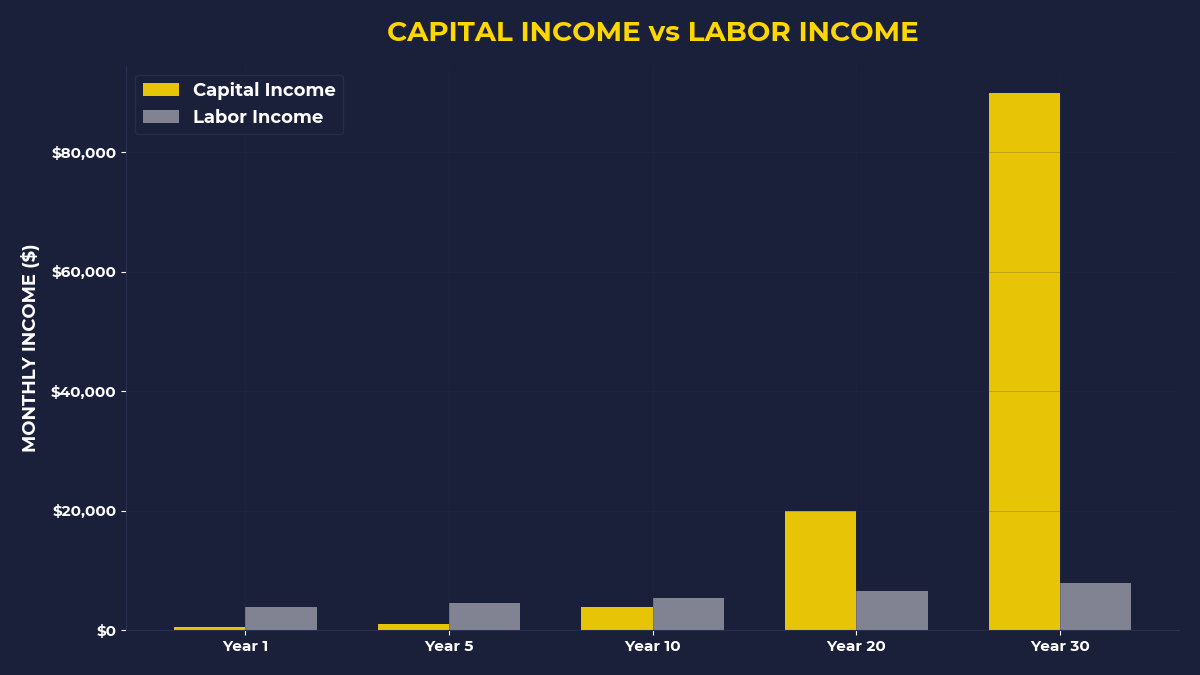
When you ask “what should I buy,” you’re looking for ways to put your money to work instead of just working for money. You’re building wealth that works while you sleep, travels without you, and grows without your constant attention.
The Compound Magic of Buying Right
Here’s another story that illustrates the power of ownership. A man named Harry was at a drugstore when someone asked his weight. He noticed a coin-operated scale nearby, paid a penny, and got weighed.
Over the next few minutes, he watched seven more people use the same scale. Curious, he asked the store owner about it. The owner explained he rented the scale and kept 25% of the revenue – about $20 per month.
Harry went to the bank, withdrew $175, and bought three scales. Soon he was earning $98 per month. But here’s the kicker: he used that income to buy 67 more scales.
Harry didn’t work 70 times harder. He bought 70 assets that worked for him.
This is compound growth in action. Not just compound interest, but compound ownership. Each asset buys the next asset, which buys the next asset, and so on.
Start With What You Can Buy Today
You don’t need $175 for scales or golf ball money to start asking better questions.
If you’re employed, you can buy shares of companies where thousands of employees work to grow your investment. Index funds let you own pieces of hundreds of profitable businesses for the price of a dinner out.
If you have skills, you can buy a domain name and start building something online that generates income while you sleep.
If you have $100, you can buy materials to create something people want to buy from you repeatedly.
The amount doesn’t matter. The question matters.
The One Thing To Remember
Every successful person I’ve studied made the same mental shift: from asking “what should I do?” to asking “what should I buy?” They stopped trying to work harder and started trying to own more. They realized that time is finite but ownership can multiply infinitely. The question you ask determines the life you build.
Here’s what you can start today:
Look at your monthly bills – Pick one expense and research how to get on the receiving end of that payment
Set up automatic investing – Even $25/month buying index funds changes your relationship with money
Ask the question – Every time you face a money decision, ask “what should I buy?” instead of “what should I do?”
🎬 Prefer watching? Check out the video version on YouTube: