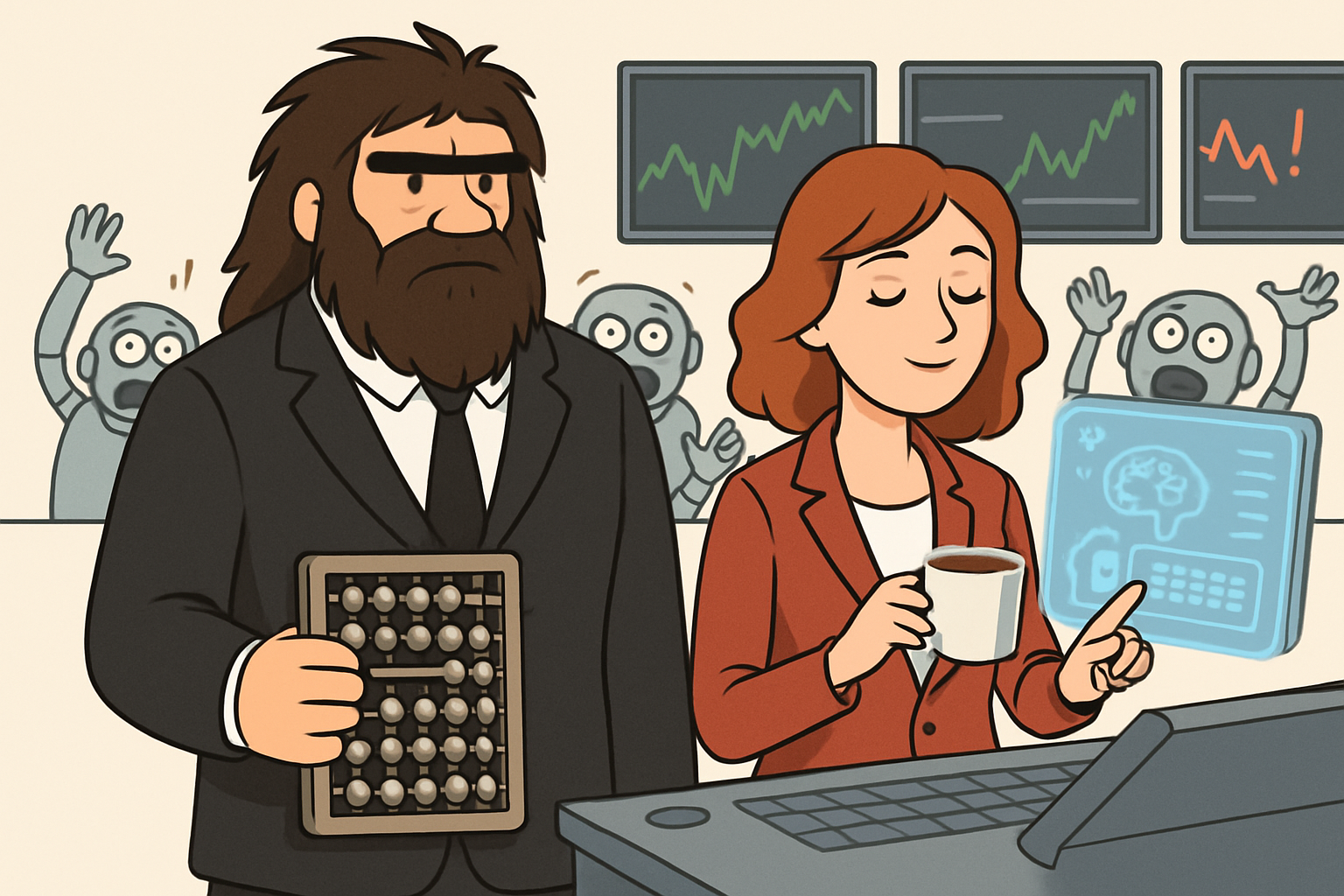
My friend Sarah — 29, marketing manager in Denver — texted me at 11:47 PM last Tuesday. “Just watched my company replace three writers with ChatGPT. They’re calling it ‘efficiency gains.’ I’m next, aren’t I?”
She wasn’t wrong.
But she was asking the wrong question. Instead of “Will AI take my job?”, she should be asking: “How do I own a piece of the AI that’s taking everyone else’s jobs?”
I Learned This the Hard Way in 2016
When Uber was crushing taxi companies, I was driving for a small cab service in Chicago. I watched our dispatch calls drop from 200 a day to maybe 30. The owner kept cutting driver pay, saying we had to “compete with technology.”
I was 27, frustrated, and asking all the wrong questions. “How can I drive more efficiently? How can I work longer hours? How can I beat Uber at their own game?”
The right question was: “How do I buy Uber stock?”
While I was trading my time for shrinking dollars, early Uber investors were collecting a percentage of every ride in every city. They weren’t working harder. They were owning the system that everyone else was working for.
That’s when I understood something that changed everything: **Capital is stored demand. When people need what you own, you have capital.**
And AI is about to create the most concentrated demand in human history.
The AI Wealth Transfer Is Already Happening
Think about your last week. How many times did you interact with AI without realizing it? Your Netflix recommendations. Your GPS route. Your credit card fraud detection. Your Google search results. Every single interaction generated revenue for someone.
But not for you.
Here’s what most people miss about the AI revolution: it’s not just changing how we work. It’s changing who owns the cash flows that come from work itself.
When Sarah’s company replaced those three writers, where did their $180,000 in combined salaries go? It didn’t disappear. It flowed to the owners of the AI system, the cloud computing infrastructure, and the software licenses. Every dollar that used to pay human workers is now paying capital owners.
This is happening across every industry, every month, at accelerating speed.
Customer service reps replaced by chatbots. Data analysts replaced by machine learning models. Even radiologists — doctors who spent 8 years in medical school — being outperformed by AI diagnostic tools.
The pattern is always the same: labor costs become capital returns.
Why Your Brain Fights This Reality
When I first tried to buy tech stocks in 2017, I felt guilty. “Shouldn’t I be focused on improving my skills? Getting better at my job? Working harder?”
Your brain is wired for survival, not wealth building. It tells you to focus on what you can control — your effort, your hours, your hustle. That made sense when human labor was irreplaceable.
But AI changes the game completely.
Working harder won’t save you when an algorithm can do your job for $0.03 per hour. Getting more education won’t help when AI can learn faster than any human. Even “creative” fields are falling: AI writes articles, generates art, composes music, codes software.
The only protection is ownership.
Look at what happened during the first wave of automation in manufacturing. The factory workers who lost their jobs to robots — where are they now? Mostly in lower-paying service jobs. Meanwhile, the people who owned stock in the companies that built those robots collected profits for decades.
Same pattern. Different technology.
What Does AI Capital Actually Look Like?
Here’s where it gets interesting. You don’t need to understand neural networks or machine learning to own a piece of the AI wealth transfer.
Remember Warren Buffett’s story about finding golf balls as a kid? He didn’t need to understand golf ball manufacturing. He just needed to recognize demand and figure out how to capture a piece of it.
AI capital works the same way.
Every time someone uses ChatGPT, OpenAI makes money. Every time a company uses cloud computing to run AI models, Amazon, Microsoft, and Google make money. Every time a self-driving car processes data, NVIDIA makes money from the chips powering that computation.
These aren’t abstract tech concepts. They’re cash-generating machines processing billions of transactions every single day. And you can own pieces of them for the cost of a Netflix subscription.
When I finally started buying shares of Microsoft in 2018, I wasn’t betting on their stock price. I was buying a tiny slice of every Office subscription, every Azure cloud computation, every AI model trained on their infrastructure. My $500 investment meant I owned a microscopic piece of a system that millions of people pay into every month.
That’s what capital ownership looks like in practice.
The Two-Class Future Is Coming Faster Than You Think
Do you notice what’s happening to job postings in your industry? I’ve been tracking this for the past 18 months. Entry-level positions are disappearing. Mid-level roles are being “restructured.” Senior positions now require skills that didn’t exist five years ago.
But here’s the twist: while human jobs are shrinking, the economic value being created is exploding. AI systems process more data, serve more customers, and generate more revenue than the human workers they replace. The pie is getting bigger. The question is: who owns the slices?
We’re heading toward a two-class system faster than anyone wants to admit:
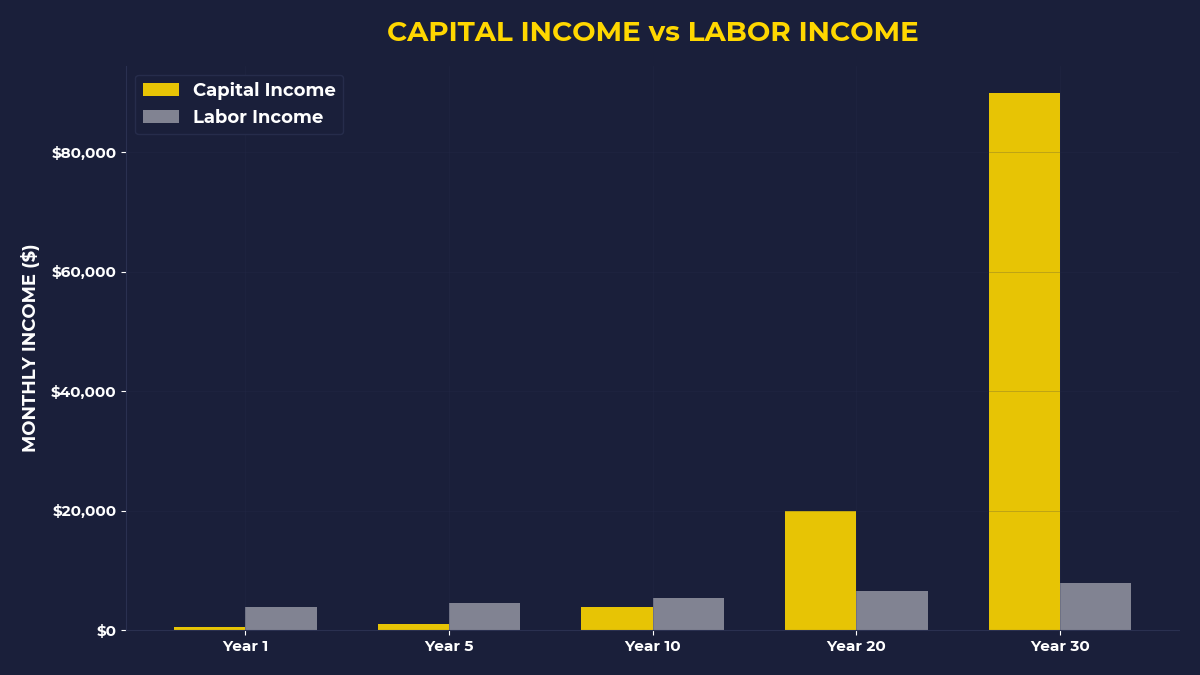
**Class 1:** People who own pieces of AI-powered businesses. They collect passive income from systems that work 24/7, serve global markets, and improve automatically.
**Class 2:** People who compete with AI systems for whatever human tasks remain. Their wages get squeezed downward by automation pressure.
The brutal truth? Most people will end up in Class 2 because they’re asking the wrong questions. They’re focused on “How do I make myself irreplaceable?” instead of “How do I own a piece of what’s replacing everyone?”
Sarah, my friend from Denver, is starting to get it. After three months of watching AI eliminate positions at her company, she opened a brokerage account. She’s putting $200 every month into AI-focused ETFs. Not because she understands the technology, but because she recognizes the cash flows.
“I can’t beat them,” she told me last week. “But I can join them.”
The Action Step Everyone Avoids
Here’s what separates the people who benefit from AI wealth transfer from those who get crushed by it: **they buy equity before they feel ready.**
Most people wait. They want to understand more. Research more. Find the perfect entry point. Learn about P/E ratios and market timing.
While they’re studying, the wealth transfer accelerates.
Think about it: every month you delay buying AI-related assets is another month of cash flows you miss. Every quarterly earnings report from Microsoft, Google, or NVIDIA represents profits that went to existing shareholders, not future ones.
The compounding advantage belongs to people who start collecting their share of AI-generated value now, not when they feel comfortable with it.
When I bought my first shares of an AI-focused ETF in 2019, I was nervous. I didn’t have spare money. I had to skip dinners out for two months to afford the initial investment. But that discomfort forced me to ask the right question: “What matters more — my comfort this month, or owning assets that benefit from technological progress for the next decade?”
The answer was obvious.
If You’re Someone Who Sees What’s Coming
If you’re reading this and nodding along — if you recognize that AI isn’t just changing individual jobs but restructuring entire economic systems — then you’re already ahead of 99% of people.
Most people are still debating whether AI will really impact their specific career. You’re thinking about capital flows and ownership structures. That mindset difference is everything.
You understand that the question isn’t “Will AI affect my industry?” but “How do I position myself to benefit from AI’s effect on every industry?”
You also probably feel the time pressure. Unlike previous technological revolutions that took decades to unfold, AI deployment is happening in quarters and years, not decades. The companies achieving AI breakthroughs today will dominate the cash flows of tomorrow.
The One Thing To Remember
**The AI wealth transfer isn’t a future possibility — it’s happening right now, in every transaction, every productivity gain, every human job that becomes an algorithmic process.** The only choice you have is whether you own a piece of the systems benefiting from this transfer or whether you compete with them for the shrinking pool of human-dependent income. Every dollar you send to rent, subscriptions, and services is voting for someone else’s capital ownership. The path to switching sides starts with your next purchase decision.
• Open a brokerage account this week and buy shares in AI-focused ETFs or the companies building AI infrastructure
• Before paying any non-essential bill this month, invest that amount in equity first — even if it means scrambling to cover expenses
• Stop asking “How do I AI-proof my career?” and start asking “How do I own the AI that’s changing every career?”
🎬 Prefer watching? Check out the video version on YouTube: