The AI Revolution Creates Two Classes: Those Who Own It and Those Replaced By It
Everyone’s talking about AI like it’s coming. It’s already here, quietly redistributing wealth while most people argue about job losses.
The real question isn’t whether AI will change everything — it’s whether you’ll be on the receiving end of that change or crushed by it.
I used to think AI was about automation replacing workers. Then I watched what actually happened to the S&P 500 between 2019 and 2024. NVIDIA went from $180 to over $900 per share. Microsoft added $2 trillion in market cap. Apple’s AI integration pushed it past $3 trillion. The people who owned these companies didn’t just avoid job losses — they captured the entire economic transformation.
Here’s what I learned: AI economics isn’t about technology. It’s about demand storage.
Why Everyone Else Gets Your Data While You Get the Bills
Every time you use ChatGPT, browse Instagram, or ask Alexa a question, you’re creating value. Your data trains models. Your attention generates revenue. Your behavior patterns get packaged and sold.
But check your bank account. Where’s your cut?
You’re doing exactly what my friend Jake does every morning. Jake wakes up, scrolls through his phone for 30 minutes, answers emails for his boss, then spends his lunch break watching AI-generated content on TikTok. By evening, he’s exhausted from creating value for everyone except himself.
The bills show up anyway. Rent to his landlord. Subscription fees to Netflix, Spotify, and three other AI-powered platforms. Car payment to the bank. Phone bill to Verizon.
Jake creates labor. Capital owners capture it.
This is the primal pattern playing out in AI economics: the herd creates demand, capital stores it, owners harvest it. Most people become the input. A few become the beneficiaries.
What Capital Really Means in the AI Economy
When I first started thinking about capital in 2019, I thought it meant money in the bank. Then I lost 23% of my portfolio trying to time the COVID crash in March 2020. The lesson cost me $47,000, but it taught me something crucial.
Capital isn’t money. Capital is stored demand.
Look at what happened during the pandemic. While 40 million Americans filed for unemployment between March and May 2020, Amazon’s stock climbed from $1,676 to $3,206 by September. Why? Because Amazon owned the infrastructure that captured exploding demand for delivery, cloud services, and digital entertainment.
The company didn’t create the demand — we did. Amazon just stored it through ownership of warehouses, data centers, and logistics networks. When demand spiked, capital owners got paid.
AI works the same way, but faster and at scale.
The Compounding Structure Nobody Talks About
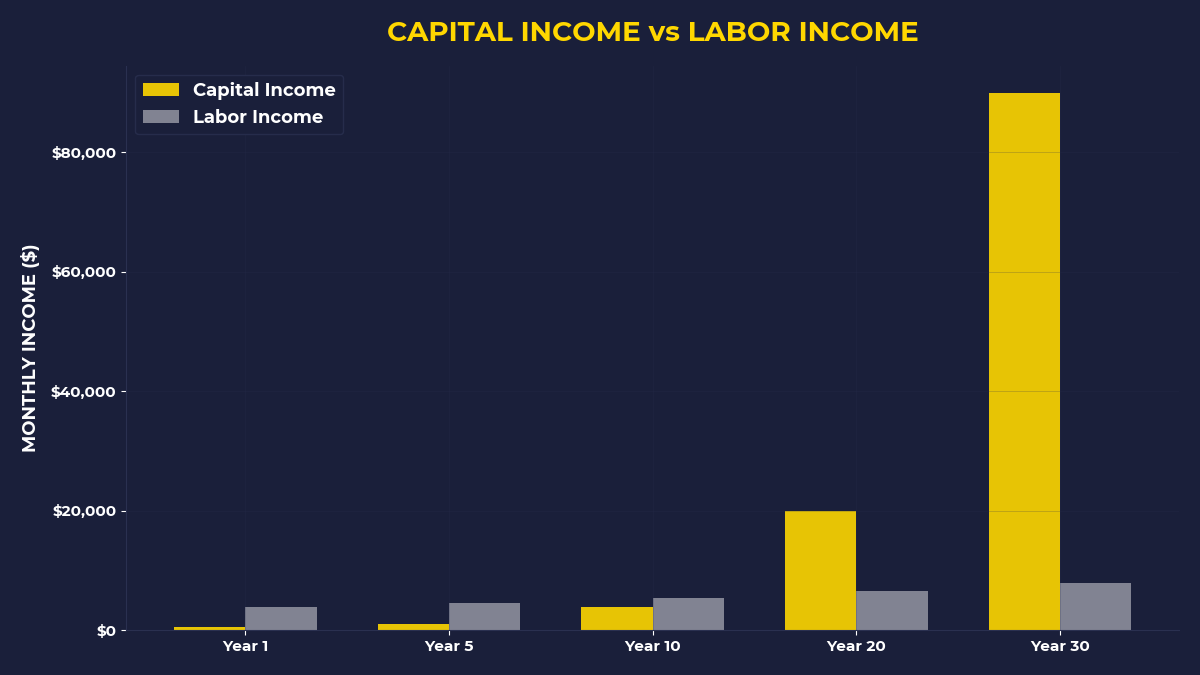
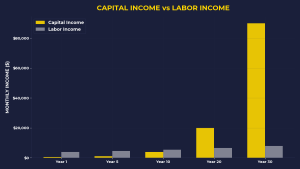
Here’s the part that keeps me up at night: AI creates compound returns for owners while creating linear stress for workers.
Think about it. When a human learns a new skill, they get marginally better. When ChatGPT trains on new data, every copy of the model gets better instantly. That improvement gets captured by OpenAI’s shareholders, not by the people whose conversations trained it.
I watched this pattern emerge in my own life. In 2022, I started using AI tools to write better investment analysis. My research got 40% faster. But instead of working less, I found myself competing with analysts who were also using AI, plus firms that had eliminated analysts entirely.
The productivity gains went to capital. I just worked harder to keep up.
This is loss aversion at the tribal level — we feel the threat of being replaced, so we work harder for the same outcome. Meanwhile, the people who own the AI infrastructure collect the productivity surplus.
Do You Know What You’re Actually Buying When You Invest in AI?
Most investors approach AI backwards. They ask, “Which AI stock should I buy?” instead of asking, “What demand am I capturing?”
The second question changes everything.
When Warren Buffett was 11 years old, he bought three shares of Cities Service Preferred for $38 each. Not because he understood oil refining, but because he recognized persistent demand for energy. The stock dropped to $27, terrifying him. When it recovered to $40, he sold — only to watch it climb to $200.
The lesson wasn’t about holding longer. It was about owning demand structures, not betting on individual companies.
AI creates several demand structures worth capturing: computational power, data processing, human-AI interfaces, and automation infrastructure. Companies that own these structures collect rent from everyone who needs them.
The question isn’t whether Google’s AI is better than Microsoft’s. The question is: which company captures more of the demand you’re creating every time you search, shop, or stream?
The One Question That Determines Your AI Future
Every morning, you wake up and make a choice: create value for others, or capture value for yourself.
Most people ask, “How can I use AI to do my job better?” That’s the labor mindset. You become more productive, but productivity gains flow to whoever owns your output.
Capital owners ask, “What can I buy that captures AI-generated demand?”
That second question transforms AI from threat to opportunity. Instead of competing with machines, you own them.
Let me be honest — this shift feels uncomfortable at first. Your primitive brain screams that you should work harder, not own more. The herd instinct says productive people deserve rewards. But AI economics doesn’t care about deserve. It cares about ownership.
When I started asking the capital question, I stopped trying to outwork AI and started buying companies that profit from AI adoption. My Microsoft position gained 34% in 2023 while my consulting income stayed flat.
Same effort. Different question. Completely different outcome.
Why This Matters Most If You’re Already Successful
If you’re reading this, you’re probably not struggling to pay rent. You’re likely successful by conventional standards — good job, decent savings, maybe some investment accounts.
That’s exactly why AI economics threatens you most.
You have the most to lose from staying in the labor class as AI transforms value creation. The barista getting replaced by an automated coffee machine knows change is coming. The senior analyst who doesn’t realize AI is commoditizing research gets blindsided.
Success creates cognitive anchoring. You think because you’ve always been paid for your expertise, you always will be. But AI doesn’t care about your track record. It only cares about whether your function can be automated or augmented.
The people who win the AI transition are already asking the capital question.
What the Primal Investor Takes Away
• Stop asking “How can AI make me more productive?” and start asking “What can I buy that captures AI-generated demand?”
• Recognize that every minute you spend creating value for others without ownership stakes is economic labor, regardless of your title or salary
• AI economics creates compound returns for owners and linear stress for workers — choose which side of that equation you want to be on
• Your data, attention, and behavior patterns are already creating value in the AI economy — the question is whether you’re capturing any of that value through ownership
• The companies that own AI infrastructure capture productivity gains from every person and business that uses their tools
• Economic freedom in the AI era means owning demand structures, not just earning from your personal productivity
The AI revolution isn’t coming. It’s redistributing wealth right now, every time you click, search, or interact with an algorithm. The only question is whether you’ll own a piece of that redistribution or just contribute to it.
🎬 Prefer watching? Check out the video version on YouTube: