The Question That Separates Owners From Workers
The most successful investors I know ask one question that 97% of people never consider: “What should I buy?” instead of “What should I do?”
Every time someone asks me how to build wealth, they frame it as a labor problem. How many hours should I work? Which skills should I develop? What side hustle should I start? What degree should I get? They’re trying to solve a capital problem with more effort.
Meanwhile, actual capital owners think differently. Warren Buffett didn’t become the world’s most famous investor by working harder than everyone else. He bought pieces of demand-generating machines and let other people do the work. At age 11, he was buying golf balls lost on courses for pennies and selling them for dollars. Not because he was the best golf ball finder in Omaha, but because he understood the question that matters: “What should I buy?”
I learned this lesson the expensive way. In my twenties, I was obsessed with optimization. Better morning routines, productivity hacks, networking events, skill development. I was asking “What should I do?” constantly. The result? I got really good at making other people rich while staying broke myself.
Why Your Brain Defaults to Labor Instead of Capital
Here’s the thing. Your brain is wired for immediate survival, not wealth building.
When you think “I need more money,” your primitive instinct defaults to effort. More hours, better performance, additional income streams. This made perfect sense when humans lived in tribes and food was scarce. Work harder, eat more, survive longer.
But in a capital-based economy, this instinct becomes a trap. While you’re optimizing your labor, someone else owns the system that captures the value you create.
Look at your last paycheck stub. How many different entities took a cut before you saw a dollar? Your employer kept the majority of the value you generated. The government took taxes. Your landlord gets housing costs. Your bank gets loan payments. Insurance companies get premiums. Subscription services get monthly fees. Every purchase you make transfers your cash flow to someone else’s capital.
The pattern is everywhere once you see it.
In 1955, the average CEO-to-worker pay ratio was 20:1. By 2022, it reached 399:1. That’s not because CEOs work 20 times harder than they used to. It’s because they own equity while workers own jobs.
What Happens When You Start Asking the Right Question
A friend of mine figured this out at 28. He was working 60-hour weeks as a software engineer, making $120,000 annually, and still feeling financially trapped. One day he asked himself: “Instead of learning another programming language, what should I buy?”
That question changed everything.
Instead of spending his evenings on coding tutorials, he started researching assets. Not to flip them for quick profits, but to own pieces of demand-generating systems. He bought rental properties in growing neighborhoods. He bought index funds that gave him equity in hundreds of companies. He bought a small laundromat that needed better management.
Five years later, his passive income exceeded his salary. Not because he worked less, but because he owned systems that worked for him.
The Golf Ball Principle in Modern Markets
When Warren Buffett was collecting and reselling golf balls as a kid, he stumbled onto something profound. He wasn’t just selling golf balls – he was buying and scaling a demand-capture system.
Think about that system: golfers lose balls predictably, creating consistent demand. The balls cost him nothing but time to collect. The profit margin was enormous. Most importantly, he could hire other kids to collect balls while he focused on expanding the operation.
Modern investing follows the same principle, just with different assets.
Amazon doesn’t make money because Jeff Bezos works harder than everyone else. Amazon makes money because it owns the infrastructure that captures value from millions of transactions. When you buy something on Amazon, you’re sending cash flow to shareholders who asked “What should I buy?” and answered “A piece of Amazon.”
The same logic applies to Apple, Microsoft, Google, and every other wealth-generating machine. Behind each company are millions of people asking “What should I do?” while a smaller group asks “What should I buy?” and purchases equity.
Why Most Investment Advice Gets This Backwards
Walk into any bookstore and count the finance books that focus on what you should do versus what you should buy. The ratio is about 10:1.
Budget better. Save more. Cut expenses. Side hustle harder. Optimize your tax strategy. Learn technical analysis. Master options trading. Develop financial discipline.
All useful advice. None of it addresses the fundamental question that determines whether you’ll build wealth or stay trapped in the labor game.
I spent years reading books that taught me how to be a better worker. How to negotiate salary increases, how to manage money more efficiently, how to reduce expenses. The advice worked, but it was solving the wrong problem. I was optimizing my position within a system instead of buying pieces of the system itself.
The Compound Interest of Ownership
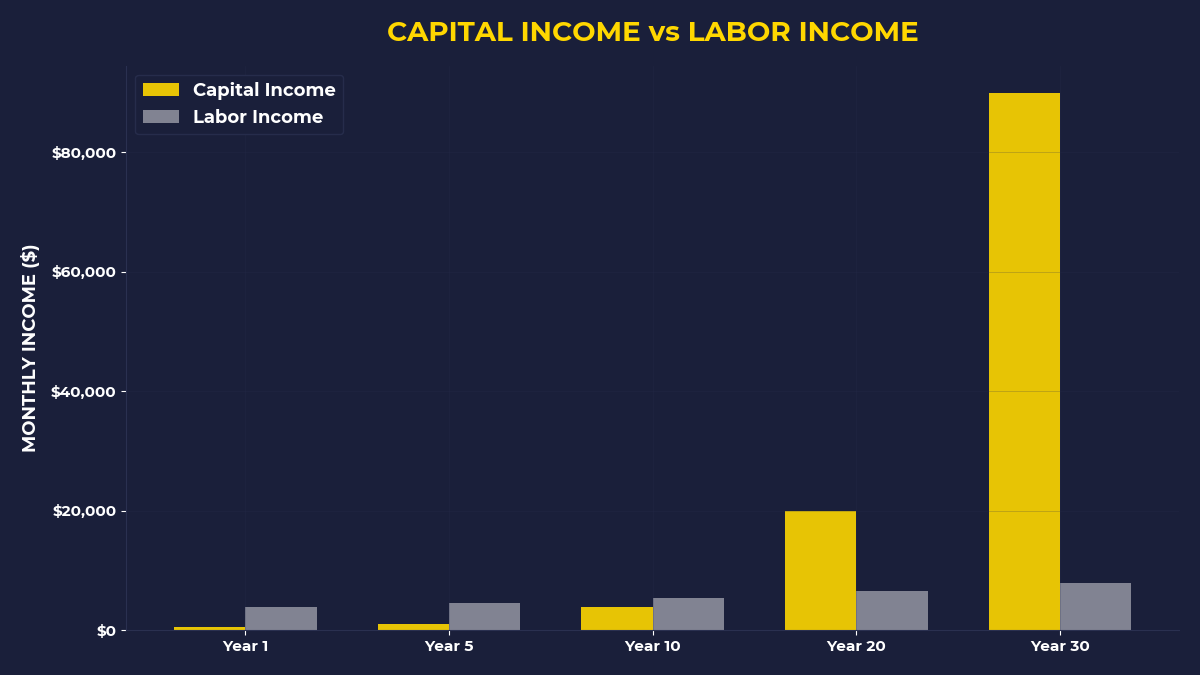
Here’s where the “what should I buy” question becomes powerful: it’s the only path to compound returns that don’t require your time.
When you ask “What should I do?” you get linear results. Work twice as many hours, make roughly twice as much money. Develop a new skill, earn a raise. Start a side business, add another income stream. But your returns are limited by your time and energy.
When you ask “What should I buy?” you get exponential possibilities.
In 1930, a man named Harry Larson saw someone weigh themselves on a coin-operated scale in a drugstore. Instead of walking away, he asked the store owner about the machine. The owner said he rented it and kept 25% of the revenue – about $20 per month.
Larson withdrew $175 from his savings and bought three scales. Soon he was earning $98 monthly from machines that worked without him. But here’s the key: he used profits from those first three scales to buy 67 more machines.
That’s the compound interest of ownership. Assets generate cash flow, which buys more assets, which generate more cash flow. The system scales beyond your personal effort.
How to Start Asking the Right Question
You don’t need $175 in 1930 money to start thinking like an owner. You need to change the question.
Instead of “How can I make more money?” ask “What asset could I buy this month?”
Instead of “What skill should I develop?” ask “What demand-generating system could I own a piece of?”
Instead of “How can I increase my income?” ask “What’s the smallest profitable system I could buy or build?”
The answers will surprise you. Maybe it’s buying 10 shares of an S&P 500 index fund instead of taking that $500 course on productivity. Maybe it’s buying a rental property instead of working overtime for the next two years. Maybe it’s purchasing a small business that’s already profitable instead of starting one from scratch.
The specific answer matters less than the question. Because once you start thinking like a buyer instead of a doer, you see opportunities everywhere.
What The Primal Investor Takes Away
• Ask “What should I buy?” before asking “What should I do?” – this single question shift separates capital owners from workers
• Your brain defaults to labor solutions because of survival instincts, but wealth comes from ownership, not effort
• Every bill you pay transfers your cash flow to someone who asked the right question and bought assets
• Compound returns only work when you own systems that generate cash flow beyond your personal time investment
• Start small but start owning – even $100 monthly toward index funds changes your relationship with capital
• The goal isn’t to stop working, it’s to own pieces of systems that work whether you do or not
Most people spend their entire lives optimizing their labor while never questioning why someone else captures most of the value they create. The moment you flip the question, you flip the game.
🎬 Prefer watching? Check out the video version on YouTube:
👉 https://www.youtube.com/@PrimalContrarian
Subscribe for daily insights on capital, wealth, and contrarian thinking.