Walk into any bookstore. Pull up Amazon. Scan the self-improvement shelf. Every success manual promises the same thing: here is what you must DO to get rich. Wake at 5 AM. Network aggressively. Master new skills. Hustle harder. Work smarter. The formula is always action-based, always effort-intensive, always about optimizing your labor.
This is precisely backward. The wealthy ask a different question entirely: What should I buy?
That mental shift — from doing to buying, from labor to leverage, from effort to ownership — separates capital from wages forever. Most people never make this transition. They spend decades perfecting their ability to work for money instead of learning to make money work for them. They optimize their human capital while ignoring actual capital. They become highly skilled, well-compensated servants of other people’s systems.
The Primitive Bias Toward Action
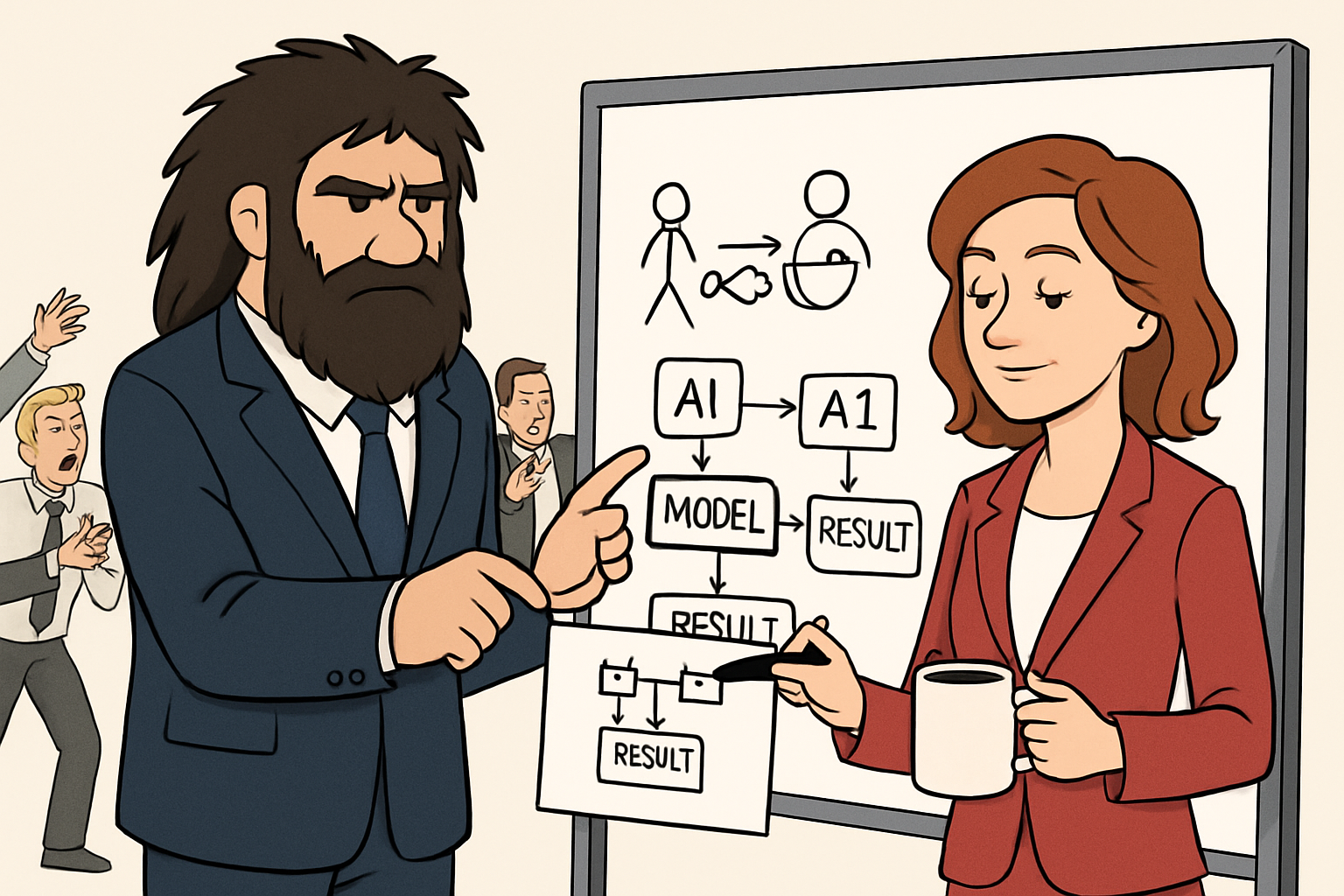
The human brain is wired for action bias — the tendency to favor doing something over doing nothing, even when inaction would produce better outcomes. In ancient environments, the hunter who sat still while prey passed by starved. The gatherer who hesitated while others collected fruit went hungry. Action meant survival.
In modern wealth building, this instinct becomes destructive. The primitive response to financial pressure is to work more hours, take on extra projects, develop new skills, hustle harder. These actions feel productive because they require visible effort and generate immediate feedback. But they trap you in the labor-for-wages cycle indefinitely.
Consider two approaches to increasing monthly income by $2,000. The action-biased response: find consulting work, drive for rideshare companies, freelance on weekends. The capital-focused response: buy dividend stocks, acquire rental properties, purchase a vending machine route. Both can generate $2,000 monthly. Only one creates an asset you own rather than work you must repeat.
Warren Buffett’s Golf Ball Economics
Young Warren Buffett collected lost golf balls around Omaha country clubs, cleaned them, and sold them in sets of twelve for six dollars. This story appears in every Buffett biography as an example of early entrepreneurship. The deeper lesson gets missed: even at age eleven, Buffett was thinking about what to buy, not what to do.
After accumulating cash from golf ball sales, Buffett didn’t buy bigger buckets or better cleaning supplies. He bought income-producing assets: pinball machines for barbershops, Rolls-Royce cars for rental, farmland for agricultural income. Each purchase generated cash flow without requiring his daily labor. The cash from Asset A funded the purchase of Asset B. The cash from Asset B funded Asset C.
This is compound interest through ownership, not compound effort through labor. Buffett could have spent fifty years perfecting golf ball collection — developing better finding techniques, more efficient cleaning processes, superior sales methods. Instead, he asked: what should I buy with this money to generate more money?
The pattern holds throughout his career. Berkshire Hathaway doesn’t compound because Buffett works harder each year. It compounds because owned businesses generate cash flows that fund the acquisition of additional businesses. The assets work; the owner allocates.

The Scale Problem With Doing
Human effort faces absolute constraints. You cannot work more than 24 hours per day. You cannot simultaneously be in multiple locations. You cannot personally execute infinite projects. These limitations create natural ceilings on earnings from labor, no matter how skilled or efficient you become.
Ownership scales differently. Harry Larson understood this in 1930s America when he observed customers using coin-operated scales at a local pharmacy. Seven people weighed themselves in fifteen minutes. The pharmacy owner revealed he earned about $20 monthly from his 25% share of scale revenues. Larson withdrew $175 from his bank account, leased three scales, and began earning $98 monthly without standing beside weighing customers.
But Larson’s breakthrough insight came next: he used scale revenues to lease additional scales. Eventually he owned 70 machines generating $1,750 monthly. The 67 additional scales were purchased entirely with coins from the original three. This is compound leveraging — using owned assets to acquire more owned assets.
If Larson had focused on “what should I do,” he might have become the best scale operator in the city — personally servicing machines, optimizing routes, providing superior customer experience. If he focused on “what should I buy,” he could own the entire scale operation without personally servicing anything. The difference is structural, not motivational.
The Leverage Effect
Consider the economics of both approaches. Working personally with three scales, Larson might earn $300 monthly while providing hands-on service. Owning 70 scales with hired maintenance, he earns $1,750 monthly while playing golf. The personal service model trades time for money. The ownership model trades money for time.
This pattern appears everywhere once you recognize it. The restaurant owner who works the kitchen every night versus the restaurant owner who systematizes operations and opens additional locations. The real estate agent who personally shows every property versus the broker who builds a team and takes overrides. The consultant who delivers every project personally versus the consultant who creates methodology and licenses it.
The Modern Application
You don’t need to operate scale routes or collect golf balls to apply this framework. The principle scales to any income level and investment capacity. The question remains: what should I buy instead of what should I do?
For the employed professional earning $75,000 annually, the answer might be shares of businesses through index funds — buying stakes in hundreds of companies whose employees work on your behalf. For the consultant with $50,000 in savings, it might mean purchasing existing profitable businesses rather than starting from zero. For the skilled tradesperson, it might mean buying the equipment other contractors rent.
The specific purchases matter less than the mental framework. Labor thinking optimizes for better performance within existing constraints. Capital thinking optimizes for removing constraints through ownership. Labor thinking asks: how can I become more valuable? Capital thinking asks: what valuable things can I own?
The Compound Difference
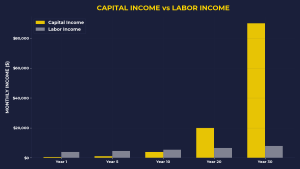
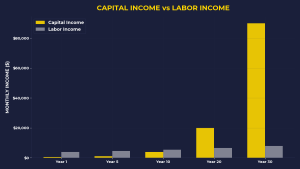
These approaches compound at different rates over time. Improving your skills might increase your hourly rate from $50 to $100 over five years — a 100% improvement. Owning appreciating, income-generating assets might compound at 8-12% annually while requiring no additional time input. After twenty years, the skill improvement is static; the ownership compounds exponentially.
More importantly, skill-based income disappears when you stop working. Ownership-based income continues whether you work or not. The surgeon who retires loses their income immediately. The surgeon who invested in medical real estate continues receiving rent checks indefinitely.

The Implementation Framework
Shifting from doing to buying requires reversing your financial sequence. Most people pay everyone else first — mortgage companies, credit card companies, utility companies, insurance companies — then invest whatever remains. This guarantees you’ll always have capital owners claiming your income before you become a capital owner yourself.
The contrarian sequence: pay yourself first by purchasing income-generating assets, then figure out how to cover remaining expenses. This forces creative problem-solving rather than default consumption. If your asset purchases leave insufficient funds for discretionary spending, you’ll find ways to earn additional income. If your discretionary spending consumes all available funds, you’ll never find ways to build assets.
Buffett exemplified this during his early business failures. When facing bankruptcy and living in a friend’s garage, he continued purchasing stocks with every dollar he earned before paying creditors. When cash ran short for basic expenses, he worked nights and weekends mowing lawns. The sequence was non-negotiable: assets first, expenses second.
This approach feels uncomfortable because it activates loss aversion — the psychological tendency to feel the pain of losses more acutely than equivalent gains. Reducing current consumption to fund future assets feels like losing money today. But that psychological discomfort signals you’re overriding primitive programming that keeps you trapped in linear thinking.
What The Primal Investor Takes Away
- Wealthy people optimize for ownership, not performance — they ask “what should I buy?” instead of “what should I do?” because assets scale without time limits while labor faces absolute constraints.
- Compound leverage beats compound effort — using asset-generated cash to buy additional assets creates exponential growth that personal productivity improvements cannot match.
- Action bias destroys capital formation — the primitive urge to solve financial problems through increased activity keeps you trading time for money instead of money for time.
- Reverse the payment sequence — buy income-generating assets first, then solve for expenses, rather than paying expenses first and investing leftovers.
- Scale requires systems, not skills — the highest-skilled person in any field who works personally is constrained by their personal capacity; ownership removes those constraints entirely.
The next time you face a financial challenge, catch your primitive brain reaching for action-based solutions. Then ask the capital owner’s question instead: what should I buy that would solve this problem permanently? The answer transforms your relationship with money from renting your time to buying back your freedom.
🎬 Prefer watching? Check out the video version on YouTube:
👉 https://www.youtube.com/@PrimalContrarian
Subscribe for daily insights on capital, wealth, and contrarian thinking.