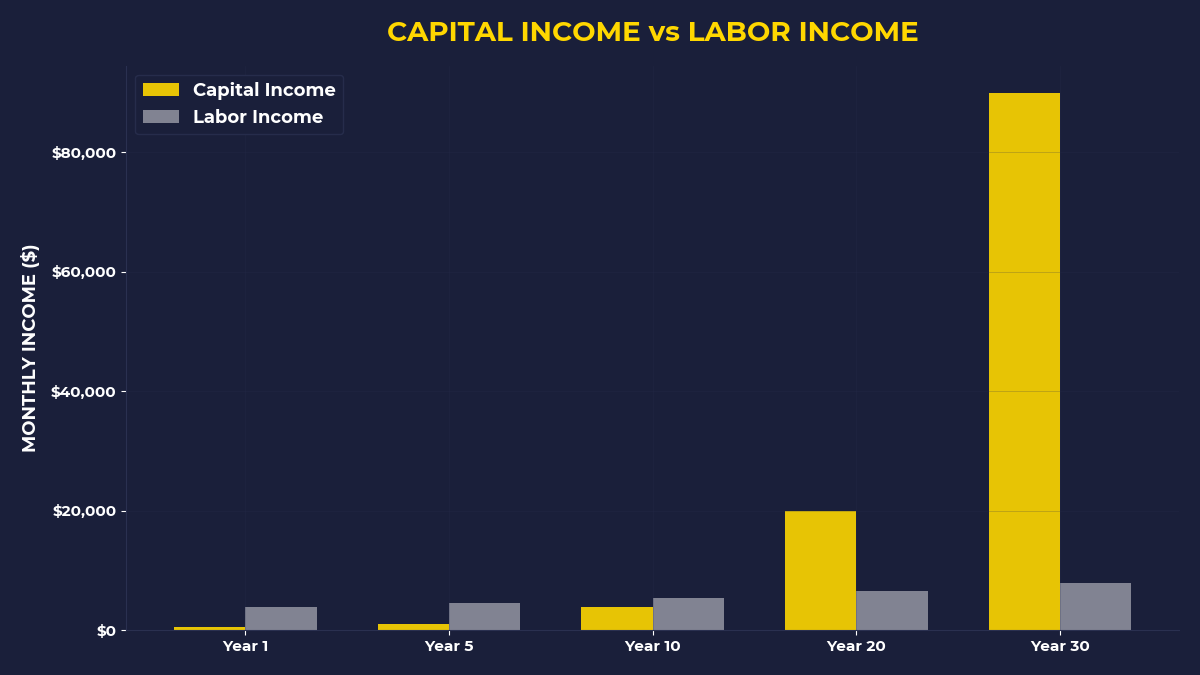
Every self-help book in every airport bookstore asks the same question: What should you do to get rich?
Wake up at 5 AM. Network aggressively. Learn to code. Get an MBA. Master emotional intelligence. Build your personal brand. The shelves groan under the weight of productivity porn and hustle culture manifestos, all promising that the right actions will unlock wealth.
Here’s what none of them tell you: You’re asking the wrong question entirely.
The people who actually build capital — the ones who escape the time-for-money trap — ask something completely different. They ask: What should I buy?
That single question separates capital owners from everyone else. It’s the difference between building wealth and just working harder.
I Used to Ask the Wrong Question Too
When I started investing, I was obsessed with doing things. I read every business biography, analyzed every successful person’s morning routine, and convinced myself that if I just worked smart enough, long enough, I’d break through.
I was asking: What should I do to make money?
The result? I became very good at trading my time for slightly more money. I optimized my productivity, expanded my skills, and climbed the ladder. But I was still climbing someone else’s ladder, funding someone else’s capital with my labor.
The breakthrough came when I noticed something about the wealthy people I knew. They weren’t necessarily smarter or more disciplined. They weren’t working 80-hour weeks. Many of them seemed almost lazy compared to the strivers around them.
The difference was structural. While I was asking what to do, they were asking what to buy.
Why Your Brain Defaults to the Labor Question
Your primate brain is wired for immediate action. See problem, solve problem. Feel anxiety, work harder. It’s the same programming that kept our ancestors alive when a rustling bush might contain a predator.
This ancient code translates into modern financial behavior: When money gets tight, your instinct screams “DO SOMETHING.” Get another degree. Work overtime. Start a side hustle. The action feels productive because you’re moving, sweating, grinding.
But action without ownership is just expensive labor.
The “what should I do” question feels virtuous because it puts you at the center of the solution. You control your actions. You can work harder, study longer, hustle smarter. It feels like taking responsibility.
The “what should I buy” question feels passive, almost lazy. Shouldn’t wealth require effort? Shouldn’t you earn it through sweat and sacrifice?
This is your mammalian brain talking. Status-seeking primates work to signal their value to the tribe. Capital owners work to buy systems that work for them.
The Golf Ball Principle: How Young Buffett Learned to Buy
Warren Buffett learned this lesson at age 13, selling lost golf balls he’d fished out of water hazards near Omaha golf courses. He’d collect a dozen balls, clean them up, and sell them for 50 cents each — about $6 in today’s money.
Here’s the key insight most people miss: Buffett didn’t scale by working harder. He didn’t wake up earlier or dive deeper or clean more balls per hour.
Instead, he asked: What should I buy?
He used his golf ball profits to buy a used pinball machine, which he placed in a barbershop. The machine generated quarters while Buffett slept. When that machine proved profitable, he bought more machines and placed them in different locations.
By age 16, Buffett was earning more from his pinball machines than many adults earned from their jobs. Not because he worked harder than adults, but because he owned assets that generated cash flow.
The golf balls taught him to work. The pinball machines taught him to buy.
What Happens When You Ask the Capital Question
Think about your last career decision. Did you ask “What should I do to advance?” or “What should I buy to build wealth?”
Most people optimize for salary increases, skill development, and resume building. They’re asking the labor question. They want to become more valuable workers.
Capital thinkers ask different questions:
Instead of “How can I get promoted?” they ask “What equity stake should I negotiate?”
Instead of “What skills should I learn?” they ask “What assets should I acquire while I’m earning?”
Instead of “How can I work more efficiently?” they ask “What systems can work for me while I sleep?”
This isn’t about being lazy or avoiding work. It’s about directing your work toward ownership rather than just performance.
Look at any industry’s top earners, and you’ll find they’ve shifted from doing work to buying work. The highest-paid doctors own medical practices. The wealthiest lawyers own law firms. The richest real estate agents own properties, not just commissions.
Why the Stock Market Rewards the Capital Question
Between 1957 and 2021, the S&P 500 generated an average annual return of approximately 10.5%. A $10,000 investment in 1957 grew to over $19 million by 2021.
But here’s what’s interesting: The people who captured those returns weren’t the ones asking “What should I do?” They were the ones asking “What should I buy?”
They bought shares of businesses that other people built and operated. They owned pieces of companies where thousands of employees showed up every day to create value. They captured leverage — other people’s time, energy, and creativity — through ownership.
The employees at those companies, many of whom were brilliant and hardworking, captured wages. The shareholders captured wealth.
Same companies. Same performance. Different questions. Different outcomes.
This isn’t a moral judgment. It’s a structural observation. Capital compounds. Labor adds up.
The Compound Interest of Ownership
Harry Larson discovered this principle in the 1930s when he watched people use a coin-operated scale at a drugstore. Instead of walking past, he asked the store owner about the business model.
The owner explained that he rented the scale from a company, which kept 75% of the revenue. Larson’s share was about $20 per month.
Instead of asking “How can I work harder to earn $20 per month?” Larson asked “What should I buy to earn $20 per month?”
He withdrew $175 from his savings and bought three scales, which immediately generated $98 monthly. But here’s where the capital question gets powerful: Instead of spending that $98, he used it to buy more scales.
Within a few years, Larson owned 70 scales generating over $1,750 monthly — about $30,000 in today’s purchasing power. The scales worked while Larson slept, while he was on vacation, while he was doing other things.
The first scale was work. The 70th scale was capital.
Why Most People Never Make the Switch
I know what you’re thinking. “This sounds great in theory, but I barely have enough money to pay my bills. How am I supposed to buy assets?”
This reaction reveals why 97% of people stay trapped in the labor question. They think buying assets requires having money left over after expenses.
Capital thinkers flip this equation. They pay themselves first — not with leftover money, but with first money. Before the rent, before the car payment, before the credit card bills.
Robert Kiyosaki tells the story of living in a friend’s garage after his business failed, owing money to creditors and facing mounting bills. Instead of asking “What should I do to pay these bills?” he asked “What should I buy with my next dollar?”
Even while living in a garage, Kiyosaki invested his first earnings in assets — stocks, small businesses, real estate deals. When bill collectors called, he worked extra jobs to generate additional income, but only after he’d paid himself first.
This sounds backwards to labor-minded people. How can you invest when you’re broke? How can you buy assets when you owe money?
Because the bills will always expand to consume whatever money you have. The only way to break the cycle is to remove capital from the equation before the bills see it.
The AI Question: What Should You Buy Next?
Artificial intelligence is creating the largest wealth transfer in human history. Not because AI will replace all jobs — though it will replace many — but because AI amplifies the gap between owners and workers.
Companies using AI are becoming dramatically more productive. Nvidia’s revenue grew from $10.9 billion in 2021 to $60.9 billion in 2024, largely because AI developers needed their chips. Microsoft’s market cap increased by over $1 trillion between 2023 and 2024 as businesses adopted their AI tools.
The people who owned shares in these companies captured that wealth creation. The people who just used AI tools captured productivity gains but not wealth gains.
Same technology. Different questions. Different outcomes.
AI workers ask: “How can I use AI to do my job better?”
AI capital owners ask: “What AI-enabled assets should I buy?”
The first question leads to career optimization. The second leads to wealth creation.
What The Primal Investor Takes Away
• Replace “What should I do?” with “What should I buy?” — every dollar you earn, every decision you make, every opportunity you evaluate
• Pay yourself first by buying assets before paying bills — even if it’s $50 per month, capital before consumption
• Look for systems that generate cash flow without your presence — businesses, stocks, real estate, intellectual property that works while you sleep
• Scale through ownership, not effort — buy more assets rather than working more hours
• Use other people’s time and energy through equity stakes — capture the compound effect of collective human effort
• Think like an owner, not an employee, in every financial decision — ask how you can buy a piece of the solution rather than just participate in it
The question you ask determines the life you build. Labor questions create labor lives. Capital questions create capital lives.
Stop asking what you should do. Start asking what you should buy.
🎬 Prefer watching? Check out the video version on YouTube: