Have you ever wondered why your neighbor drives a nicer car, takes better vacations, and seems less stressed about money—even though you work just as hard?
I used to think it was about income. Get a better job, work more hours, maybe pick up a side hustle. The math seemed simple: more work equals more money equals better life.
Then I noticed something that changed everything.
The Monthly Bill Reality Check
Look at your phone right now. Check your monthly subscriptions.
Netflix. Spotify. Your phone plan. Internet. Car payment. Rent or mortgage. Insurance. Gym membership.
Now add up those numbers.
Shocking, right? But here’s the part that really hit me: every single one of those payments goes to someone who owns something.
Netflix owns a content platform. Your landlord owns real estate. The bank owns your car loan. The gym owns equipment and space.
You’re paying for access. They own the assets.
This is the fundamental divide in our economy. There are people who own things that generate income, and people who pay to use those things.
Most of us spend our entire lives on the wrong side of that equation.
The Weight Scale Story That Changes Everything
Back in the 1930s, a guy named Harry Larson was buying medicine at his local drugstore when someone asked him to guess his weight. Harry looked around and spotted a coin-operated scale. He dropped in a penny and weighed himself.
Over the next few minutes, Harry watched seven more people use that same scale.
Curious, he asked the store owner about it. The owner explained he rented the scale and kept 75% of the coins—about $20 per month just from that one machine.
Harry went home, emptied his savings account of $175, and rented three scales for different locations.
Within weeks, he was earning $98 per month. But here’s where it gets interesting: Harry didn’t stop there. He used those earnings to buy more scales. Then more. By the end, he owned 70 weight scales across his city.
Think about what Harry discovered: he found something people needed (to know their weight), something they’d pay for repeatedly (every visit), and something that worked without him standing there.
Harry didn’t work 70 times harder than someone with one scale. He owned 70 times more.
That’s the difference between working for money and owning assets that work for you.
Why You Stay Trapped in the Payment Cycle
Here’s the brutal truth: most people are trained to be excellent employees and terrible owners.
We’re taught to get good grades, find stable jobs, and pay our bills on time. All admirable qualities. But notice what’s missing from that equation?
Nobody teaches you to buy before you pay.
Robert Kiyosaki tells a story that shocked me when I first read it. After one of his businesses failed, he and his wife were living in a friend’s garage. Bills were piling up. Creditors were calling.
But Kiyosaki did something most people would think was crazy: when money came in, he invested in assets first, then figured out how to pay the bills.
While living in that garage, he’d take any income and immediately buy stocks, real estate, or business investments. Only after that would he work nights and weekends—mowing lawns, doing odd jobs—to earn money for the bills.
Most people do the exact opposite. Pay all the bills first, then invest whatever’s left over.
Guess what’s usually left over? Nothing.
Kiyosaki forced himself into a corner where he had to generate extra income. But the key insight: he prioritized building his asset base even when it was uncomfortable.
That garage period didn’t last long. Those assets started generating their own income.
The Hidden Difference Between Rich and Poor
Poor people buy things that create monthly bills.
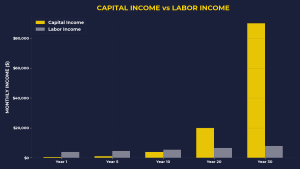
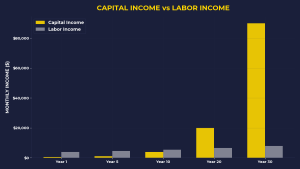
Rich people buy things that create monthly income.
It sounds simple, but look around. Most people’s biggest purchases are cars (depreciating assets with insurance, maintenance, and loan payments), houses they barely own (with 30-year mortgages), and stuff that loses value the moment they buy it.
Meanwhile, wealthy people buy rental properties, business shares, intellectual property, and systems that generate cash flow.
The middle class gets trapped because they buy slightly better versions of poor people’s purchases. A nicer car with a bigger payment. A bigger house with a bigger mortgage. Better stuff that still costs money every month.
They’re still on the wrong side of the ownership equation.
What Ownership Actually Looks Like Today
You might think you need millions to start owning assets that pay you back. That’s not true.
A friend of mine started buying dividend-paying stocks with $50 per month. Nothing fancy—just companies that pay shareholders quarterly. After five years, those payments cover his phone bill.
Another friend bought a duplex, lived in one side, and rented the other. The rental income covers most of his mortgage. He’s essentially living for free while building equity.
My neighbor started a small online course teaching people how to use Excel. It took him three months to create, but now it generates a few hundred dollars monthly with minimal maintenance.
These aren’t get-rich-quick schemes. They’re ownership assets that generate passive income over time.
The key insight: these people stopped thinking “what job should I get?” and started thinking “what should I own?”
The Creative Work Shift
Here’s something most people don’t realize: ownership transforms the type of work you do.
When you’re an employee, you do repetitive work for someone else’s vision. Show up, follow the process, collect the paycheck. It’s predictable but limiting.
When you own assets, you shift into creative work. You’re building something, improving systems, making decisions about your own future.
Think about the difference between laying bricks for someone else’s house versus designing and building your own. Same physical effort, completely different mental experience.
Ownership doesn’t guarantee you’ll love every moment. But it gives you the freedom to create rather than just execute.
And here’s the compound effect: creative work often creates more ownership opportunities. The person building their own house learns skills they can use to build rental properties. The person writing their own course can create more courses.
Repetitive work for others rarely compounds. You get better at the job, but the job doesn’t create more opportunities for ownership.
The One Thing To Remember
Most people work their entire lives to pay other people’s assets. Your rent pays your landlord’s mortgage. Your Netflix subscription pays for their content platform. Your car payment pays the bank’s loan portfolio. Every month, your cash flow transfers to people who own things.
The wealthy understand a simple truth: it’s better to own a small piece of something big than to own nothing at all. Start building your ownership position before you’re financially comfortable enough to do it easily. Force yourself to buy assets first, then hustle to cover the bills.
Here’s what you can do starting today:
Calculate how much you pay monthly to use other people’s assets—it’s probably shocking
Commit to investing in one ownership asset this month before paying discretionary bills
Ask yourself “what could I own?” instead of “what job could I get?” when thinking about income