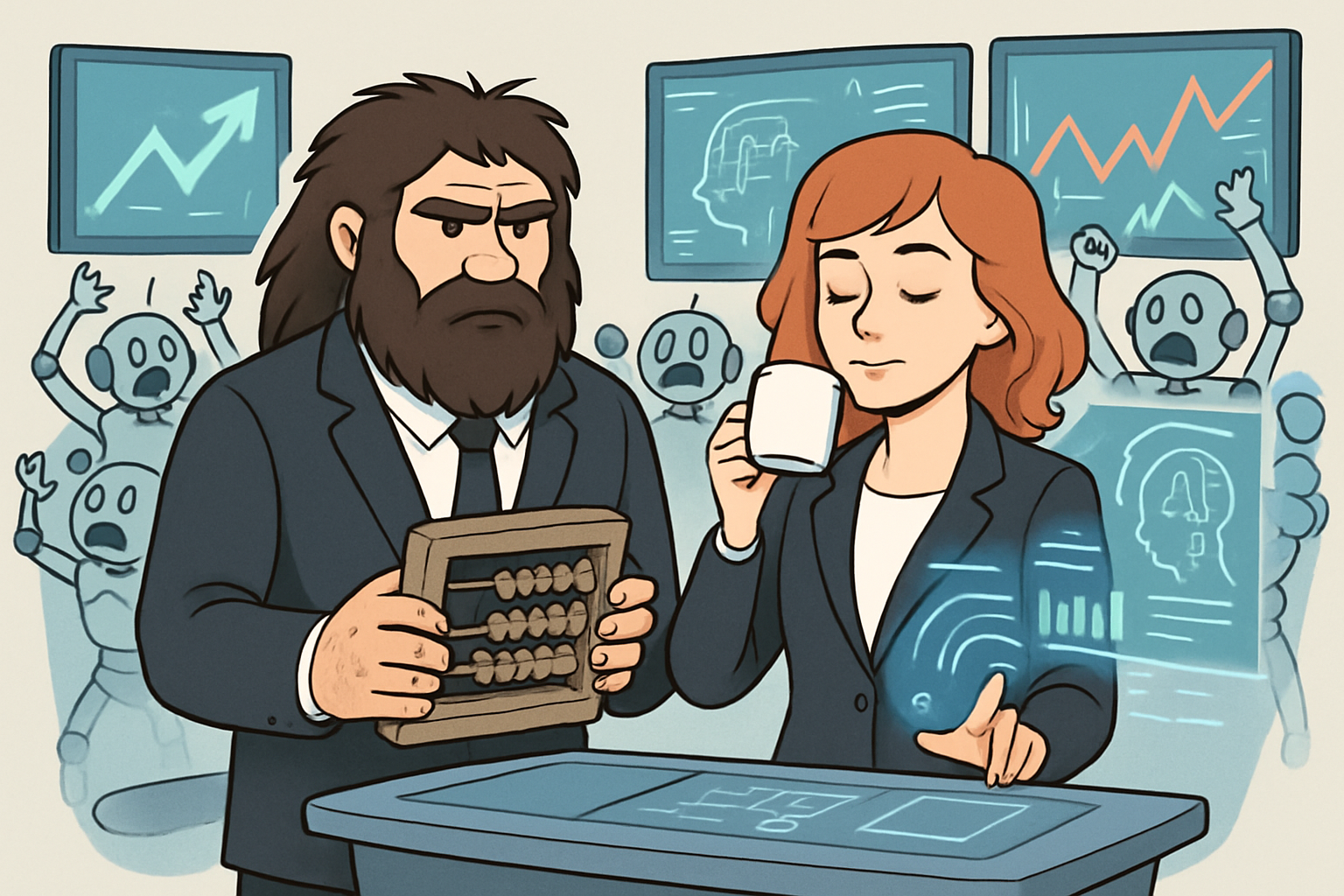
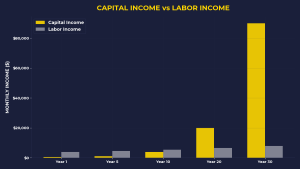
Every AI breakthrough makes someone rich and someone else obsolete. The difference isn’t intelligence, education, or how hard you work — it’s whether you own the demand or just fulfill it.
I learned this the expensive way in 2016 when I watched translation companies collapse overnight. Google Translate didn’t just improve — it became good enough to eliminate entire departments. The translators I knew had impressive degrees, spoke four languages fluently, and worked 60-hour weeks. None of that mattered. Google owned the system that replaced them.
Here’s what I missed then but see clearly now: AI economics operates by a different set of rules than industrial economics. In the factory age, humans and machines were complementary. In the AI age, humans and machines are substitutes. And when you’re a substitute, you’re always one algorithm away from unemployed.
Why Your Skills Become Yesterday’s News
Think about what happened to chess grandmasters after 1997. Deep Blue didn’t just beat Garry Kasparov — it made human chess expertise economically worthless. Today, a $50 smartphone app plays better chess than any human who ever lived.
The pattern repeats across every cognitive domain. Radiologists who spent 12 years learning to read X-rays? AI now detects cancer more accurately than they do. Financial analysts who built complex models? GPT-4 builds them faster and finds patterns humans miss. Legal researchers who memorized case law? AI reads every court decision ever filed in seconds.
What’s your job, exactly?
Because whatever it is, someone is building an AI to do it cheaper, faster, and more accurately than you can. The only question is whether you’ll own that AI or be replaced by it.
The Capital Structure of AI Economics
I used to think AI was just another tool, like Excel or email. I was catastrophically wrong. AI isn’t a tool — it’s a capital structure that stores and amplifies human judgment at zero marginal cost.
Here’s the difference: When Netflix replaced Blockbuster, they still needed humans to recommend movies. When AI replaces you, it doesn’t need you at all. It owns the pattern recognition, the decision-making, and the execution. The entire value chain gets compressed into code.
Consider what happened to photography between 2007 and 2015. Instagram didn’t just change how we shared photos — it eliminated the entire professional photography industry for most use cases. Why hire a photographer when everyone has a better camera in their pocket than Ansel Adams ever used?
But Instagram’s founders became billionaires. They owned the platform that captured the demand for visual sharing. They turned everyone into photographers while owning the infrastructure that made it possible.
That’s AI economics in a nutshell: democratize the capability, capture the value.
The Demand Storage Problem
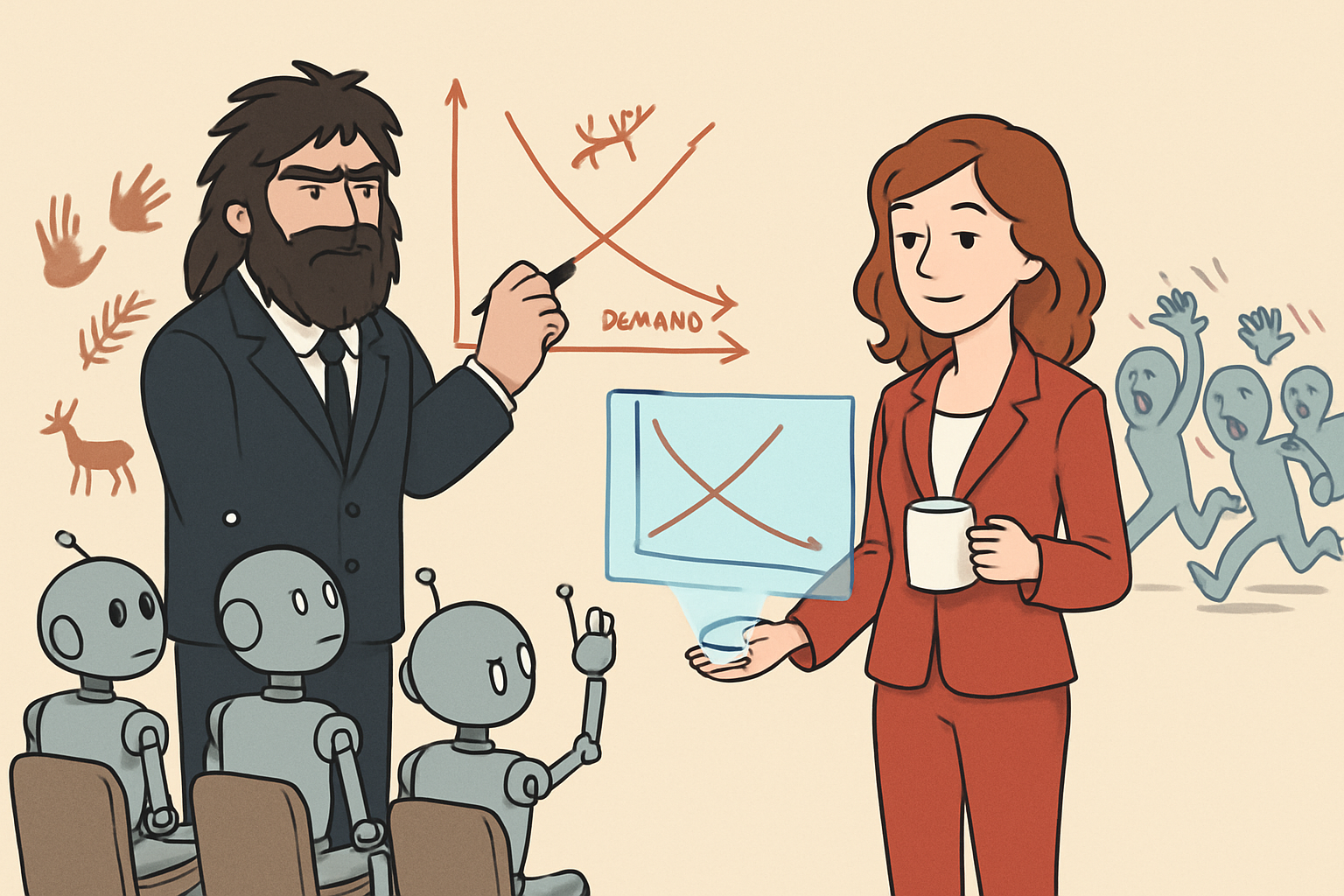
Let me be honest about something that kept me awake for months after I finally understood it. Every dollar you earn from your job is stored demand — but not your demand. It’s your employer’s demand.
When AI automates your role, your employer doesn’t lose money. They save it. The demand for what you produce doesn’t disappear — it just gets fulfilled more efficiently. Your company’s revenue stays the same or grows. Your paycheck vanishes.
The brutal math: In 1990, GM employed 761,000 people and generated $125 billion in revenue. In 2022, they employed 167,000 people and generated $156 billion. Same demand, 78% fewer workers. That’s what technological displacement looks like in practice.
AI economics accelerates this pattern across every knowledge industry simultaneously.
The Ownership Question Nobody Asks
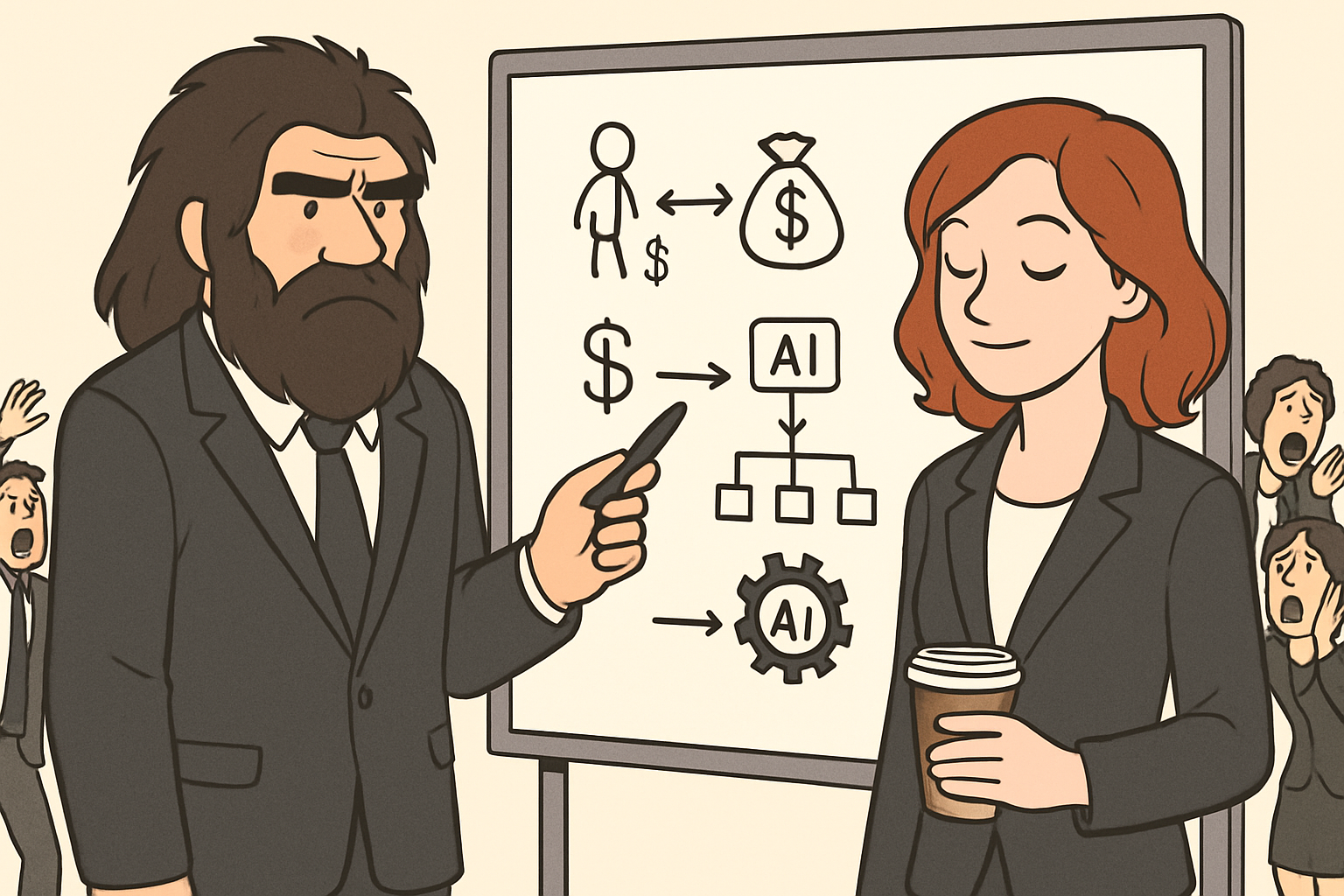
Here’s the question that separates future capital owners from future unemployed: What AI demand can you buy instead of what AI skills can you learn?
Everyone asks the wrong question. They want to know which AI tools to master, which courses to take, which certificates to earn. They’re optimizing for productivity when they should be optimizing for ownership.
I made this mistake for years. I spent thousands of hours learning AI tools, thinking I was future-proofing my career. I was actually making myself more efficient at a job that was about to disappear.
The right question: Which companies are building the AI that replaces human judgment? Which platforms capture the demand that AI fulfills? Which infrastructure enables AI to scale?
Because that’s where the money goes when your job disappears.
The Stored Demand Revolution
AI doesn’t just automate tasks — it stores human expertise in scalable systems. When Netflix’s recommendation algorithm suggests a movie you love, it’s storing the collective taste of millions of viewers and applying it to your preferences. No human curator required.
When Tesla’s Autopilot navigates traffic, it’s storing the driving experience of millions of miles and applying it to your commute. No human driver required.
When ChatGPT writes code, it’s storing the programming knowledge of millions of developers and applying it to your project. No human programmer required.
The economic value doesn’t disappear — it gets captured by whoever owns the system that stores the demand.
Smart money isn’t learning to use AI tools. Smart money is buying the companies that own AI demand.
If You’re the Kind of Investor Who Sees What’s Coming
This matters most if you’re someone who understands that every technological revolution creates two groups: owners and obsolete. If you’re reading this, you’re probably smart enough to see the AI wealth transfer happening in real time.
The question is whether you’re positioning yourself to benefit from it or be destroyed by it.
The window is closing faster than most people realize. By 2030, McKinsey estimates that AI will contribute $13 trillion to global economic output. That money doesn’t materialize from thin air — it comes from the economic value that humans used to create.
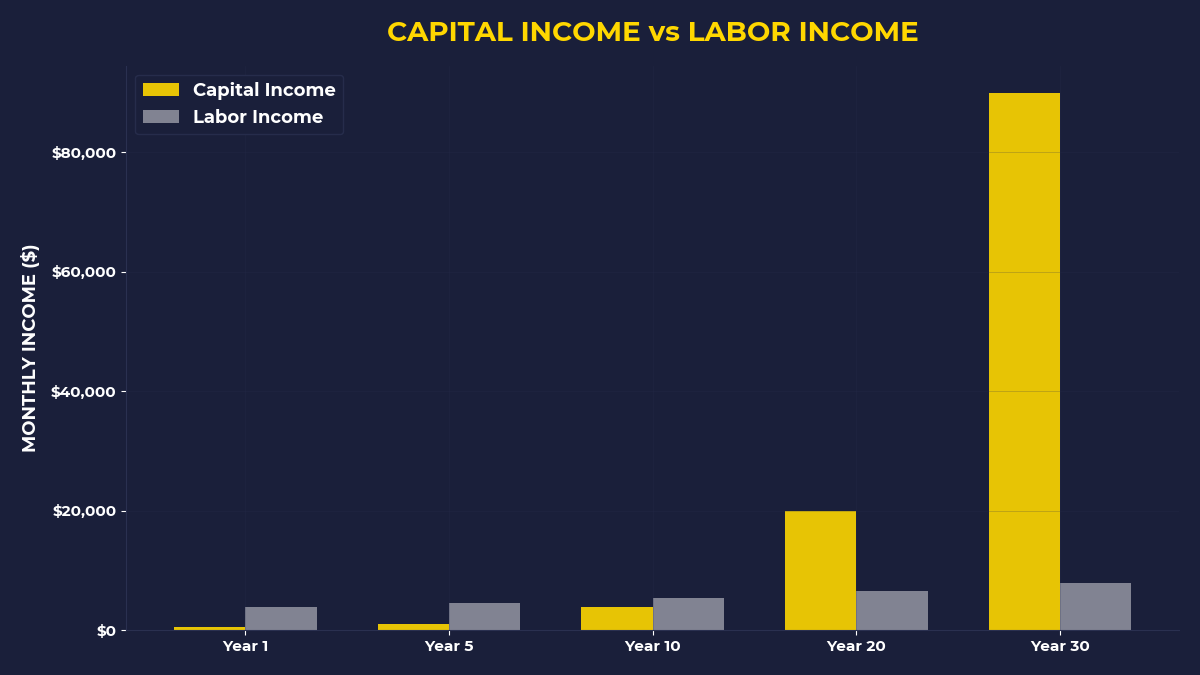
You can either own a piece of that $13 trillion or watch it replace your income.
What The Primal Investor Takes Away
• Buy AI capital, not AI skills. Invest in companies that own the platforms, infrastructure, and systems that capture AI-generated demand. Skills become obsolete; ownership compounds.
• Look for demand storage, not task automation. The most valuable AI companies don’t just automate work — they store human expertise in scalable systems that replace entire job categories.
• Follow the money flow from wages to dividends. When AI eliminates jobs, that salary expense becomes profit margin. Position yourself to receive those profits as an owner, not lose them as an employee.
• Recognize your substitution risk honestly. If your job involves pattern recognition, research, analysis, or routine decision-making, AI is coming for it. Plan accordingly.
• Own the infrastructure that enables AI. Focus on companies that provide the chips, cloud computing, data storage, and network infrastructure that makes AI possible. They capture value regardless of which specific AI applications succeed.
The AI revolution isn’t coming — it’s here. The only question is whether you’ll own it or be owned by it.
🎬 Prefer watching? Check out the video version on YouTube: