Have you ever wondered why your barista knows your coffee order by heart, but ChatGPT can write a business plan in thirty seconds?
We’re living through something that hasn’t happened since the steam engine changed everything in the 1800s. Artificial intelligence isn’t just another tech trend — it’s reshaping the entire economy. And if you understand what’s really happening, you’ll see opportunities that most people are completely missing.
The Pizza Delivery Driver Who Saw It Coming
Let me tell you about Marcus, a guy I met at a coffee shop last year. He delivered pizzas for three years while teaching himself to code. Not because he loved programming, but because he noticed something strange.
Every week, his delivery app got a little smarter. Better route optimization. More accurate time predictions. Fewer mistakes with addresses. Marcus realized the app was learning from thousands of drivers like him, getting better without any human programmer writing new code.
That’s when it hit him.
The app wasn’t just helping him deliver pizzas faster. It was learning how to replace him.
So Marcus made a choice that seemed crazy to his friends. Instead of working more shifts to save money, he worked fewer shifts and spent those hours learning to build AI systems himself. He didn’t want to feed the machine that would eventually eat his job — he wanted to own a piece of it.
Today, Marcus runs a small company that helps restaurants optimize their delivery routes using AI. He went from being replaced by artificial intelligence to profiting from it.
That’s AI economics in a nutshell.
What Capital Really Means in an AI World
Here’s what most people get wrong about artificial intelligence and money. They think AI is just another tool, like a faster computer or a better smartphone.
It’s not.
AI is what I call “stored intelligence.” Just like capital is stored demand — when people need what you own — AI captures and stores human thinking patterns. Then it can apply that thinking at massive scale, without the original human being present.
Think about it this way. When you use Google Translate, you’re accessing the language knowledge of thousands of translators who helped train that system. But those translators don’t get paid every time you translate a sentence. Google does.
That’s the new economy taking shape. The companies that own AI systems capture the value from all the human intelligence that went into building them. The people who provided that intelligence? Most of them get nothing after the initial transaction.
Unless they own equity in the companies building these systems.
The Middleman Extinction Event
Remember when you needed a travel agent to book a flight? A stockbroker to buy shares? A taxi dispatcher to get a ride?
AI is doing to entire industries what the internet did to travel agents. But faster, and at a scale we’ve never seen before.
I was talking to a friend who works at a law firm recently. She told me about an AI system that can review contracts in minutes — work that used to take junior lawyers hours. The partners love it because they can serve more clients with fewer employees.
But here’s what she noticed. The AI doesn’t just replace the junior lawyers. It changes what “being a lawyer” even means.
The lawyers who survive won’t be the ones who can review contracts fastest. They’ll be the ones who understand people, who can navigate complex negotiations, who can think strategically about problems the AI can’t solve.
Or better yet, they’ll be the lawyers who own stakes in the AI companies transforming their industry.
Why “AI-Proof” Jobs Miss the Point
Everyone’s talking about which jobs are “safe” from artificial intelligence. Teachers, therapists, plumbers — work that requires human connection or physical presence.
This is backwards thinking.
The question isn’t whether AI can replace your job. The question is whether you can use AI to create something valuable that didn’t exist before.
Take writing, for example. AI can write decent blog posts, product descriptions, even basic news articles. So many writers panic, thinking they’re doomed.
But the smart writers I know aren’t competing with AI on basic content. They’re using AI to handle the routine stuff — research, first drafts, editing suggestions — so they can focus on the uniquely human parts. Deep storytelling. Complex analysis. Personal perspective.
Some of them are even building AI-powered tools for other writers, becoming entrepreneurs instead of just freelancers.
The pattern is always the same: don’t fight the technology, own a piece of it.
The New Wealth Formula
Here’s how AI economics changes the wealth-building game.
In the old economy, you had two basic choices: sell your time for money (employee) or sell products/services for money (business owner). Both required you to show up and work.
AI creates a third option: own systems that generate value without your constant involvement.
This isn’t just about buying tech stocks — though that’s part of it. It’s about understanding that artificial intelligence makes it possible for small teams to create massive value.
Look at Instagram. Thirteen employees when Facebook bought it for a billion dollars. Look at WhatsApp. Fifty-five employees when Facebook paid $19 billion.
AI makes this pattern even more extreme. Because once you build an AI system that solves a real problem, it can serve millions of customers without hiring thousands of employees.
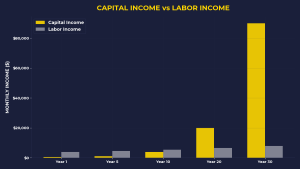
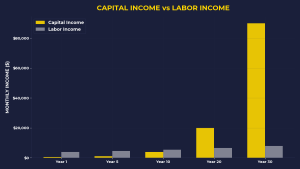
The wealth concentrates in the ownership, not the labor.
Three Ways AI Changes Your Money Strategy
First, every subscription you pay is training someone else’s AI system. Netflix learns your viewing preferences. Spotify learns your music taste. Amazon learns your shopping patterns. Your monthly bills aren’t just expenses — they’re data contributions that make these companies smarter and more valuable.
Ask yourself: are you just feeding these systems, or do you own pieces of them?
Second, AI makes it easier than ever to start a one-person business. You can use AI to handle customer service, create content, manage social media, even write code. Tasks that used to require entire teams can now be done by one person with the right tools.
The barrier to entrepreneurship just got much lower.
Third, the skills that matter are changing fast. Learning to “prompt” AI systems effectively is becoming as important as knowing how to use Google search was twenty years ago. But more than that, understanding how to combine AI capabilities with human judgment becomes the ultimate leverage.
The One Thing To Remember
AI economics isn’t about predicting which jobs will disappear or which stocks will soar. It’s about recognizing that we’re moving from a world where humans do most of the thinking to a world where humans direct most of the thinking. The people who prosper will be those who own the systems doing the thinking, not those who compete against them. Your goal shouldn’t be to become “AI-proof” — it should be to become AI-empowered.
Here’s what you can do starting today:
- Identify one repetitive task in your work or personal life and find an AI tool that can handle it, then use that freed-up time to focus on higher-value activities
- Instead of just paying for AI subscriptions, research owning shares in the companies building the AI systems you use most
- Start thinking about problems in your industry that AI could solve, and consider whether you could be the one to build or invest in that solution