Marcus Chen — 29, graphic designer in Denver — opened ChatGPT on a Tuesday morning and watched his career evaporate in real time.
He’d been working on logo concepts for a client. Three hours of sketching, researching color psychology, iterating through dozens of ideas. Then he fed the prompt to the AI: “Modern tech startup logo, minimalist, trustworthy, blue and gray palette.”
Twelve seconds later, ChatGPT delivered six logos that were better than anything he’d produced that morning. Not just faster. Better. More polished. More creative. More exactly what the client wanted.
Marcus sat back in his chair and felt something cold settle in his stomach. This wasn’t some distant future disruption. This was happening now. And he was on the wrong side of it.
The question that kept him awake that night wasn’t “How do I compete with AI?” It was deeper and more terrifying: “What happens to people like me?”
I Know That Feeling Because I Lived It
I remember the first time I understood what was coming. Not the marketing hype about AI making everyone more productive. The brutal economic reality.
I was 31, running a small content agency. We had twelve writers, four editors, two project managers. Good people. Talented people. People with mortgages and kids and dreams of building something.
Then GPT-4 launched.
Within three months, I could produce the same output with two writers that previously required eight. The math was simple and merciless. Eight salaries became two. Eight health insurance plans became two. Eight retirement contributions became two.
The writers I had to let go weren’t lazy. They weren’t untalented. They were just caught in the transition between the old economy and the new one. And most of them had no idea what was happening until it was over.
That’s when I realized something that changed everything about how I think about money and the future.
AI Doesn’t Replace Jobs — It Concentrates Ownership
Here’s what everyone gets wrong about AI economics.
The story you hear is: “AI will eliminate some jobs but create new ones. Just retrain. Adapt. Learn to work with AI.”
That’s not what’s actually happening. AI isn’t just changing what work gets done. It’s changing who owns the economic value that work creates.
Think about Marcus’s situation. When he spent three hours creating logos, his time was the scarce resource. Clients paid him $150 per hour because design skill + time was valuable and limited.
But AI removed scarcity from the equation.
Now the same design output can be produced in twelve seconds for essentially zero marginal cost. The economic value didn’t disappear — it got captured by whoever owns the AI infrastructure.
OpenAI shareholders. NVIDIA shareholders. Microsoft shareholders. Amazon Web Services shareholders.
The people who own the capital that powers AI are collecting the economic value that used to flow to individual workers like Marcus.
Why This Changes Everything About Building Wealth
Most people think the AI revolution is about technology. It’s actually about capital ownership.
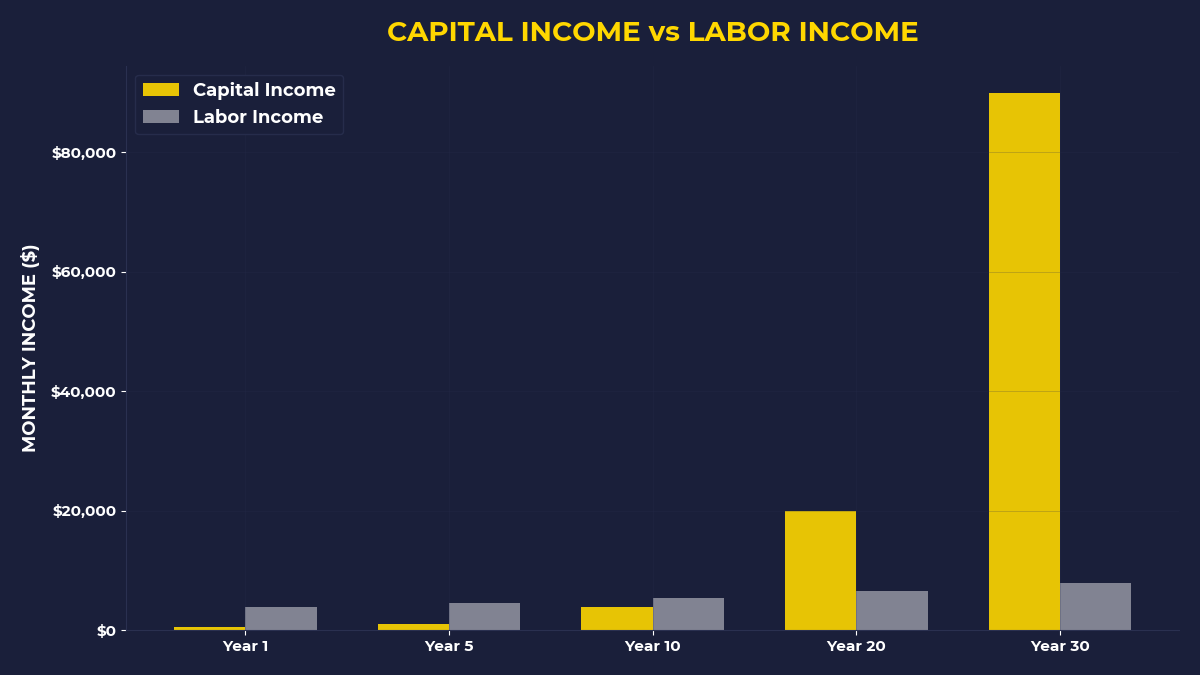
In the old economy, you could trade time for money and gradually build wealth. Work hard, get promoted, save 15% of your income, invest in index funds, retire in 40 years.
That path still works if your job can’t be automated. But for the 60% of knowledge workers whose tasks can be replicated by AI, the equation is breaking down.
When I realized this, I made a decision that felt crazy at the time but saved my financial future.
Instead of trying to compete with AI in content creation, I started buying shares in the companies building AI. Instead of working harder to preserve my agency’s revenue, I shut it down and bought Microsoft stock with the remaining cash.
I went from trying to earn money from AI-replaceable labor to owning a piece of the capital that was replacing that labor.
The returns? My content agency revenue was declining 20% quarterly in 2023. My Microsoft position gained 47% that same year.
The New Wealth Equation
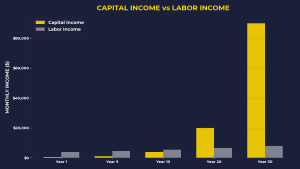
Here’s what I learned from watching my industry get transformed: AI economics creates two distinct classes.
Capital owners who benefit from AI productivity gains. And workers whose productivity gets captured by someone else’s capital.
The difference isn’t about being smart or hardworking. It’s about what you own.
Let me give you a concrete example that shows how this works.
Sarah Williams, 34, marketing manager in Chicago, makes $85,000 per year. She’s excellent at her job. She uses AI tools to be more productive. She can now do in two hours what used to take her all day.
But here’s the trap: her salary stays the same while her productivity multiplies. The economic value of that extra productivity flows to her company’s shareholders, not to her.
Meanwhile, someone who owns $100,000 worth of Microsoft stock collects dividends and capital gains from AI productivity improvements across thousands of companies. They benefit from Sarah’s AI-enhanced productivity without doing any of the work.
The person trading time for money gets stuck at the same income level. The person who owns capital gets richer automatically.
What Do You Own That Benefits From AI?
This is the question that separates people who will thrive in the AI economy from people who will struggle.
Most people focus on how AI will change their job. The right question is: what do you own that captures value from AI productivity gains?
If the answer is “nothing,” you’re on the wrong side of the biggest economic shift in decades.
I’m not talking about picking the next hot AI stock. I’m talking about owning pieces of the infrastructure that makes AI valuable.
The semiconductor companies that build AI chips. The cloud providers that run AI workloads. The software companies that integrate AI into business processes. The platforms that distribute AI capabilities.
These companies capture the economic value that AI productivity creates. When you own shares in them, you collect your portion of that value.
The Time Advantage Is Shrinking
Here’s what makes this urgent: the transition is happening faster than most people realize.
In 2020, GPT-3 could barely write a coherent paragraph. In 2024, AI can write code, create art, analyze data, generate videos, and automate complex workflows. In 2027, it will do things we can’t imagine today.
The people who position themselves as capital owners before the transition accelerates will benefit from every productivity improvement AI delivers.
The people who wait will watch AI make other people’s capital more valuable while their own labor becomes less valuable.
I know this sounds harsh. But economic transitions don’t care about fairness. They create winners and losers based on who owns what when the change happens.
Your Move in the AI Economy
If you’re someone who earns money primarily from knowledge work, you have a choice to make right now.
You can focus on becoming better at working with AI tools. That’s not wrong, but it’s not enough. You’re still trading time for money in an economy that’s reducing the value of that time.
Or you can start building capital ownership in the companies and infrastructure that benefit from AI adoption.
This doesn’t mean you quit your job tomorrow. It means you start thinking like an owner instead of just a worker.
Every month, before you pay any other bills, you move money into ownership positions in AI-benefiting companies. Even if it’s just $200. Even if it means eating ramen for a few extra dinners.
Because the economic value AI creates has to go somewhere. It’s either flowing to you as a capital owner, or it’s flowing past you to someone else who owns what you don’t.
The One Thing To Remember
AI isn’t just changing how work gets done — it’s changing who captures the economic value work creates. The people who own capital that benefits from AI productivity will get richer automatically. The people who only own their labor will watch that labor become less valuable over time. The transition is happening now, not in some distant future.
What you need to do:
Open a brokerage account this week if you don’t have one
Buy shares in companies that provide AI infrastructure: Microsoft, Amazon, NVIDIA, Google
Set up automatic investments so you’re building ownership while everyone else is just adapting to AI
🎬 Prefer watching? Check out the video version on YouTube: