Have you ever wondered why the smartest person you know drives a twenty-year-old car but somehow never has money to invest?
Or why your friend who aced calculus in college panics and sells everything when the stock market drops 10%?
The answer isn’t about intelligence. It’s about how our brains are wired. And once you understand this wiring, you’ll never look at money decisions the same way again.
The Caveman in Your Portfolio
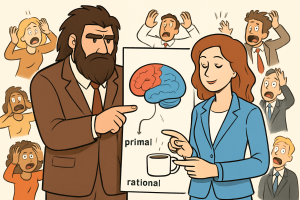
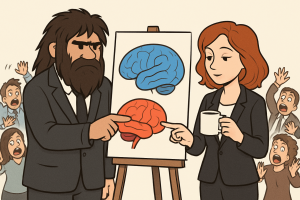
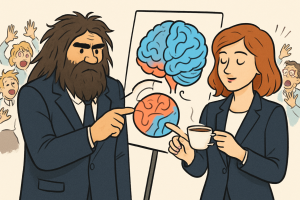
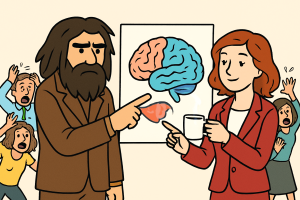
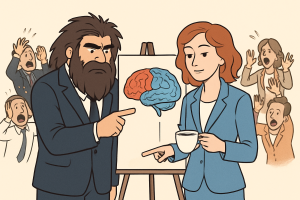
Your brain evolved over thousands of years to keep you alive in a world where a rustling bush might hide a predator.
That same brain now has to make decisions about retirement accounts and compound interest.
See the problem?
When the stock market crashes, your ancient brain doesn’t see “temporary volatility in capital markets.” It sees a saber-toothed tiger charging at you. Every instinct screams: RUN.
This is why perfectly rational people do irrational things with money. Your caveman brain hijacks your investment decisions before your logical brain can even process what’s happening.
The field that studies this hijacking has a name: behavioral finance for beginners starts with understanding this simple truth.
The Story of Two Investors
Let me tell you about Sarah and Mike. They both started investing in January 2020 with $10,000 each.
Sarah read about index funds and bought a simple S&P 500 fund. Then she did something remarkable: nothing. She automated her monthly contributions and forgot about it.
Mike, meanwhile, read everything. Financial blogs, market analysis, economic reports. He was convinced his superior knowledge would give him an edge. When COVID hit in March 2020 and markets plunged 30%, Mike’s extensive research told him this was different. This was the big one. He sold everything at the bottom.
By December 2020, Sarah’s “boring” index fund was up 18% for the year. Mike? He was still sitting in cash, paralyzed by analysis and waiting for the “perfect” time to get back in. That perfect time never came.
The irony? Mike was objectively smarter about markets. He could explain P/E ratios and yield curves. But Sarah understood something more valuable: her own psychology.
This story illustrates the core insight of behavioral economics investing: knowledge without self-awareness is often worse than ignorance with good systems.
Your Brain’s Biggest Money Tricks
Your brain plays three major tricks on your money decisions. Once you see them, you can’t unsee them.
Trick #1: Loss Feels Twice as Bad as Winning Feels Good
Losing $100 hurts more than winning $100 feels good. This isn’t just a feeling—it’s measurable. Researchers found losses feel roughly twice as painful as equivalent gains feel pleasant.
This is why you check your investment account obsessively when it’s going down but barely glance at it when it’s going up. Your brain is hardwired to focus on threats.
Trick #2: You See Patterns That Don’t Exist
Your friend mentions three stocks that “everyone’s talking about” and suddenly you see them everywhere. Billboards, news articles, random conversations.
This isn’t magic. It’s your pattern-seeking brain creating connections where none exist. The stocks didn’t become more popular—you just started noticing them.
Trick #3: You Overvalue What You Already Have
Ever notice how your stuff feels more valuable once you own it? That car you bought feels worth more to you than identical cars for sale. Economists call this the “endowment effect.”
With investments, this makes you hold losing stocks too long (“But I paid $50 for this!”) and sell winners too early (“I better lock in this profit before it disappears!”).
The Monthly Bills Revelation
Here’s where behavioral finance gets really interesting for building actual wealth.
Look at your monthly bills. Rent, subscriptions, groceries, gas, insurance. Every payment is money flowing from you to someone who owns capital.
Your landlord owns real estate. Netflix owns content libraries. The grocery chain owns distribution networks. The gas company owns energy infrastructure.
Now here’s the reframe: What if instead of just paying these bills, you owned tiny pieces of the companies receiving your payments?
This isn’t about picking stocks or trying to beat the market. It’s about slowly shifting from being purely a consumer to being partly an owner.
But here’s where psychology of money decisions gets tricky: your brain will resist this shift.
Paying bills feels necessary and urgent. Investing feels optional and distant. Your brain prioritizes the immediate and tangible over the distant and abstract.
The solution? Make ownership feel as automatic as paying bills.
The Pay-Yourself-First Hack
Robert Kiyosaki popularized a simple concept: pay yourself first, then scramble to cover everything else.
Most people do the opposite. They pay all their bills, buy what they want, then invest whatever’s left over. (Spoiler: there’s rarely anything left over.)
But what if you flipped this?
What if the first “bill” you paid each month was to your future self—buying tiny ownership stakes in productive assets?
Here’s what happens: your brain treats it like any other fixed expense. It stops feeling optional and starts feeling automatic.
You find ways to make the rest work. You negotiate that subscription down. You find a cheaper phone plan. You cook at home one more night per week.
The magic isn’t in the specific dollar amount. It’s in training your brain to prioritize ownership over consumption.
Why Investors Make Bad Choices (And How to Stop)
The biggest investing mistakes aren’t technical. They’re emotional.
People who overcome investment biases don’t have special knowledge about markets. They have better systems for managing their own psychology.
Here’s the uncomfortable truth: you will want to panic-sell during the next market crash. You will want to chase whatever investment just made headlines. You will want to time the market “just this once.”
These aren’t character flaws. These are features of human psychology that kept your ancestors alive.
The solution isn’t to fight these instincts. It’s to design systems that make good decisions automatic and bad decisions harder.
Want to avoid panic-selling? Don’t give yourself easy access to the sell button. Use retirement accounts with penalties for early withdrawal.
Want to avoid chasing hot stocks? Automate your investments into boring index funds before you see the headlines.
Want to stop checking your balance obsessively? Delete the apps from your phone.
The One Thing To Remember
Your brain evolved to survive in a world that no longer exists, but it’s the only brain you’ve got for navigating modern money decisions. The goal isn’t to become a perfectly rational economic actor—that’s impossible. The goal is to design simple systems that work with your psychology, not against it. When you automate good decisions and make bad decisions harder, you stop fighting your own brain and start using it as an ally in building wealth.
Three things you can start today:
Set up automatic transfers to an investment account on the same day you get paid—before you pay any other bills
Delete investment apps from your phone to reduce the temptation to make emotional decisions
Write down three specific scenarios that would make you want to panic-sell, and decide now what you’ll do instead