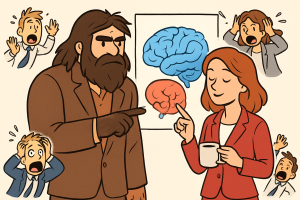
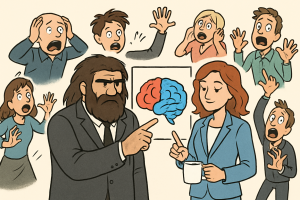
The safest thing you can do as a contrarian investor is the thing that feels most dangerous: think completely alone.
I learned this the expensive way. Back in 2018, I joined an “exclusive” contrarian investing group. Smart people. Impressive track records. They preached buying when others sold, selling when others bought. Classic contrarian stuff.
Within six months, I realized I’d made a fundamental error. I wasn’t being contrarian anymore — I was following a contrarian herd. Same bias, different tribe. When the group got excited about distressed energy stocks in late 2018, I followed along. When they all started talking about “value opportunities” in retail, I bought in. The results were predictably mediocre.
Here’s what nobody tells you about contrarian investing: the moment you join any crowd — even a contrarian crowd — your edge disappears.
Why Most “Contrarian” Investors Are Just Hipster Herders
Think about the investors you know who call themselves contrarians. How many of them read the same newsletters, follow the same Twitter accounts, attend the same conferences?
They’re not contrarian. They’re hipsters.
Real contrarian behavior happens in complete isolation from any tribe. When everyone is buying growth stocks, the contrarian doesn’t automatically buy value stocks because some value investing guru told them to. They ask: “What structural dynamics is everyone missing right now?”
The herd instinct is so powerful that it captures even people who think they’re immune to it. I’ve watched brilliant investors — people who understood behavioral finance better than I did — get swept up in contrarian groupthink about everything from gold to emerging markets to cryptocurrency.
Look at what happened during March 2020. While retail investors were panic-selling, the “contrarian” crowd was busy buying the dip together, posting about it on social media, congratulating each other for being so smart. They were right, but for the wrong reasons. They weren’t being contrarian — they were following a different script.
The Structural Edge Hidden in True Isolation
When I finally started investing in complete intellectual isolation — no newsletters, no investing podcasts, no Twitter feeds — something shifted.
Instead of looking for what the crowd was doing wrong, I started looking for what everyone was structurally missing. The difference is subtle but crucial.
In 2019, everyone was either bullish on tech or bearish on tech. The “contrarians” were buying banks and energy stocks because they were unloved. But the real opportunity was hiding in plain sight: software companies with subscription models that were trading at reasonable valuations because they weren’t sexy enough for the growth crowd or cheap enough for the value crowd.
True contrarian thinking isn’t about zigging when others zag. It’s about seeing the game everyone else is missing entirely.
Consider this: between 2010 and 2020, the S&P 500 returned about 13.6% annually. Most professional fund managers — including many who called themselves contrarian — underperformed this basic index. Why? They were all playing the same game with slightly different strategies, not seeing entirely different games.
What Does Real Independence Look Like?
How do you know if you’re thinking independently? Here’s the test I use: if you can predict what the “smart money” contrarians will say about a market event before it happens, you’re still trapped in groupthink.
Real independence means your investment decisions would surprise both the mainstream crowd and the contrarian crowd.
When Tesla was approaching $400 in 2020, the mainstream crowd was buying because of the story. The contrarian crowd was shorting because of the valuation. The independent thinker was asking: “What if this isn’t a car company at all, but an energy storage and software company that happens to make cars?”
That question led to a different conclusion than either crowd reached.
The Compound Cost of Following Any Tribe
Here’s what following even contrarian crowds costs you over time: your judgment atrophies.
Every time you defer to someone else’s framework — even a brilliant contrarian framework — you get a little worse at thinking for yourself. After a few years of this, you can’t tell the difference between your own insights and recycled wisdom from your tribe.
I remember sitting in my apartment in 2019, looking at my brokerage app, realizing I couldn’t explain why I owned half the stocks in my portfolio without referencing something I’d read or heard from other investors. That was terrifying.
The anchorage bias was running my entire investment process. I was anchoring to contrarian opinions instead of mainstream opinions, but anchoring nonetheless.
The Capital Allocation Question Nobody Asks
When you strip away all the noise — all the tribes, all the systems, all the frameworks — one question remains: where is capital being allocated inefficiently right now?
This isn’t a question about sentiment or positioning. It’s about structure.
In the 1970s, capital was being allocated inefficiently to conglomerates. In the 1990s, it was being allocated inefficiently to any company with a dot-com in its name. In the 2000s, it was being allocated inefficiently to housing and financial leverage.
The contrarian crowds identified some of these inefficiencies, but they usually identified them by following their anti-mainstream scripts, not by independent structural analysis.
True independence means asking: what’s getting too much capital right now, and what’s getting too little, based on long-term demand dynamics that most people can’t see yet?
Why This Matters More in the AI Era
If you’re the kind of investor who wants to build real wealth over the next two decades, independence isn’t just an edge — it’s survival.
AI is going to accelerate everything. Information will spread faster. Patterns will be recognized quicker. The half-life of any investment insight will shrink dramatically.
In this environment, following any crowd — mainstream or contrarian — becomes even more expensive. By the time a crowd forms around an idea, that idea has already been arbitraged away.
The only sustainable edge will be the ability to see structural shifts that neither the algorithms nor the crowds have spotted yet. And that requires complete intellectual independence.
What The Primal Investor Takes Away
• Stop reading investment newsletters and unfollow investing Twitter accounts for 90 days. Let your brain reset.
• Before making any investment decision, ask: “Would this surprise both the mainstream and contrarian crowds?”
• Focus on structural questions about capital allocation, not sentiment or positioning.
• Test your independence: if you can predict what the “smart contrarians” will say about market events, you’re still trapped.
• Remember that AI will make crowd-following even more expensive. True independence becomes the only sustainable edge.
Your brain evolved to follow the tribe. But capital flows to those who can think outside every tribe.
🎬 Prefer watching? Check out the video version on YouTube: