Marcus — 29, software engineer in Denver — sat in his Honda Civic outside a Starbucks on a Tuesday morning, staring at his banking app. His checking account showed $847. His credit card balance showed $3,200. He’d been making $85,000 a year for three years now, but somehow the math never worked.
He refreshed the app, hoping the numbers might change. They didn’t.
Later that week, Marcus called his older brother Jake for advice. Jake owned two rental properties and somehow always seemed to have money for vacations, nice dinners, whatever he wanted. “How do you do it?” Marcus asked. “You don’t even make more than me.”
Jake’s answer stopped him cold: “Different question, man. You’re asking ‘How can I make more money?’ I ask ‘What should I buy?'”
I Used To Ask the Wrong Question Too
I know exactly how Marcus felt because I was there too. Back when I was 26, working 50-hour weeks and wondering why my bank account looked like a leaky bucket, I was obsessed with the wrong problem.
Every self-help book I read, every finance blog I consumed, every conversation with successful people — they all focused on what I should DO. Work harder. Learn new skills. Get promoted. Network more. Wake up at 5 AM. Meditate. Read 50 books a year.
Here’s what nobody told me: all that advice assumes you’re trying to win a game that’s rigged against you.
I spent two years following productivity gurus and career coaches. I got better at my job. I even got a raise. But I was still living paycheck to paycheck, just with a slightly bigger paycheck.
The breakthrough came when I overheard two guys talking at a coffee shop. One was complaining about his rent going up $200 a month. The other guy — who looked about my age — just shrugged and said, “That’s another $2,400 a year going straight to my landlord’s retirement fund instead of mine.”
That’s when it hit me.
The Question That Changes Everything
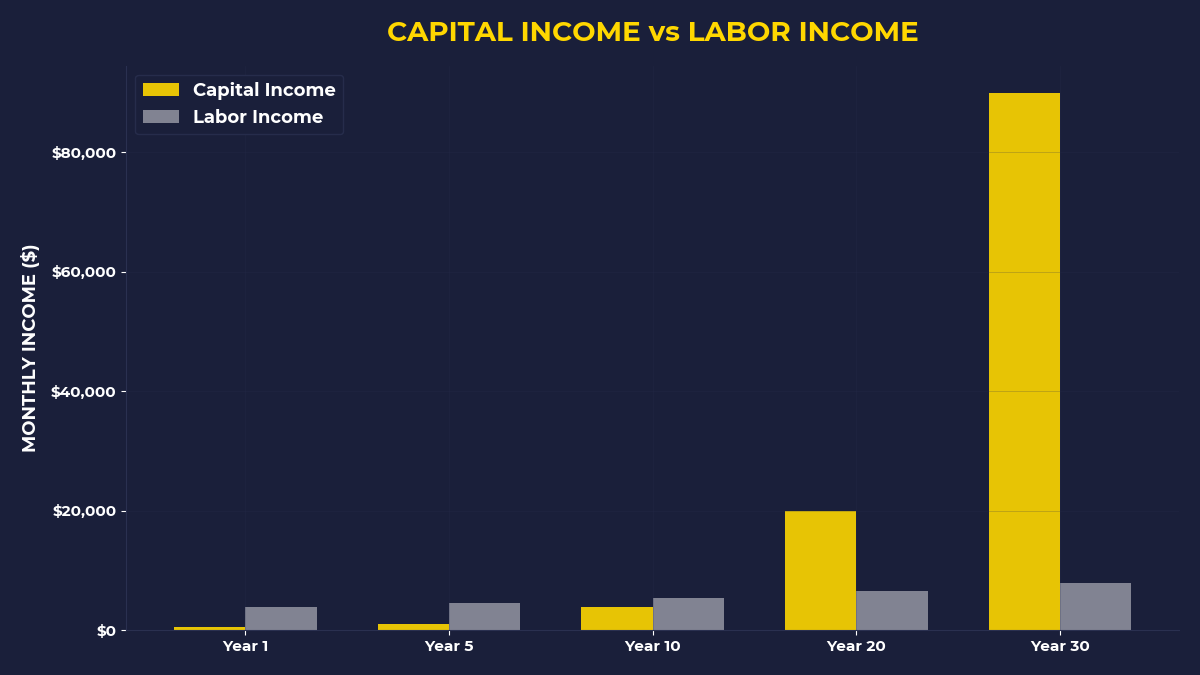
Most people spend their entire lives asking “What should I do to make money?” Capital owners ask “What should I buy to make money?”
It sounds like semantics, but it’s the difference between addition and multiplication.
When you ask “What should I do?” you’re thinking about trading your time for money. You’re thinking about working harder, getting better skills, climbing the corporate ladder. You’re thinking about addition — adding more hours, adding more effort, adding more stress to your life.
When you ask “What should I buy?” you’re thinking about leverage. You’re thinking about systems that work without you. You’re thinking about multiplication.
Let me show you what this looks like in practice.
Remember Warren Buffett’s childhood golf ball story? Young Warren would find lost golf balls around golf courses, clean them up, and sell them for 6 cents each. Classic “what should I do” thinking — trade time and effort for money.
But here’s the part most people miss. If Warren had kept thinking “what should I do,” he would have spent his entire life picking up golf balls. Instead, he shifted to “what should I buy.” He took the money from selling golf balls and bought assets that generated cash flow. Then he used that cash flow to buy more assets.
The golf balls were just the seed money. The real wealth came from asking the right question.
Your Monthly Bills Are Economic Textbooks
Want to see this principle in action? Look at your bank statement from last month.
Rent or mortgage: $1,400. Your landlord asked “What should I buy?” and bought your apartment building. You ask “How can I afford this?” every month.
Car payment: $380. The bank asked “What should I buy?” and bought your car loan. You ask “What’s the lowest payment I can get?”
Netflix, Spotify, gym membership: $47. These companies asked “What should we buy?” and built platforms that collect $47 from millions of people every single month. You ask “What shows should I watch?”
Your grocery bill, your coffee runs, your utility payments — every single expense is someone else’s revenue. Every dollar leaving your account is flowing to someone who asked “What should I buy?” instead of “What should I do?”
The Harry Larsen Revelation
There’s this story Warren Buffett tells about a guy named Harry Larsen. Harry was at a pharmacy when someone asked him about his weight. He looked around, found a coin-operated scale, put in a penny, and weighed himself.
Over the next few minutes, Harry watched seven other people use the same scale.
Most people would have walked away. Harry asked the store owner about the scale. Turns out, the owner was renting it and keeping 25% of the revenue — about $20 a month per scale.
Harry went to his bank, withdrew $175, and bought three scales. Soon he was making $98 a month in passive income.
But here’s the kicker: “I eventually bought 70 machines,” Harry said, “and the last 67 were paid for with coins from the first three.”
This is compound wealth building in its purest form. Harry didn’t work 70 times harder. He bought 70 times smarter.
Why Your Brain Fights This
Your brain is programmed to ask “What should I do?” It’s an ancient survival mechanism. For thousands of years, the people who survived were the ones who could work harder, hunt better, outlast their competitors.
But we don’t live in that world anymore.
In today’s economy, the people who get rich are the ones who own things that other people need. Your brain still thinks like a hunter-gatherer, but the economy rewards capital owners.
This is why 97% of people never make the mental shift. Their brain keeps them focused on doing more instead of owning more.
The Compound Leverage Effect
Here’s what happened to Marcus after his conversation with Jake.
Instead of looking for ways to work more hours or get a side hustle, Marcus started asking “What should I buy?” He looked at his $847 bank balance differently. Instead of seeing it as “not enough,” he saw it as seed capital.
He bought $500 worth of QQQ, an ETF that owns pieces of the 100 largest tech companies. Every month, he bought more. When he got his tax refund, he bought more. When he worked overtime, he bought more.
But here’s the thing — he didn’t just buy financial assets. He started thinking like an owner about everything.
When his company was deciding between two software vendors, Marcus researched which ones were publicly traded. When he needed a new laptop, he bought Apple stock first, then the laptop. When everyone was complaining about rising grocery prices, Marcus bought shares in Costco.
Eighteen months later, Marcus called Jake again. This time, he was calling from his own rental property showing — he’d saved enough for a down payment by thinking like an owner instead of a worker.
Are You Ready to Change Your Question?
If you’re someone who works hard but never seems to get ahead financially, this shift in thinking could change everything. If you’re tired of watching your paycheck disappear into other people’s assets, it’s time to flip the script.
But I’ll be honest with you — this isn’t for everyone. If you’re someone who just wants to clock in, clock out, and not think about money, keep doing what you’re doing. If you believe that working harder is always the answer, this probably won’t resonate.
This is for people who are tired of the addition game and ready to start playing the multiplication game.
The One Thing to Remember
Every dollar you spend is someone else’s revenue. Every bill you pay is flowing to someone who asked “What should I buy?” instead of “What should I do?” The fastest way to change your financial trajectory isn’t to work harder or earn more — it’s to start thinking like the people who own the things you’re buying. Stop asking “How can I make money?” Start asking “What should I buy?”
Action items for today:
Before you pay any bill this month, buy $50 worth of stock in a company you regularly pay money to
Write down three things you spend money on monthly, then research if those companies are publicly traded
Next time you catch yourself asking “How can I afford this?” reframe it as “What should I buy that helps other people afford this?”
🎬 Prefer watching? Check out the video version on YouTube: