Marcus — 29, software engineer in Denver — called me at 11 PM on a Tuesday. His voice had that hollow quality I recognized immediately. “I make $95,000 a year,” he said. “I should feel rich. But I looked at my savings account today and it’s basically the same number it was two years ago.”
I knew exactly where this conversation was heading because I’d had it with myself a hundred times.
I Used to Ask All the Wrong Questions
Marcus spent the next twenty minutes walking through his strategy. He’d read the productivity books, optimized his morning routine, negotiated a 12% raise last year. He was doing everything right, which was exactly his problem.
Look, I get it.
When I was 26 and making decent money as a marketing manager, I was obsessed with the same question Marcus was asking: “What should I do to get ahead financially?” I read every self-help book in Barnes & Noble. I tracked my expenses in spreadsheets. I learned about tax optimization and side hustles and personal branding.
And you know what happened? I got really good at being busy while staying broke.
The breakthrough came during a conversation with my neighbor Dave, who owned three rental properties and a small logistics company. I was complaining about my student loans when he said something that stopped me cold: “You’re asking the wrong question.”
The Question That Changes Everything
Dave explained it like this: “Most people ask ‘What should I do?’ Capital owners ask ‘What should I buy?'”
At first, I thought he was being pedantic. Then he walked me through his morning routine. While I was optimizing my productivity system, Dave was scanning real estate listings. While I was networking at industry events, Dave was researching small businesses for sale. While I was taking online courses to improve my skills, Dave was buying shares of companies run by people with better skills than either of us.
Think about that.
Here’s what Dave understood that I didn’t: Every dollar you spend is a vote for someone else’s capital. Your rent check? That’s revenue for your landlord’s real estate investment. Your Netflix subscription? That’s cash flow for Netflix shareholders. Your grocery bill? That’s profit for Kroger investors.
You’re already participating in the capital game. You’re just playing on the wrong side.
The Golf Ball Principle
Dave told me a story that night that I’ve never forgotten. When Warren Buffett was a kid, he collected lost golf balls from the local course and sold them in 12-packs for $6 each. Most people focus on the hustle — the young Buffett crawling through bushes, cleaning golf balls, dealing with customers.
But here’s what made it genius: Buffett took the money from those golf balls and bought assets. Farm land. Stock in companies. Eventually, a Rolls Royce that he rented out.
The kid wasn’t just working. He was converting labor into leverage.
Marcus had been working the golf ball hustle his entire career — putting in hours, collecting paychecks, getting good at his job. But he never asked the follow-up question: “What should I buy with this money?”
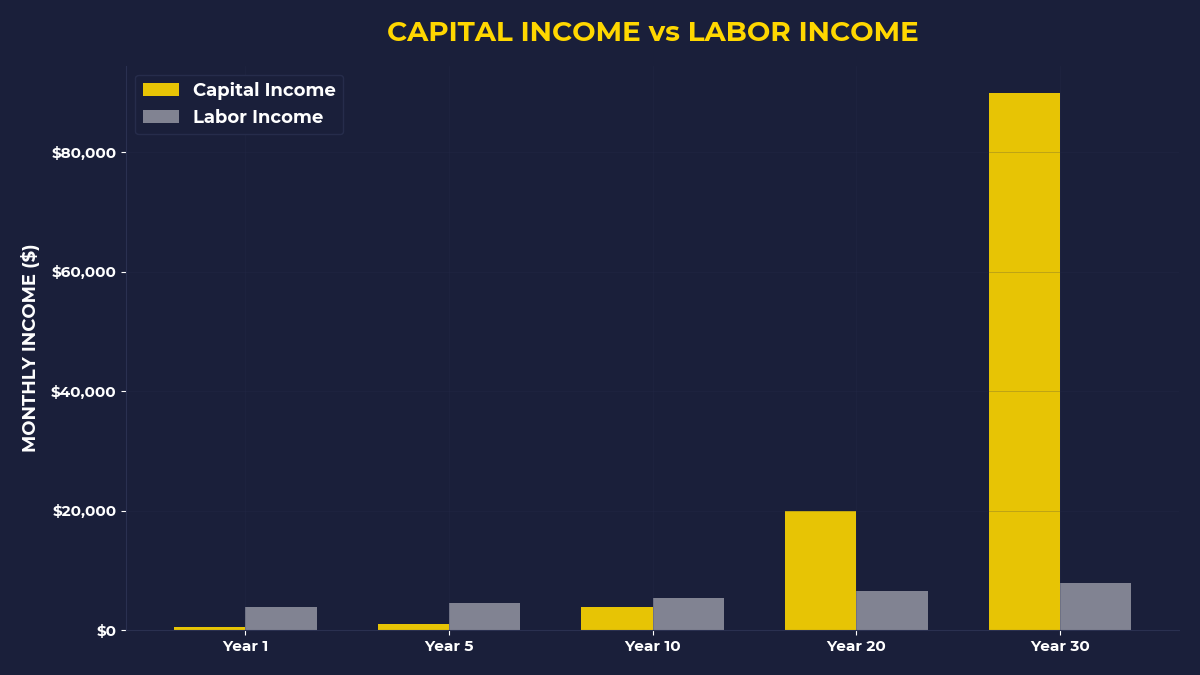
I walked him through the math. His $95,000 salary minus taxes and living expenses left him with maybe $20,000 a year in discretionary income. If he kept asking “What should I do?” — take another course, start a side hustle, negotiate another raise — he might bump that number up gradually.
But if he started asking “What should I buy?” — index funds, individual stocks, rental property, a small business — that $20,000 could start working for him while he slept.
Why Your Brain Resists This Shift
Here’s the thing that tripped me up for years: buying assets feels passive compared to taking action. We’re programmed to believe that effort equals results. More hours, more skills, more hustle.
But capital doesn’t work that way.
When you buy a share of Apple, you own a tiny piece of the iPhone supply chain. When you buy a rental property, you own a piece of someone else’s housing demand. When you buy an index fund, you own a slice of the entire economy’s growth.
You’re not being lazy. You’re being leveraged.
Marcus pushed back on this hard. “But I don’t have enough money to buy anything meaningful,” he said. “What am I going to do, buy $100 worth of stocks?”
Yes. Exactly that.
The Compound Trap
I made Marcus write down every recurring bill he paid last month. Rent: $1,800. Car payment: $420. Student loans: $340. Utilities: $180. Subscriptions: $120. Insurance: $150. Groceries: $400.
“You paid everyone else first,” I told him. “Your landlord, the bank, Netflix, the grocery store shareholders. Then whatever was left over, you paid yourself.”
What if he flipped it?
What if, before paying any of those bills, Marcus moved $200 into a brokerage account? Even if it meant scrambling to cover everything else. Even if it meant eating ramen for a week.
I know this sounds backwards. Your brain is screaming that bills come first. But think about what’s really happening: you’re prioritizing other people’s capital over your own.
Your landlord is building equity in real estate. The bank is earning interest on your loans. Netflix is generating cash flow from your subscription. Meanwhile, you’re left with whatever scraps remain.
The system is designed to extract your money before you can deploy it.
The Leverage Question
Six months after our conversation, Marcus texted me a screenshot of his brokerage account. $1,400 invested across four different index funds. Not life-changing money, but something had shifted.
“I get it now,” he wrote. “I’m not just saving. I’m buying demand.”
That’s exactly right.
When you own shares in an S&P 500 index fund, you own a piece of the demand for Apple iPhones, Microsoft software, Amazon deliveries, and Tesla cars. You own a slice of every transaction those companies process.
Are you ready for the real question that separates capital owners from everyone else?
It’s not “How can I make more money?” It’s not “What skills should I develop?” It’s not even “What should I buy first?”
The question is: “What do people need that I can own a piece of?”
The One Thing To Remember
Every successful person I know made the same mental shift Marcus made. They stopped asking “What should I do?” and started asking “What should I buy?” The person who optimizes their productivity system stays busy. The person who buys appreciating assets gets wealthy. Capital creates more capital, but only if you own some first.
Here’s what you do today:
• Before paying any bills this month, move $50-200 (whatever feels uncomfortable but not impossible) into a brokerage account
• Buy shares of a broad market index fund like VTI or VOO — you now own pieces of the 500 largest companies in America
• Next month, do it again before paying bills — even if you have to scramble to cover rent
🎬 Prefer watching? Check out the video version on YouTube: