Marcus — 29, software engineer in Denver — called me last Tuesday at 11 PM. He’d just finished his third 12-hour day in a row, debugging code for someone else’s app that would make someone else millions. “I’m doing everything right,” he said. “Good salary, 401k contributions, emergency fund. So why do I feel like I’m running in place?”
I knew exactly what Marcus meant because I’d been there.
For years, I asked the same question everyone asks: “What should I do to get ahead?” I read the productivity books. Optimized my morning routine. Learned new skills. Got promoted twice. And watched my bank account grow at the speed of molasses while my rent checks flew out the door at light speed.
The Question Everyone Asks (That Keeps You Poor)
Walk into any bookstore. Browse the self-help section. Every title promises to teach you what to do.
“7 Habits of Highly Effective People.” “What Successful People Do Before Breakfast.” “The 4-Hour Workweek Action Plan.” It’s all about doing.
Here’s the thing. I spent my twenties optimizing what I did. I woke up at 5 AM. Meal prepped on Sundays. Networked like crazy. Took online courses after work. I was a productivity machine.
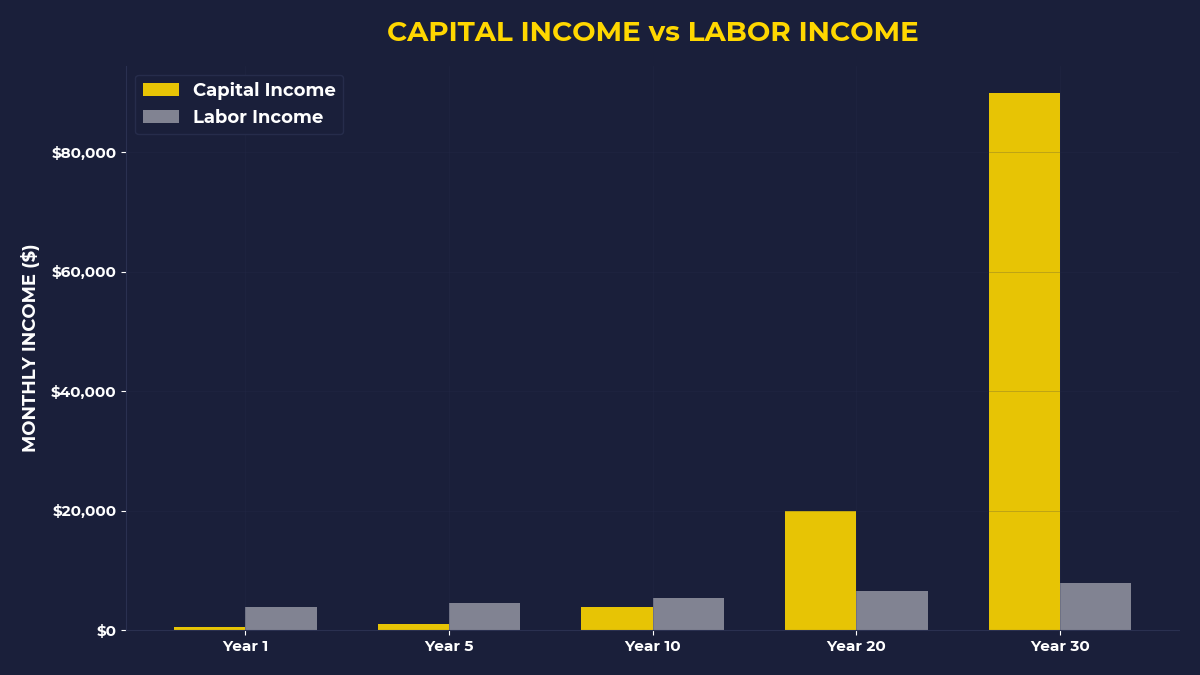
And I was still sending 67% of my paycheck to capital owners every single month.
Rent to my landlord — $1,800. Car payment to the bank — $340. Student loans to Sallie Mae — $280. Groceries to Whole Foods shareholders — $400. Netflix, Spotify, gym membership — another $89 combined. Even my morning coffee was a $4 dividend payment to Starbucks investors.
Every swipe of my card was a vote for someone else’s wealth.
The Question That Changes Everything
Then I stumbled across Warren Buffett’s golf ball story. When he was 11, young Warren would hunt for lost golf balls around Omaha country clubs, clean them up, and sell them by the dozen. Most people focus on his work ethic — the kid was entrepreneurial, right?
But that misses the real lesson.
Warren didn’t keep asking “What should I do next?” He asked “What should I buy next?”
The money from golf balls went toward buying a pinball machine, which he placed in a barbershop. That machine generated quarters while Warren slept. The quarters bought more pinball machines. The pinball profits bought farmland. The farmland income bought stocks.
At every step, Warren asked the same question: “What should I buy that people will pay to use?”
Not “How can I work harder?” Not “What skills should I develop?” Those questions keep you trapped in the labor game.
Capital owners ask different questions.
Why Most People Never Switch Sides
I get it. When Marcus called me that night, exhausted from another 12-hour day, buying assets felt impossible. He barely had money left after bills. How was he supposed to buy anything that generated income?
This is where most people give up. They think capital requires massive upfront cash.
But remember Harry Larson’s story from “1,000 Ways to Make $1,000.” Harry was standing in a drugstore when someone asked about his weight. He noticed a coin-operated scale — drop in a penny, get your weight. In ten minutes, Harry watched seven people use that machine.
Harry asked the store owner about the setup. The owner explained he rented the machine and kept 25% of the revenue — about $20 per month in 1930s money.
Harry withdrew $175 from his savings and rented three scales. Soon he was earning $98 monthly. But here’s the kicker: “I bought seventy machines total, and the additional sixty-seven were paid for entirely with coins from my first three machines.”
Harry switched from asking “What work should I do?” to “What should I buy that generates cash?”
The Compound Capital Question
When you start asking “What should I buy?” instead of “What should I do?” everything changes.
Let me tell you what happened when I made this shift. I was 27, living in a studio apartment in Austin, making $52,000 as a marketing coordinator. After rent, student loans, and basic expenses, I had maybe $200 left each month.
Instead of putting that $200 toward “doing more” — another course, better clothes, networking events — I asked the capital question: “What can I buy that people need?”
My first answer was laughably small. I bought $200 worth of QQQ shares — an ETF that owns pieces of the biggest tech companies. Not sexy. Not revolutionary. But those shares meant I owned tiny slivers of Apple, Microsoft, Google.
Every iPhone sold put a few cents in my pocket. Every Google search generated a microscopic dividend. Every Microsoft Office subscription sent me a tiny check.
The next month, I did it again. $200 into QQQ. Then again. By month six, I was receiving $3.47 in quarterly dividends. Not life-changing money. But for the first time in my adult life, money was flowing toward me instead of away from me.
That $3.47 taught me more about wealth than every productivity book I’d ever read.
Why This Question Terrifies Most People
Do you know why 97% of people never ask “What should I buy?” instead of “What should I do?”
Because buying requires capital you might lose. Doing just requires effort you’re already spending.
When you buy a rental property, you might pick wrong and lose $10,000. When you buy stocks, the market might crash. When you start a side business, customers might not show up.
But when you focus on doing more, working harder, optimizing your productivity — the downside feels controllable. You can’t lose money you never invested. You can only lose time you were going to spend anyway.
This is exactly backwards.
Time is the only asset you can never replace. When you spend forty years trading time for money, optimizing how efficiently you can labor for others, you’ve spent the most precious thing you own.
Capital can be replaced. Money can be earned back. Time cannot.
The Lazy Person’s Guide to Capital
Here’s what I wish someone had told Marcus — and me — ten years ago.
You don’t need to start a business. You don’t need to buy rental properties. You don’t need to launch the next Uber.
You just need to start asking the capital question with whatever money you have.
Can’t afford a whole rental property? Buy REITs that own hundreds of them. Can’t start the next Apple? Buy shares of the actual Apple. Don’t have $10,000 to invest? Start with $100.
The amount doesn’t matter. The question matters.
Every month, before you pay Netflix, before you buy groceries, before you do anything else with your paycheck, ask: “What should I buy that people will pay to use?”
Then buy that thing. Even if it’s just $50 worth. Even if it means eating ramen for a week. Even if your friends think you’re crazy for “investing” such a small amount.
Especially then.
The One Thing to Remember
Capital isn’t money sitting in your bank account. Capital is stored demand — ownership of things people need, want, and will pay for repeatedly. The moment you start asking “What should I buy?” instead of “What should I do?” you switch from building someone else’s capital to building your own. It’s the difference between being the person who pays rent and the person who collects it.
Here’s what to do right now:
• Open your banking app and move $50 into a brokerage account before you pay any other bills this month
• Buy shares of QQQ, SPY, or any broad market index fund with that $50
• Next month, do it again with $50 more — regardless of whether the market went up or down
🎬 Prefer watching? Check out the video version on YouTube: