The Labor Trap Everyone Misses
You’re training your own replacement and paying for the privilege.
Every prompt you feed to ChatGPT, every document you upload to Claude, every workflow you optimize with AI tools — you’re generating training data that makes the machines better at doing what you do. The irony is delicious in the most painful way possible. You think you’re getting more productive. You’re actually building the case for why companies won’t need you.
This is the central paradox of AI economics that 97% of knowledge workers completely miss. They see AI as a productivity enhancer. Smart money sees it as a capital multiplier that makes human labor increasingly optional.
When I First Understood What AI Actually Does
I used to think AI was just another tool, like Excel or email. Something to make my work faster, better, more efficient. I was consulting for tech companies in 2019, helping them think through digital transformation strategies. Everyone was excited about “AI-powered this” and “machine learning that.”
Then I watched what happened at one client. They implemented an AI system to handle customer service inquiries. Within six months, they went from 47 customer service reps to 12. The AI handled 73% of all customer interactions. The remaining humans dealt with edge cases the AI escalated.
Here’s what hit me: those 35 people didn’t become “more productive.” They became unnecessary. The AI didn’t amplify human labor — it replaced it. The company’s profit margins expanded while their payroll costs collapsed.
That’s when I realized AI economics isn’t about making workers more efficient. It’s about making workers obsolete while making capital owners richer.
Why AI Creates Capital, Not Jobs
The conventional wisdom is backwards. Everyone talks about how AI will “create new types of jobs” and “augment human capabilities.” This is the same comfort-food thinking that predicted the internet would democratize wealth.
Look at the data instead. Between 2010 and 2020, technology companies created approximately 2.2 million jobs in the United States. Sounds impressive until you realize these same companies eliminated an estimated 3.7 million jobs through automation, offshoring, and platform effects.
AI accelerates this trend exponentially.
The difference is structural. Previous automation replaced physical labor — factory workers, assembly line operators. AI replaces cognitive labor. The accountant who reconciles books. The lawyer who reviews contracts. The analyst who builds financial models. The radiologist who reads scans.
These aren’t minimum-wage jobs. These are $75,000 to $200,000 annual salaries getting compressed into $50-per-month software subscriptions.
Meanwhile, who benefits? The companies that own the AI systems. NVIDIA’s market cap went from $195 billion in January 2023 to over $1 trillion by May 2024. That wealth didn’t trickle down to workers — it flowed up to shareholders.
The Stored Demand Revolution
Here’s what makes AI different from every previous technological shift: it doesn’t just automate tasks, it captures and stores human demand patterns.
When you use AI to write emails, you’re teaching it how people communicate. When you use AI to analyze data, you’re teaching it how people think. When you use AI to generate code, you’re teaching it how people solve problems. The AI absorbs these patterns and converts them into scalable, reproducible processes.
This is stored demand in its purest form. Instead of needing 100 analysts to process market data, you need one AI system and maybe 5 humans to oversee it. The demand for analysis hasn’t decreased — it’s just being served by capital instead of labor.
The Korean philosopher I study puts it this way: capital is stored demand, not money in a bank account. AI represents the most efficient demand-storage mechanism ever created. It takes human cognitive patterns and converts them into executable code that runs 24/7 without salary, benefits, or vacation time.
Why Your Productivity Gains Are Someone Else’s Profit
Every time you use AI to do your job better, you’re participating in a massive wealth transfer. You just don’t realize you’re on the wrong side of it.
Let’s say you’re a marketing manager using AI to write copy 3x faster. You think this makes you more valuable. Actually, it demonstrates that your company needs 1/3 as many marketing managers. The AI captured your writing patterns, your strategic thinking, your creative process. Now that knowledge is stored in the system.
Your boss notices. Not just that you’re more productive, but that productivity comes from the AI tool, not from you. The tool is scalable. You’re not.
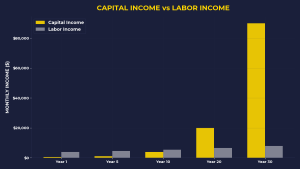
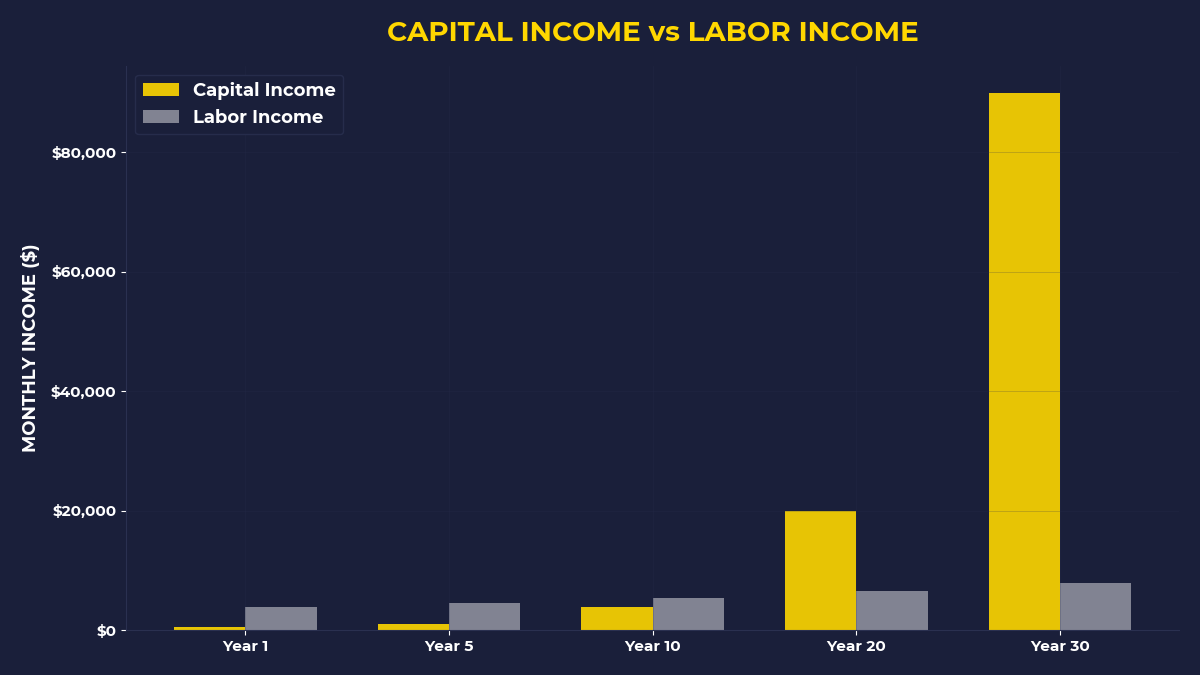
This is why AI economics creates a bifurcation: those who own the AI systems get richer while those who use the AI systems get replaced. The productivity gains flow to capital owners, not labor providers.
The primitive instinct driving this whole dynamic? Loss aversion. Workers focus on keeping their current jobs more productive instead of thinking about how to own the systems making them productive.
What Separates AI Capital From AI Labor?
The question isn’t whether you should use AI tools. The question is whether you should own AI-powered businesses.
AI labor: Using ChatGPT to write better emails. Using Midjourney to create graphics. Using GitHub Copilot to code faster. You’re trading time for money, just with better tools.
AI capital: Owning shares in companies that sell AI tools to millions of users. Owning stakes in businesses that use AI to eliminate labor costs. Building or buying systems that capture AI-generated value streams.
The wealth isn’t in using AI efficiently. The wealth is in owning AI systematically.
Consider this: every subscription to OpenAI’s ChatGPT Plus generates roughly $20 monthly in recurring revenue. Multiply that by 10 million subscribers, and you get $200 million in monthly recurring revenue flowing to OpenAI and its investors — not to the people creating the content that trains the AI.
The Two Classes AI Economics Creates
We’re watching the formation of two distinct economic classes that will define the next 30 years of wealth distribution.
Class 1: AI Capital Owners. They own stakes in companies building AI systems, companies using AI to replace labor, and companies capturing AI-generated productivity gains. Their wealth compounds as AI systems become more capable and more widely deployed.
Class 2: AI Labor Providers. They use AI tools to do their jobs better, faster, cheaper. They think they’re becoming more valuable while actually making themselves more replaceable. Their skills get absorbed into AI systems that eventually don’t need human operators.
The gap between these classes will make the wealth inequality of the past 40 years look quaint. Between 1980 and 2020, the top 1% captured about 28% of total income growth in the United States. With AI, that number could reach 60% or higher because AI-generated productivity gains flow almost entirely to capital owners.
Look at what happened with social media. Facebook, Twitter, YouTube, TikTok — billions of users create content for free while a handful of platform owners capture trillions in market value. AI economics follows the same pattern, but faster and more decisively.
What The Primal Investor Takes Away
• Stop optimizing your job performance with AI — start buying shares in companies that sell AI tools to workers like you. Every productivity gain you create with AI demonstrates market demand for AI capital.
• Invest in businesses that use AI to eliminate labor costs, not businesses that depend on human labor becoming more efficient. The former compounds wealth; the latter gets compressed by competition.
• Own a piece of the AI training data economy — buy stakes in companies that control large datasets, not companies that generate data for others to monetize. The data creators get paid once; the data owners get paid forever.
• Treat every AI tool you use as market research for potential investments. If ChatGPT saves you 2 hours per week, imagine what it’s worth to a company that can eliminate 2,000 employee hours per week.
• Build or buy businesses that capture AI productivity gains, not jobs that depend on human productivity gains. AI makes capital more valuable and labor less necessary.
The AI revolution isn’t coming — it’s already redistributing wealth from workers to owners. The only question is which side of that transfer you choose to be on.
🎬 Prefer watching? Check out the video version on YouTube:
👉 https://www.youtube.com/@PrimalContrarian
Subscribe for daily insights on capital, wealth, and contrarian thinking.