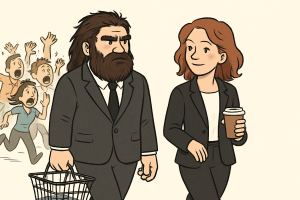
Marcus — 28, marketing manager in Denver — called me last Tuesday at 11 PM. He’d just finished reading his third book on capital theory that month. “I get it now,” he said, voice exhausted. “Capital is stored labor, right? Or wait, is it stored demand? And what about Marx versus Austrian economics?”
I could hear him flipping through pages.
“Marcus,” I said. “How much capital do you actually own?”
Long pause. “Well, I’ve got about $3,200 in my checking account.”
“That’s not capital. That’s cash sitting there losing value to inflation.”
Another pause. “But I’m learning—”
“You’re procrastinating.”
I Used to Be the Guy Reading About Capital Instead of Owning It
Look, I get it. Five years ago, I was Marcus. I had Austrian economics books stacked on my nightstand. I could explain the difference between capital goods and consumer goods at dinner parties. I knew that capital was “heterogeneous” and “time-sensitive” and all the academic buzzwords.
I was broke.
Not paycheck-to-paycheck broke — I had a decent software job. But broke in the way that matters: every dollar I earned went to someone else’s capital. My rent check went to my landlord’s real estate empire. My car payment went to Ford’s shareholders. My Netflix subscription, my grocery bills, my insurance premiums — all of it flowed upward to people who owned things.
I was funding other people’s capital while studying capital theory like it was ancient philosophy.
The turning point came when my friend Sarah — 31, owns three rental properties — saw my book collection. “You’ve read more about capital than most finance professors,” she said. “How much do you own?”
I started explaining the theoretical framework of capital accumulation.
“That’s not what I asked.”
Capital Is Simpler Than Everyone Makes It Sound
Here’s what I wish someone had told me: Capital is anything people need that you own.
That’s it.
Not “stored labor.” Not “means of production.” Not some complex economic theory that requires a PhD to understand.
When people need shelter, and you own the apartment building — you have capital. When people need to get from point A to point B, and you own Uber stock — you have capital. When people need to search for information online, and you own Google shares — you have capital.
The pop star who makes $50 million a year? She owns something people demand: her voice, her brand, her songs. The moment people stop wanting what she offers, her capital evaporates.
Your landlord isn’t smarter than you. He just owns something you need.
Why Your Bills Are Actually Capital Invoices
Think about yesterday. How much money left your bank account?
Your morning coffee — $4.50 to Starbucks shareholders. Your lunch — $12 to whatever restaurant chain you chose. Your Spotify subscription — $9.99 to music streaming capital owners. Your gas — money to oil company shareholders. Your phone bill — revenue for telecom investors.
Every single transaction was you sending cash to capital owners.
This isn’t some conspiracy. It’s how capitalism works. People who own things that other people need get paid by those people. The question isn’t whether this system is good or bad — the question is which side you want to be on.
Marcus spent three months reading about economic systems while sending $2,400 in rent to his landlord, $450 in car payments to Ford, and $200 in various subscriptions to tech companies.
He transferred $3,050 to capital owners while owning zero capital himself.
The Golf Ball Principle That Changed Everything
Warren Buffett’s childhood golf ball business taught me more about capital than any economics textbook.
Young Warren found lost golf balls at the local course, cleaned them up, and sold them for 6 cents each. Simple enough. But here’s the part that matters: he took every penny he earned and bought more assets — first more golf balls, then pinball machines, then farmland, then stocks.
He didn’t spend his golf ball money on better golf ball cleaning equipment or golf ball marketing courses.
He bought things that other people needed.
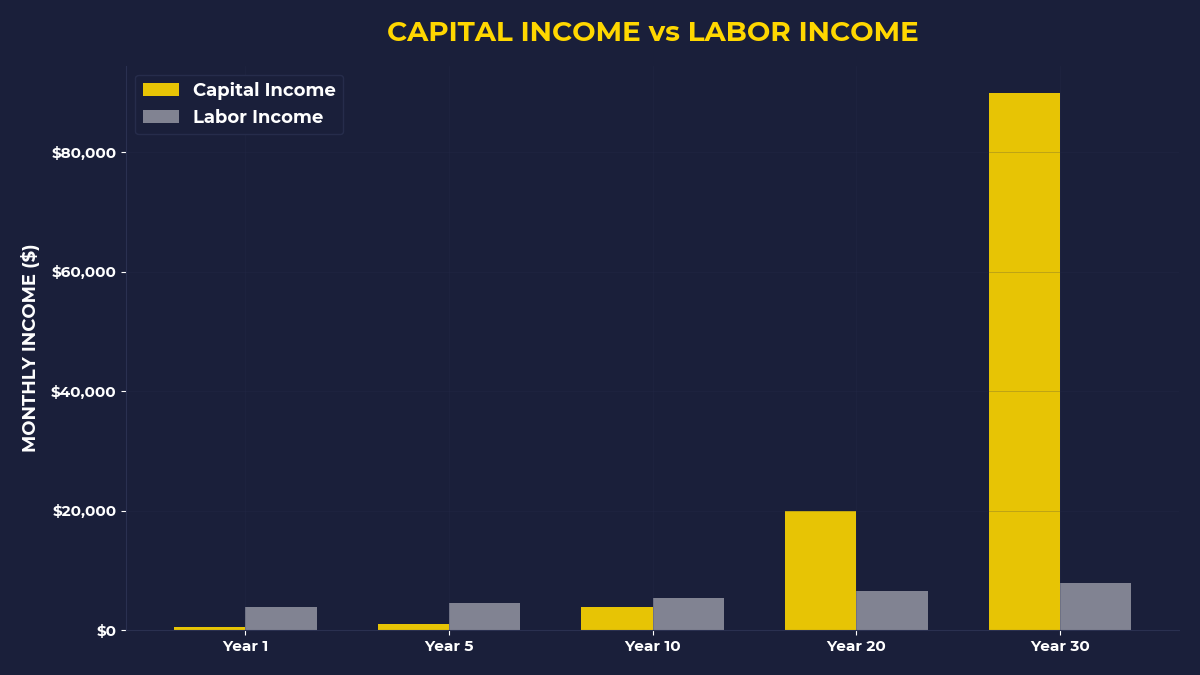
That’s the pattern every successful capital owner follows: earn money, buy assets that generate demand, use that income to buy more assets. The assets do the work. You collect the payments.
Most people do the opposite. They earn money, pay all their bills, buy things they want, then wonder why they never get ahead.
What Happens When You Finally Start Buying Instead of Learning
Remember Marcus? After our phone call, he did something that surprised me.
Instead of buying another book, he opened a brokerage account the next morning. He bought $500 worth of VTI — an ETF that owns pieces of 4,000+ companies. Suddenly, he owned tiny pieces of Apple, Microsoft, Amazon, and thousands of other businesses that people depend on every day.
For the first time in his adult life, other people’s daily purchases were generating income for him instead of the other way around.
Three months later, he called again. “It’s only $23 so far, but it’s the first time money has ever flowed toward me instead of away from me.” His voice was different. Calmer.
That $23 represented something bigger than the dollar amount.
Here’s What Nobody Tells You About Building Capital
You don’t need to understand monetary theory to own capital. You need to understand demand.
Ask yourself: What do people need that never goes away?
Shelter. Food. Transportation. Communication. Entertainment. Healthcare. Energy.
Buy pieces of companies that provide these things, and you own pieces of permanent demand. You don’t need to pick individual stocks — index funds let you own slices of entire economies.
But here’s the crucial part that Marcus almost missed: you have to buy assets BEFORE you pay your other bills.
Not after. Before.
This sounds backwards because it is backwards. Normal people pay all their bills first, then save or invest what’s left over. Capital owners pay themselves first, then figure out how to cover everything else.
When I started doing this — moving money into assets before paying rent — something strange happened. I found ways to make the rent payment work. Extra freelance work. Selling things I didn’t need. Cutting subscriptions I’d forgotten about.
When you pay yourself last, you get whatever’s left over (usually nothing). When you pay yourself first, you find ways to make everything else work.
If You’re Someone Who Thinks About Money More Than You Own
This post is for you if you’ve ever found yourself reading investment books while your bank account stays flat. If you can explain different economic theories but can’t explain where your paycheck went last month. If you understand compound interest in theory but don’t own anything that compounds.
You don’t need more knowledge. You need more ownership.
The people getting rich around you aren’t necessarily smarter or more educated. They just own pieces of things that other people need.
The One Thing to Remember
Capital theory boils down to this: own things that generate demand, use that income to own more things that generate demand, repeat until you have enough passive income to live the life you want. Everything else is academic noise. The moment you start buying assets instead of studying assets, you switch from being someone who pays capital owners to being someone who gets paid by capital users.
Your next moves:
• Open a brokerage account today — Schwab, Fidelity, or Vanguard all work
• Buy $100 worth of VTI or VXUS this week, before paying any other bills
• Set up automatic investment of whatever amount you can afford monthly — even $50 matters
🎬 Prefer watching? Check out the video version on YouTube:
👉 https://www.youtube.com/@PrimalContrarian
Subscribe for daily insights on capital, wealth, and contrarian thinking.