The Data Scientist Who Automated Himself Out of Wealth
Marcus — 28, data scientist at a Fortune 500 company in Seattle — spent three months last year building an AI model that could analyze customer behavior patterns 10x faster than his team. He was proud of it. His manager loved it. The company saved $2.3 million in operational costs.
Marcus got a $5,000 bonus and a pat on the back.
The shareholders got $2.3 million in increased profits. Forever.
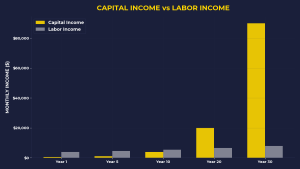
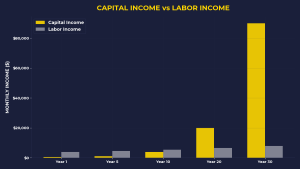
Six months later, Marcus watched his company’s stock price climb 18% while his own net worth stayed exactly the same. He’d built the machine that printed money for everyone except himself. That’s when it hit him — he was creating labor while others were capturing capital.
I Used To Think Skills Were Capital
I know exactly how Marcus felt because I made the same mistake for years.
Back in 2019, I spent six months learning Python and machine learning frameworks. I thought I was investing in myself. I thought skills were capital. I was wrong on both counts.
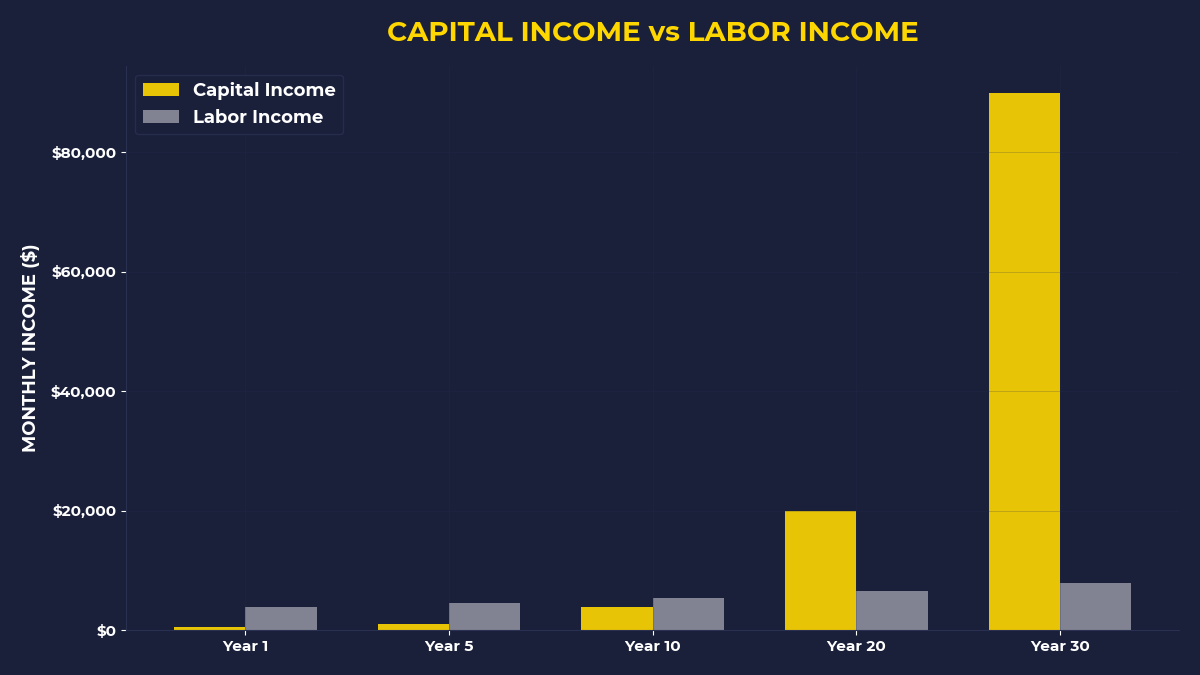
Skills are labor. No matter how advanced, how rare, how in-demand. Skills require your time to generate value. Capital generates value while you sleep.
Here’s what I wish someone had told me then: **In AI economics, there are two types of people — those who own the demand for AI, and those who fulfill it.**
Marcus was fulfilling demand. The shareholders owned it.
The AI Capital Transfer Is Already Happening
Every time you use ChatGPT, you’re sending cash to OpenAI’s investors. Every time someone automates a process with AI, the efficiency gains flow to capital owners, not the people who implemented it.
This isn’t theoretical. Between 2022 and 2024, AI-related companies added over $7 trillion in market value. That money didn’t come from nowhere. It came from the future labor that AI will replace.
Think about that for a second.
The market is literally pricing in the fact that AI will do your job better, faster, and cheaper than you can. And if you don’t own a piece of that AI capital, you’re on the wrong side of the biggest wealth transfer in human history.
Why Everyone Misses the Real AI Opportunity
Most people approach AI the same way Marcus did — they ask “What should I learn?” instead of “What should I buy?”
They take courses on prompt engineering. They learn to code in Python. They become AI consultants. All of these create labor. None create capital.
Meanwhile, the real money flows to people who own shares in companies that capture AI demand. NVIDIA doesn’t care if you know how to fine-tune a language model. They care that everyone needs their chips to run those models.
Microsoft doesn’t care if you’re an expert prompt engineer. They care that 100 million people pay for Copilot subscriptions.
The difference? You’re building skills to serve AI demand. They’re buying the companies that own AI demand.
The Grocery Store Test
Here’s how to tell if you’re thinking like a capital owner or a laborer.
You’re at the grocery store. Your bill is $127. You have $130 in checking and $47 in savings. There’s a new AI stock that just dropped 15% on earnings despite growing revenue 67% year-over-year.
What do you do?
Most people buy groceries and go home. They preserve cash for immediate needs. They think this is responsible.
A capital owner thinks differently. They buy $50 worth of that AI stock first. Then they figure out the grocery situation — maybe they eat rice and beans for a week, maybe they borrow $20 from a friend, maybe they sell something they don’t need.
This sounds insane to most people. But here’s what they miss: **you’re going to be hungry next month regardless.** The question is whether you’ll own a piece of the AI revolution or just be displaced by it.
What AI Economics Really Means
I learned this lesson the hard way in 2023. I spent $3,000 on an AI bootcamp to “future-proof my career.” Smart move, right?
Wrong. That same $3,000 invested in AI-related ETFs would be worth $4,200 today. The bootcamp got me a 12% salary increase — once. The investment would keep paying forever.
AI economics isn’t complicated. It’s just the opposite of what feels natural:
• While you’re learning AI skills, buy AI stocks
• While you’re automating processes, own the automation companies
• While you’re using AI tools, invest in the platforms that make them
Every time you save time with AI, someone else is making money from that saved time. Make sure some of that someone is you.
The Capital Question That Changes Everything
Marcus called me last month. He’d been reading about AI investing and had a simple question: “Should I put money into NVIDIA or should I learn more about chip design?”
That question reveals everything about capital versus labor thinking.
Learning chip design = creating labor. You trade your time for money, once.
Buying NVIDIA = buying capital. Your money works 24/7 while you sleep.
Marcus bought 10 shares at $891. Three weeks later, they were worth $1,043. His $8,910 investment gained $1,520 — more than his last quarterly bonus — while he did absolutely nothing.
Meanwhile, his coworker spent those same three weeks taking an online course on semiconductor manufacturing. Guess who’s building wealth?
If You’re Someone Who Gets It
This post isn’t for everyone. It’s for people who are tired of building other people’s dreams while their own bank account stays flat.
If you’re spending more on learning about AI than owning AI companies, you’re creating labor while others capture capital.
If you’re automating processes at work but not investing in automation companies, you’re increasing other people’s profits, not your own.
If you’re excited about AI’s potential but own zero AI stocks, you’re going to watch from the sidelines as the biggest wealth creation event of your lifetime happens without you.
The One Thing To Remember
**AI creates capital for owners and eliminates jobs for workers.** You get to choose which side you’re on, but you have to choose soon. Every month you spend building AI skills without buying AI assets, you’re falling further behind the wealth curve. The companies automating your industry won’t care how good you are at prompt engineering when they can replace you with software.
• Open a brokerage account this week and buy $100 of any AI-related ETF
• Before you pay for another AI course, buy shares in the company that makes the software
• Stop asking “What AI skills should I learn?” Start asking “What AI companies should I own?”
🎬 Prefer watching? Check out the video version on YouTube:
👉 https://www.youtube.com/@PrimalContrarian
Subscribe for daily insights on capital, wealth, and contrarian thinking.