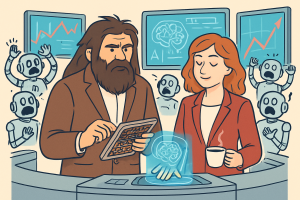
Marcus — 29, software engineer in Seattle — watched his company’s stock price double after they announced their new AI integration last month. He’d been working there for three years, writing code that would soon write itself. His salary stayed exactly the same.
The company’s shareholders made millions. Marcus made his usual $8,000 monthly paycheck, minus taxes, minus rent to his landlord, minus payments to the bank that owns his car loan.
I’ve Been Watching This Movie Before
I know exactly how Marcus feels because I lived through the internet boom differently than most people. In 1999, I was 24 and working at a consulting firm, building websites for clients who didn’t understand what they were buying. I got paid hourly. They got paid in equity that would be worth billions.
Here’s the thing. I thought I was participating in the revolution because I understood the technology.
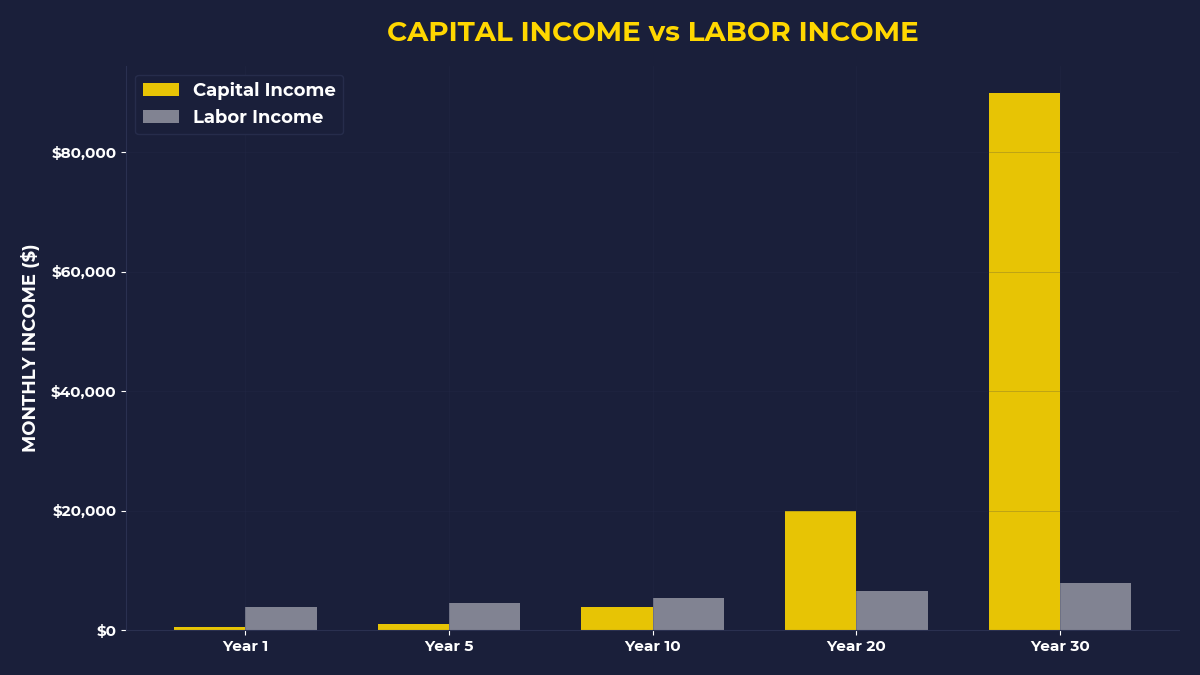
I wasn’t. I was just skilled labor getting paid to build other people’s wealth machines. The real money went to the people who owned pieces of the infrastructure — domain names, servers, platforms, data networks. They bought demand. I sold time.
Twenty-five years later, I’m watching the exact same pattern unfold with AI, except this time the wealth transfer will be faster and more extreme.
AI Creates Capital, Not Jobs
Every few weeks, another friend tells me their company is “experimenting with AI.” They’re excited about becoming more efficient, getting promoted, staying relevant. They’re asking the wrong questions.
The right question isn’t “How do I use AI at my job?”
The right question is “What should I buy?”
My friend Sarah — 31, marketing manager in Austin — spent six months learning ChatGPT to make herself “AI-ready.” She can now do her job 40% faster. Her company loves this. They haven’t raised her salary. But they’ve started talking about “rightsizing” the marketing team since one person can now do what three people used to do.
Sarah is optimizing herself out of relevance while her company’s efficiency gains flow straight to shareholders.
The Two Classes AI Is Creating
Think about what AI actually does. It takes human cognitive work and automates it. Every AI breakthrough makes certain types of human labor less valuable while making the systems that replace that labor more valuable.
This creates two groups:
The Owners: People who own pieces of AI systems, platforms, and the infrastructure that powers them. They collect rent every time someone uses what they own.
The Users: People who use AI to do their jobs better, faster, cheaper. They compete with the AI and with each other to stay employable.
Here’s what nobody talks about: The second group is temporary.
Remember when everyone said “learn to code” during the last economic shift? Now AI writes code. The people who owned the platforms where that code runs made fortunes. Most of the coders just got really good at competing with machines.
What Warren Buffett’s Golf Ball Story Teaches Us About AI
When Warren Buffett was a kid, he collected lost golf balls from courses and sold them back to golfers. Smart hustle. But the real insight came later: Instead of collecting golf balls himself, he could have hired other kids to collect them and paid them per ball while keeping the profit from the sales system he built.
AI is the ultimate golf ball collection system.
Every AI tool that gets created can work 24/7 without sick days, without raises, without bathroom breaks. It collects value continuously. The question is whether you’re the kid getting paid per ball or the one who owns the collection and sales system.
Most people are positioning themselves as high-efficiency golf ball collectors. They’re learning to use AI tools to work faster, produce more, compete better. They’re becoming very expensive human labor in a world that increasingly doesn’t need expensive human labor.
The smart move is to own the system that benefits from all that efficient collection.
Where the Real AI Money Flows
I started tracking this two years ago when I realized that every conversation about AI focused on jobs and skills, not ownership. Follow the money instead.
Every time someone uses ChatGPT, OpenAI collects revenue. Every time a company integrates AI to reduce headcount, their profit margins improve and shareholders benefit. Every time an AI system gets trained on more data, the companies that control that data become more valuable.
The value isn’t going to the people using the tools. It’s going to the people who own pieces of the companies making the tools.
NVIDIA’s stock went up 239% in 2023 because AI needs their chips. Microsoft’s market cap hit $3 trillion partly because they own a stake in OpenAI. Amazon Web Services prints money because AI requires massive cloud infrastructure.
Meanwhile, graphic designers are learning MidJourney to stay competitive, writers are mastering ChatGPT to keep their jobs, and analysts are building AI dashboards to prove their worth.
Guess which group is building wealth and which group is fighting over scraps?
But I Don’t Have Silicon Valley Money
Look, I get it. You can’t write a $10 million check to invest in the next OpenAI. Neither can I.
But you don’t need to.
Remember, capital is stored demand. AI is creating massive, sustained demand for computing power, data storage, network infrastructure, and specialized chips. You can own pieces of the companies that control these resources.
When I first understood this, I was 32 and making $67,000 a year as a consultant. I couldn’t buy a data center. But I could buy shares in the companies that own data centers. I couldn’t create an AI platform. But I could own stakes in the companies building the platforms.
The AI wealth transfer isn’t just happening at the startup level. It’s happening inside every public company that successfully integrates AI to reduce costs and increase efficiency. Their shareholders capture that value.
The janitor at Microsoft doesn’t get richer when Copilot increases productivity. Microsoft shareholders do.
The One Decision That Changes Everything
Here’s what I wish someone had told me in 1999: In every technological revolution, the biggest fortunes go to the people who own infrastructure, not the people who use it skillfully.
The railroad barons got rich, not the fastest train conductors. The oil tycoons got rich, not the best drillers. The internet billionaires owned platforms, not websites.
AI follows the same pattern, just faster.
Most people will spend the next five years learning to work with AI. A small percentage will spend the next five years buying pieces of AI infrastructure. In ten years, the wealth gap between these two groups will be staggering.
Which side do you want to be on?
The One Thing To Remember
Every month, you send money to dozens of capital owners — your landlord, your bank, your insurance company, the shareholders of every company you buy from. AI is about to create the most valuable capital in human history. You can keep sending your paycheck to AI capital owners, or you can become one. The choice is simple, but it won’t stay available forever.
Start here:
Before you pay next month’s bills, move $100 into a brokerage account and buy shares of companies building AI infrastructure
Stop asking “How can AI make me better at my job?” Start asking “How can I own pieces of AI systems?”
Every time you use an AI tool, research who owns it and whether you can buy shares in that company
🎬 Prefer watching? Check out the video version on YouTube: