The Invoice Training Program
Marcus — 29, graphic designer in Portland — opened his laptop at 7:43 AM last Tuesday and felt that familiar knot in his stomach. Seven notifications from his banking app. Rent: $1,850. Car payment: $427. Student loan: $312. Phone: $89. Insurance: $156. Netflix, Spotify, gym membership: another $67 combined.
He did the math he does every month. Paycheck minus bills equals whatever’s left for groceries, gas, and maybe a beer with friends if he’s careful.
Marcus earns $67,000 a year. He’s good at his job. He pays his bills on time. He even has $2,300 in savings — his emergency fund that every finance blog told him to build first.
And he’s getting poorer every month.
Not because he’s irresponsible. Because every single one of those bills is training his brain to think like labor instead of capital. He’s been enrolled in a cognitive program he never signed up for, and it’s rewiring how he approaches money.
The Education You Never Noticed
I know exactly how Marcus feels because I was there too. Three years ago, I sat in my Chicago apartment doing the same monthly ritual. Bills first, everything else second. It felt responsible. It felt like adulting.
It was actually the most expensive education I never realized I was getting.
Here’s what I didn’t understand: every monthly bill is an invoice from someone who owns capital, sent to someone who doesn’t. My landlord owned the building. Ford Credit owned my car loan. Sallie Mae owned my student debt. Verizon owned the cell towers.
I owned nothing except the obligation to pay them.
But the real damage wasn’t the money leaving my account. It was what those bills were teaching my brain about how money works. Every month, I was training myself to ask the wrong question entirely.
Instead of “What should I buy that will pay me back?” I was asking “How can I afford these bills and maybe have something left over?”
Those are two completely different operating systems for your financial life.
The Demand Collection System
Let me show you what’s really happening in Marcus’s monthly routine.
That $1,850 rent? It’s going to someone who figured out that people need housing. They bought the building, and now Marcus’s need generates their cash flow. The $427 car payment goes to a company that figured out people need transportation. They finance cars, and Marcus’s need generates their profit.
Every bill represents stored demand. Someone identified what people consistently need, positioned themselves to own that demand, and now collects payment from everyone who has the need but not the asset.
Marcus creates value all day as a graphic designer. But he doesn’t own the demand for that value — his clients do. So he gets paid once for his work, while his bills get paid forever from his work.
The math is brutal when you see it clearly.
Think about that. Marcus is functionally a collection agent for other people’s capital, using his own labor as the source.
Why Your Emergency Fund Is Training You Wrong
Here’s where it gets worse. Marcus has that $2,300 emergency fund, and he’s proud of it. Every personal finance guru told him to save 3-6 months of expenses before investing anything.
But what is that emergency fund really teaching him?
It’s teaching him that his job is to stockpile cash to pay other people’s bills when times get tough. It’s training him to think like someone whose role in the economy is to make sure capital owners get paid, even during his own emergencies.
I followed the same advice for two years. Six months of expenses in a high-yield savings account earning 1.2%. I felt financially responsible. I was actually just getting really good at being on the wrong side of every economic transaction.
The emergency fund trains you to think defensively about money instead of offensively. It makes you comfortable being the one who pays bills instead of the one who sends them.
The Question That Changes Everything
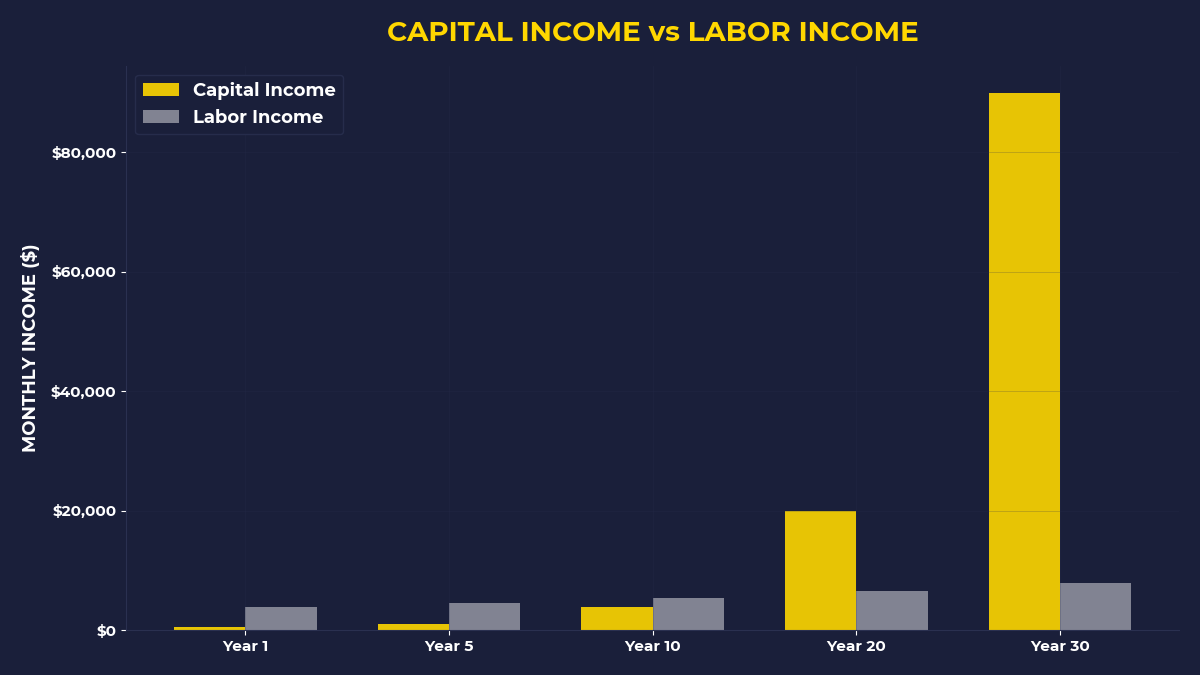
What if Marcus asked a different question this month?
Instead of “How do I make sure I can cover all my bills?” what if he asked “What should I buy that will send me bills?”
Not theoretical bills. Actual checks. Rent payments from tenants. Dividend payments from companies. Interest payments from bonds. Royalty payments from creative work he owns.
I know what you’re thinking: “But he needs to pay his actual bills first. You can’t just ignore rent.”
That’s exactly the programming talking.
Here’s what I did when I finally understood this: I took $400 from my emergency fund — money I’d been saving to pay other people’s bills — and bought shares of a REIT that owned apartment buildings. Not enough to make me rich, but enough to make me an owner instead of just a payer.
For the first time in my adult life, I received a check instead of writing one. It was $11.43 in quarterly dividends.
Eleven dollars and forty-three cents changed how my brain worked with money forever.
The Capital Question vs. The Labor Question
Most people approach their finances by asking labor questions:
- How can I earn more money?
- How can I cut my expenses?
- How can I budget better?
- How can I save more?
These aren’t bad questions. They’re just limited. They assume your role is to work harder and spend less so you can have more money left over to… work harder and spend less.
Capital owners ask different questions:
- What should I buy that other people need?
- What should I own that will pay me?
- Where is demand predictable and ongoing?
- How can I position myself to collect instead of pay?
Warren Buffett started asking capital questions when he was 11 years old, selling golf balls he found on the course. He wasn’t asking “How can I work harder to find more golf balls?” He was asking “How can I own the golf ball supply system?”
By age 13, he was buying golf balls from other kids and hiring them to find more while he focused on selling. Same work, different question, completely different outcome.
Your Bills Are Someone Else’s Business Model
Look at your bank statement from last month. Every recurring charge is evidence of someone who figured out what you predictably need and positioned themselves to own that demand.
Your Netflix subscription? They own entertainment demand. Your gym membership? They own fitness demand. Your phone bill? They own communication demand.
None of these are bad services. But notice what’s happening: you’re consistently sending money to people who own what you need, while owning nothing that other people need.
The goal isn’t to stop paying bills. The goal is to start sending them.
The One Thing to Remember
Your monthly bills aren’t just expenses. They’re a education program that teaches you to think like labor instead of capital. Every time you pay without owning, you’re training your brain to see yourself as the one who works for money, not the one who money works for. The fastest way to break this programming is to start asking “What should I buy?” instead of “What can I afford?” Even if you start with $50, you’re training yourself to think like an owner.
- Before you pay any bill this month, move $50 to a brokerage account and buy a dividend-paying stock or REIT
- List your three biggest monthly bills and research who actually receives those payments — those are business models you can buy into
- Replace the question “How can I afford this?” with “How can I own this?” for the next 30 days
🎬 Prefer watching? Check out the video version on YouTube:
👉 https://www.youtube.com/@PrimalContrarian
Subscribe for daily insights on capital, wealth, and contrarian thinking.