The Philosophy That Keeps You Sending Checks
Marcus — 29, marketing manager in Denver — sent me a screenshot of his bank account last Tuesday. He’d just paid rent, car payment, student loans, and utilities. The balance showed $247 left for the next three weeks.
“I follow all the advice,” he wrote. “Emergency fund first, then invest what’s left. But there’s never anything left.”
Marcus didn’t realize it, but his investment philosophy wasn’t coming from financial advisors or wealth-building books. It was coming directly from his landlord, his car dealership, his credit card company — every entity that profits from his monthly payments.
Here’s what I mean. The conventional wisdom tells you to secure your survival first, then think about wealth. Pay your bills. Build your emergency fund to 6 months of expenses. Only then, if there’s money left over, consider investing.
Sounds responsible, right?
It’s actually the perfect system to keep you broke forever.
I Learned This From My Own Landlord
I know exactly how Marcus feels because I lived it for eight years. From 2011 to 2019, I sent $1,850 every month to my landlord in Austin. Never missed a payment. Never even paid late.
During those same eight years, that landlord’s property appreciated from $280,000 to $485,000. She collected $177,600 in rent from me and gained $205,000 in equity.
I paid her mortgage, her property taxes, her maintenance costs, and still left her with positive cash flow every month. In return, I got a place to sleep and exactly zero ownership of anything.
But here’s the part that took me years to understand: she didn’t just profit from my rent checks. She inadvertently taught me the exact investment philosophy that kept her rich and me poor.
See, I was following the “responsible” path. I had my emergency fund. I paid all my bills on time. I invested the leftover scraps — maybe $200-400 per month when things went well.
Meanwhile, she was living by a completely different philosophy.
The Capital Owner’s Real Investment Philosophy
When my landlord bought that property in 2011, she didn’t wait until she had “enough” money. She put down $56,000 and borrowed the rest. She used leverage to control an asset worth five times her cash.
When the property needed a new roof in 2015 — $8,000 — she didn’t drain her emergency fund. She raised my rent by $150 per month. She made the asset pay for its own improvements.
When property values started climbing in 2017, she didn’t sell and “take profits.” She refinanced, pulled out $85,000 in tax-free cash, and bought another rental property.
Her investment philosophy was simple: acquire assets that generate cash flow, then use that cash flow to acquire more assets.
My investment philosophy was: survive first, invest later with whatever’s left.
Guess who got rich?
What If You Had $500 Right Now?
Let me ask you something. If you had $500 in your hand right now, what would you do with it?
Most people say: “Pay down debt” or “Add to emergency fund” or “Catch up on bills.”
But Robert Kiyosaki tells a story about living in a friend’s garage after his business failed. The bills were piling up. Creditors were calling. He was broke.
And every time he got $100, he bought a stock or put money toward a small investment before paying anyone else.
People called him irresponsible. His wife questioned his judgment. But here’s what happened: when you pay yourself first — when you buy an asset before paying the bills — you create pressure.
Pressure to find another way to pay the rent. Pressure to earn more. Pressure to think like a capital owner instead of a bill payer.
When Kiyosaki didn’t have enough for rent after investing first, he didn’t sell his stocks. He mowed lawns on weekends. He found side work. He did whatever it took to keep the assets and pay the bills.
This is the opposite of what they teach you in personal finance class.
And it’s exactly what separates capital owners from everyone else.
The Bill That Teaches You To Stay Poor
Every monthly bill you pay is a masterclass in the wrong investment philosophy.
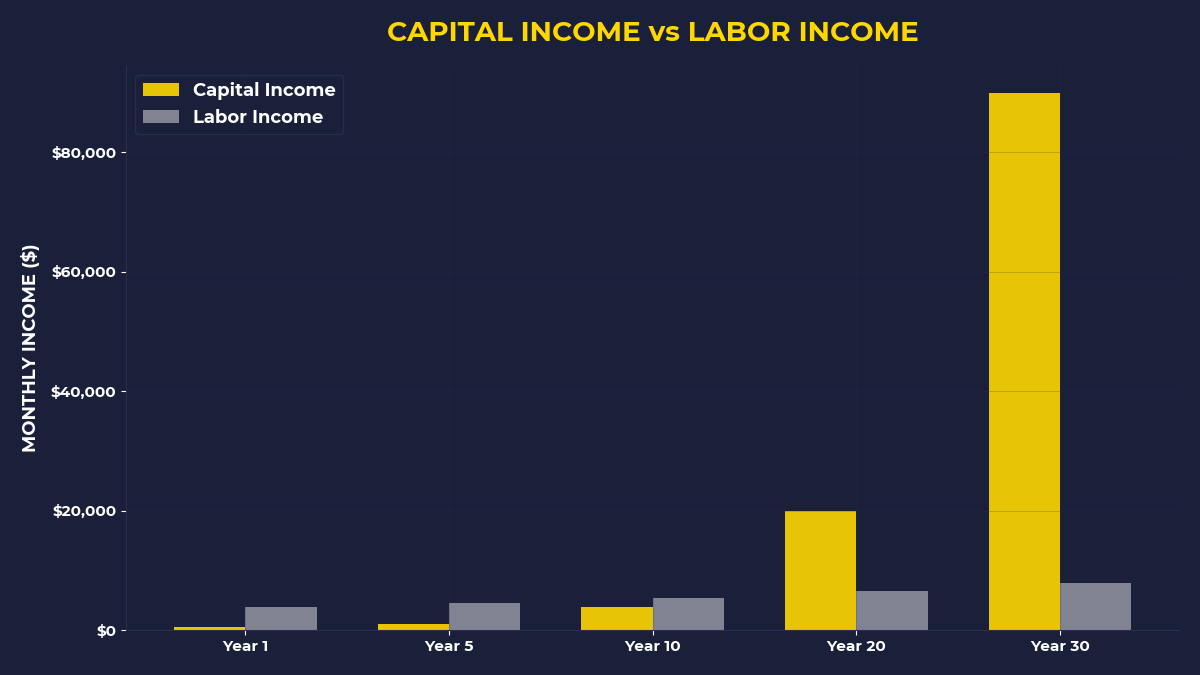
Your landlord collects $1,800 from you, deducts $900 for mortgage and expenses, and nets $900 in cash flow plus equity appreciation. Her $200,000 property is earning her $15,000 per year — a 7.5% return.
Your car payment sends $450 per month to a bank that leveraged $20 for every $1 of capital to create that loan. They’re earning 8% interest on money they essentially created out of thin air.
Your credit card company makes 18-24% on your balance while paying depositors less than 1%.
Every payment you make is funding someone else’s investment philosophy. And that philosophy is: acquire assets that generate cash flow from people who need what we own.
Meanwhile, you’re taught to prioritize survival over accumulation. Pay the bills first. Be responsible. Don’t take risks.
That’s not your investment philosophy — that’s theirs.
The Golf Ball Lesson
Warren Buffett tells a story about selling golf balls as a kid. He’d find lost balls around the golf course, clean them up, and sell them for 6 cents each.
Simple business model. Find demand, fulfill it, collect cash.
But here’s the key detail most people miss: when young Warren made money from golf balls, he didn’t spend it on candy or toys. He used the cash to buy assets — a pinball machine for the barbershop, shares in his dad’s investment firm, eventually entire businesses.
He turned one income stream into multiple income streams. Cash flow from golf balls became cash flow from pinball machines. Cash flow from pinball machines became cash flow from stocks.
That’s compound capital accumulation. Every asset you buy gives you more cash to buy more assets.
Most people do the opposite. They earn money, pay all their bills, then invest whatever’s left over. But there’s never anything left over because bills expand to consume available cash.
It’s Parkinson’s Law applied to your bank account.
If You’re Someone Who Sends Your Paycheck To Capital Owners Every Month
Look, I get it. You have obligations. Rent is due. Car payments don’t skip themselves. I’m not suggesting you become homeless to buy stocks.
But if you’re someone who’s tired of working hard just to make other people rich — if you’re someone who wants to switch sides from bill payer to bill receiver — then you need to adopt the investment philosophy of capital owners, not bill collectors.
Here’s what that means practically: when money comes in, pay yourself first. Before the rent check, before the car payment, before anything else, move money into assets.
Even if it’s $25. Even if it means scrambling to cover expenses later.
Especially then.
Because that scrambling forces you to think like an owner instead of a renter. It forces you to find additional income sources. It forces you to optimize expenses instead of just accepting them.
Most importantly, it builds the habit of accumulating capital instead of just surviving month to month.
The One Thing To Remember
Your current investment philosophy isn’t really yours — it’s borrowed from the people who profit from keeping you on the payment plan. They want you to prioritize survival over accumulation because survival payments are their cash flow. But capital owners live by a different rule: acquire assets first, solve cash flow problems second. The pressure this creates isn’t a bug in the system — it’s the feature that forces you to think and act like an owner instead of a renter.
Three things you can do this week:
• Before paying any bill this month, transfer $50 to a brokerage account and buy an index fund. Even if it means eating ramen for three days.
• Calculate exactly how much money you’ve sent to your landlord, car company, and credit card companies in the past year. That number represents your education in their investment philosophy.
• Ask yourself: what asset could I buy this month that might pay me back next month? Then buy it instead of something that definitely won’t.
🎬 Prefer watching? Check out the video version on YouTube:
👉 https://www.youtube.com/@PrimalContrarian
Subscribe for daily insights on capital, wealth, and contrarian thinking.