The most successful investors I know are terrible at predicting the future but excellent at asking one specific question. That question isn’t “what should I do?” — it’s “what should I buy?”
This sounds like a trivial distinction. It’s not. The difference between these two questions is the difference between building someone else’s wealth and building your own.
Why Your Bookshelf Is Training You To Stay Poor
Walk into any bookstore and count the success books. I did this exercise last year — spent an hour in the business section of a Barnes & Noble in Chicago. Out of 247 titles I counted, 231 focused on what you should do. Wake up at 5 AM. Network better. Learn new skills. Optimize your productivity. Master time management.
Only 16 books focused on what you should buy.
Here’s the thing. I used to be a “what should I do” person. I read every productivity book, took courses on negotiation, learned advanced Excel functions. I thought harder work would create more wealth. For three years, I optimized my human capital while my financial capital stayed flat.
Then I met someone who changed my frame entirely. A friend’s father — quiet guy, drove a 10-year-old Honda — mentioned he owned 47 rental properties. Not because he was a real estate genius. Because in 1987, he started asking “what should I buy” instead of “how can I work harder.”
That conversation rewired my brain.
The Golf Ball Principle Nobody Teaches
Warren Buffett’s childhood golf ball business illustrates this perfectly. At age 11, Buffett collected lost golf balls from local courses and sold them for 6 cents each. Most people focus on his hustle — the kid worked hard, picked up balls, cleaned them, found buyers.
They miss the real lesson.
Buffett could have stayed a golf ball picker forever. Instead, he took the profits and bought assets. First, he bought a pinball machine and placed it in a barbershop for passive income. Then more machines. Then a farm. Then stocks. Each purchase generated cash flow that funded the next purchase.
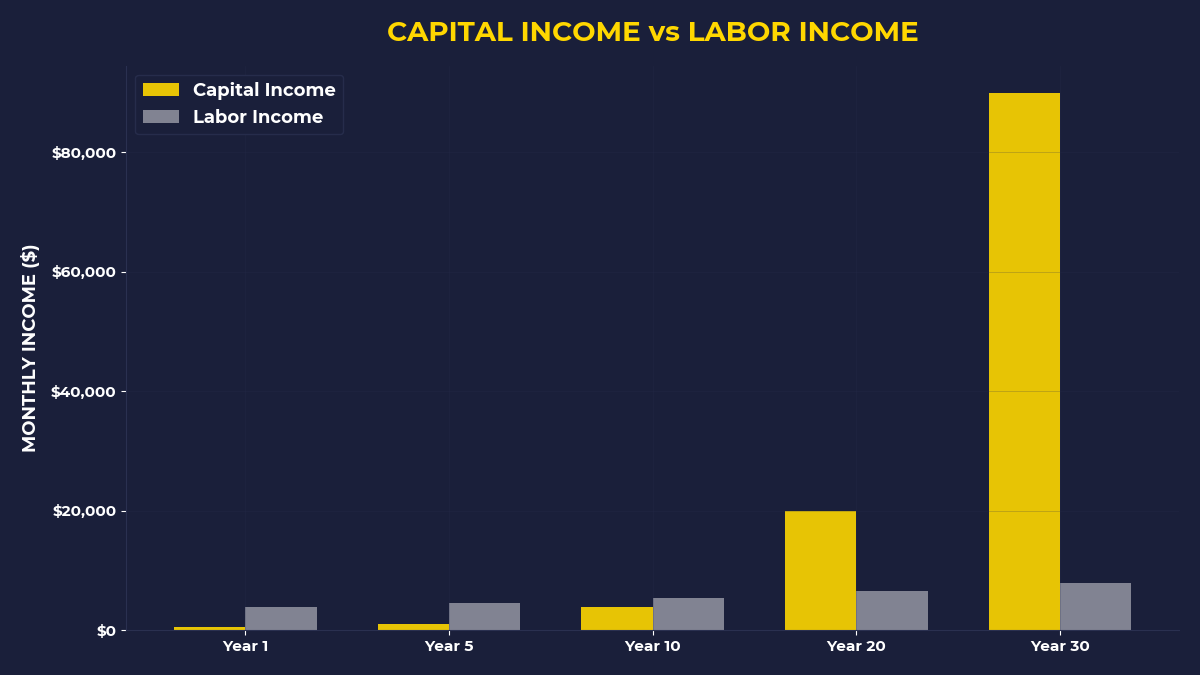
The transition from “what should I do” to “what should I buy” happened early. By age 14, Buffett earned more from his assets than from his labor.
Most people never make this transition. They optimize their doing while ignoring their buying.
Why Your Brain Defaults to the Wrong Question
Our primate brains are wired for immediate action. When resources feel scarce — which they always do — the ancient limbic system screams “work harder!” This made sense 50,000 years ago when more hunting meant more food.
It’s financial suicide in 2024.
Think about that anxiety you feel when money gets tight. Your first instinct isn’t “what assets should I acquire?” It’s “what extra work can I take on?” You consider freelance projects, part-time jobs, overtime hours. You default to trading more time for more money.
This is loss aversion disguised as productivity. Your brain interprets asset purchases as losses — money leaving your account. It interprets work as gains — money entering your account. The wiring is backwards for wealth building.
Capital compounds. Labor just adds.
What Happens When You Ask the Right Question
Let me give you a concrete example from my own life. In 2019, I wanted to increase my income by $2,000 per month. The “what should I do” approach would have been consulting work, freelance writing, maybe driving for Uber on weekends. All trading time for money.
Instead, I asked “what should I buy?”
I found a duplex in Cleveland — not glamorous, but the numbers worked. $89,000 purchase price, $1,400 monthly rent, $700 mortgage payment. After expenses, it generated $400 monthly cash flow. Not the $2,000 I wanted, but here’s what happened next.
Six months later, I used the equity to buy another duplex. Then another. Within 18 months, I had five properties generating $1,850 monthly. Not quite the $2,000 target, but close enough.
More importantly, the assets worked while I slept. No additional time investment required.
If I had chosen the “what should I do” path, I’d still be trading hours for dollars. Instead, other people’s rent payments now fund my asset purchases.
The Leverage Principle Most People Miss
Here’s what separates buyers from doers: leverage.
When you ask “what should I do,” you’re limited by your personal bandwidth. Twenty-four hours per day, seven days per week. No matter how productive you become, time is the constraint.
When you ask “what should I buy,” you access other people’s time. Every stock you own represents thousands of employees working for your benefit. Every rental property represents tenants paying your mortgage. Every business you acquire represents systems generating income without your direct involvement.
Consider Harry Rasson’s story from the 1930s — one of Buffett’s favorite examples. Rasson noticed a coin-operated scale in a drugstore generating significant foot traffic. Instead of thinking “I should get a job selling scales,” he asked “what should I buy?” He purchased one scale for $175, earning $98 monthly profit.
Then he bought 69 more scales with the profits from the first.
By the end, Rasson owned 70 scales generating $1,750 monthly — roughly $35,000 in today’s dollars. He didn’t work 70 times harder. He bought 70 times smarter.
Why This Matters More Now Than Ever
Are you someone who feels trapped by the time-for-money equation? Someone who knows working harder isn’t the answer but can’t see an alternative? This shift matters more for you than anyone else.
The AI revolution is accelerating the divide between owners and workers. ChatGPT didn’t eliminate jobs — it eliminated the competitive advantage of doing things. What remains valuable is owning things that generate cash flow regardless of technological disruption.
Companies will automate labor. They can’t automate ownership.
The question “what should I do” becomes less valuable every year. The question “what should I buy” becomes more valuable.
Start asking it.
The Practical Framework for Switching Questions
Next time you feel financial pressure, catch yourself before defaulting to “what should I do.” Instead, run through this sequence:
First, identify cash flow gaps. Don’t think “I need more income.” Think “I need $1,200 monthly cash flow.”
Second, research assets that generate that cash flow. REITs paying dividends. Rental properties. Profitable businesses for sale. Index funds with dividend yields.
Third, calculate the purchase price required. Need $1,200 monthly? At a 6% annual yield, you need $240,000 in assets. Sounds like a lot, but it’s specific and achievable.
Fourth, work backwards to the first purchase. Can’t buy $240,000 worth of assets today? Start with $24,000 worth. Or $2,400 worth. The principle scales.
The “what should I buy” question forces you to think in terms of capital allocation rather than time allocation. This changes everything.
What The Primal Investor Takes Away
• Your next financial decision should start with “what should I buy?” not “what should I do?” — this single question shift separates capital builders from wage earners
• Time constraints limit doing; capital constraints limit buying — but capital constraints can be overcome while time constraints cannot
• Every asset purchase should generate cash flow that funds the next asset purchase — this is how compound interest actually works in practice
• Leverage amplifies buying decisions while personal bandwidth limits doing decisions — choose the path without natural constraints
• The AI revolution makes ownership more valuable and labor less valuable — position yourself accordingly
Stop optimizing what you do. Start optimizing what you buy. Your future self will notice the difference in their bank account.
🎬 Prefer watching? Check out the video version on YouTube: