Sarah — 29, marketing manager in Denver — spent three months crafting her “investment philosophy” last winter. She read every blog post, watched every YouTube video, filled out risk tolerance questionnaires. She built spreadsheets comparing growth versus value, domestic versus international, active versus passive. She felt ready.
Six months later, she was down 12% while the S&P 500 was up 8%.
Her carefully constructed philosophy had one fatal flaw: it wasn’t actually hers. It was a patchwork of other people’s ideas stitched together by someone who’d never owned capital that mattered.
I Used to Build Investment Philosophies Too
I know exactly how Sarah felt because I was there too.
When I first started thinking about money seriously — I was 26, making $52,000 as a content writer — I thought I needed to invent my own approach to investing. I spent weeks reading about Benjamin Graham’s value investing, Ray Dalio’s all-weather portfolio, Jack Bogle’s index fund philosophy. I tried to synthesize them into something uniquely mine.
Here’s the thing.
I was asking the wrong question entirely. Instead of “How should I invest?” I should have been asking “How do people who already own capital think about capital?”
The difference changed everything for me. And it took a conversation with my friend’s dad — a guy who owned seven rental properties and a small trucking business — to show me what I was missing.
What Capital Owners Actually Think About
Tom didn’t talk about asset allocation or risk-adjusted returns when I asked him about his investment philosophy. He talked about demand.
“I don’t buy investments,” he said, leaning back in his kitchen chair. “I buy things people need and can’t easily get somewhere else.”
His rental properties? All within three blocks of the university. Students need housing. Parents pay rent. The demand is predictable and recurring.
His trucking business? He hauls construction materials to sites that can’t be reached by rail. Specific demand that nobody else could serve as efficiently.
His stock picks? Companies that own things people have to use. Utilities. Toll roads. Software platforms that businesses depend on daily.
I realized something that night that most finance content never mentions: successful investment philosophy isn’t about creating a balanced portfolio. It’s about understanding where demand comes from and positioning yourself to capture it.
The Question That Separates Owners From Everyone Else
Here’s what I learned from watching people who actually own capital: they don’t ask “What should I do?” They ask “What should I buy?”
Think about that for a second.
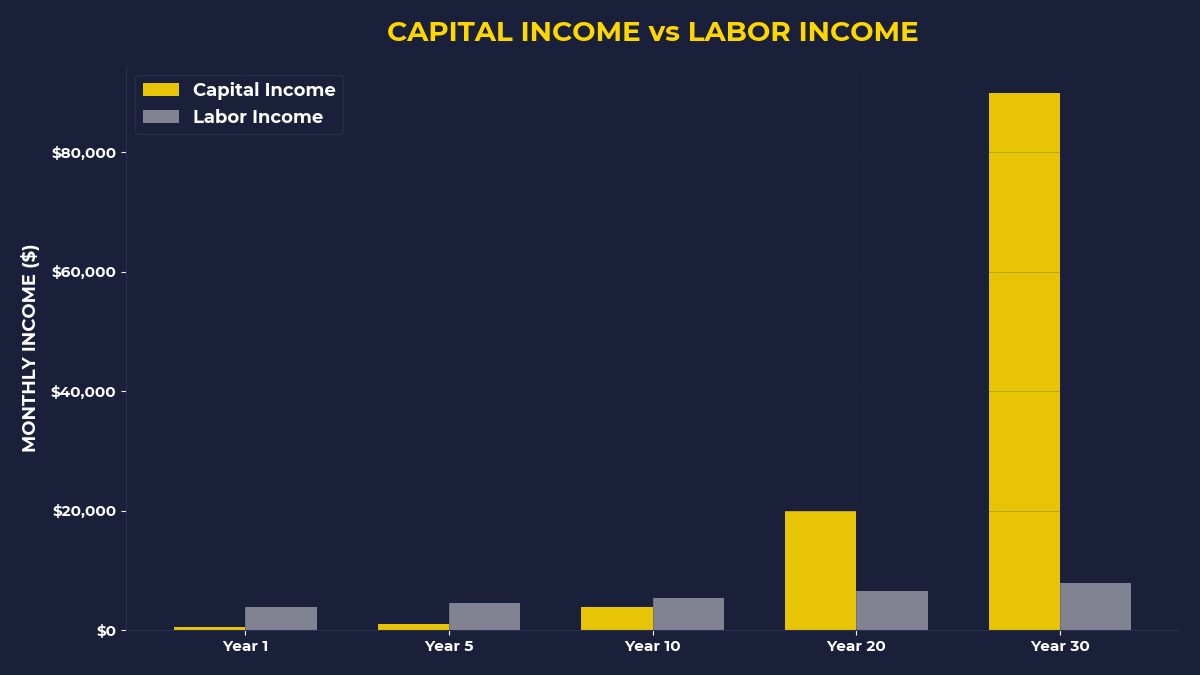
Most people — including the version of me from five years ago — approach wealth building as a labor problem. Work harder, get promoted, save more, invest better. It’s all about doing.
Capital owners approach it as an ownership problem. What can I own that other people need? What generates cash flow without my direct involvement? What stores demand?
Warren Buffett’s first business wasn’t complicated investment analysis. It was selling golf balls he found in the woods back to golfers who’d lost them. He found demand, figured out how to capture it, then used the profits to buy more demand-capturing assets.
The compound interest everyone talks about? It’s not magic. It’s buying one cash-flowing asset, using that cash to buy another, then repeating until the assets are working harder than you are.

Why Your Current Investment Philosophy Keeps You Poor
Most investment advice treats you like a saver who occasionally buys stocks. Save up some money, diversify across asset classes, rebalance quarterly, stay the course for 30 years.
This approach has one massive problem: it assumes you’ll always be trading your time for money.
Capital owners think differently. They assume they’ll eventually stop working — not because they retire, but because they’ll own enough demand-capturing assets that working becomes optional.
Sarah’s philosophy failed because she was optimizing for growth on money she already had instead of optimizing for ownership of things people need. She bought mutual funds that owned pieces of 500 companies she’d never heard of instead of focusing on assets she could understand and evaluate.
When those funds dropped, she had no idea why or whether to hold on. She didn’t understand what she owned.

How to Steal a Capital Owner’s Investment Philosophy
You don’t need to invent a new approach to wealth. You need to copy the approach that already works.
Here’s the framework I borrowed from people who actually own capital:
First, buy before you spend. Before paying any monthly bill — rent, groceries, Netflix — move money into assets. Even if it’s $50. Even if it makes the month tight. Especially then.
This isn’t about the amount. It’s about training yourself to think like an owner instead of a spender. Capital owners pay themselves first because they understand that money sent to assets comes back with friends. Money sent to bills vanishes forever.
Second, buy what you understand and use. Don’t buy index funds of companies you’ve never heard of. Buy shares in companies you actually interact with. The coffee shop where you spend $5 daily. The software platform your company can’t function without. The bank that processes your paycheck.
If you can explain what the company does and why people need it, you can evaluate whether it’s worth owning.
Third, buy more when you’re uncomfortable. Capital owners buy when regular people are selling. Not because they’re contrarian for sport, but because they understand demand doesn’t disappear just because prices drop.
People still need coffee during recessions. Businesses still need software during market crashes. Tenants still pay rent during corrections.

If You’ve Never Owned Capital That Matters, Start Small
Look, I’m not telling you to quit your job and start a trucking business tomorrow. But I am telling you to start thinking like someone who owns demand instead of someone who just saves money.
Most people never own anything that pays them back. Their biggest “investments” are their house (which costs them money every month) and their 401k (which they can’t touch for decades).
Start with $100. Buy one share of a company you understand. Watch what happens to your money over a month. Not the price — that’ll bounce around. Watch the company. See how it makes money. Notice whether people keep buying what it sells.
You’re not trying to get rich from one share. You’re trying to understand what ownership feels like.
The One Thing To Remember
Investment philosophy isn’t about finding the perfect strategy or balancing the optimal portfolio. It’s about adopting the mindset of people who own things instead of just earning money. They ask what to buy, not what to do. They capture demand instead of just generating income. They build systems that work without them instead of jobs that require them. Once you start thinking like an owner, the tactics become obvious.
- This week, move $50 into a brokerage account before paying any bills — even if it makes things tight
- Buy one share of a company you interact with daily and can explain to a friend
- Ask yourself: “What do I buy every month that I could own a piece of instead?”
🎬 Prefer watching? Check out the video version on YouTube:
👉 https://www.youtube.com/@PrimalContrarian
Subscribe for daily insights on capital, wealth, and contrarian thinking.